What Is an FAQ Chatbot? How It Works, Examples, and How to Build(2026)
TL;DR
An FAQ chatbot answers repetitive questions by matching user queries with a knowledge base and returning grounded responses using rules, AI retrieval, or both.
Modern FAQ chatbots use confidence checks to deliver instant answers for strong matches and fall back to broader retrieval or human handoff when confidence is low.
Rule-based bots work well for predictable questions, while AI and RAG-based systems handle varied phrasing and follow-up queries more effectively.
Metrics such as deflection rate, containment rate, and CSAT help measure whether the chatbot is actually resolving customer questions.
Platforms like YourGPT combine FAQ training with YourGPT’s AI Studio to control retrieval, fallback, and human escalation.
An FAQ chatbot has one job. It turns a question that gets asked over and over into an answer that shows up before anyone has to open a ticket. Support teams see the same handful of questions on repeat: password resets, appointment rescheduling, subscription cancellations. Answering each one by hand does not scale past a certain point, and that is the gap a chatbot exists to close.
Take a customer with one question about a refund window. Three options open up: scroll a support article and hope it covers the exact case, open a ticket and wait, or ask directly and get an answer before the tab closes. The chatbot is what makes that third option work.
Most explanations stop at what a chatbot looks like. Rule-based bots use decision trees. AI bots use natural language processing. Businesses save time either way. That covers the marketing pitch. This guide gets into how a chatbot actually decides what counts as a good match, and why getting that decision wrong is the real reason some bots frustrate people instead of helping them.
What is FAQ Chatbot?
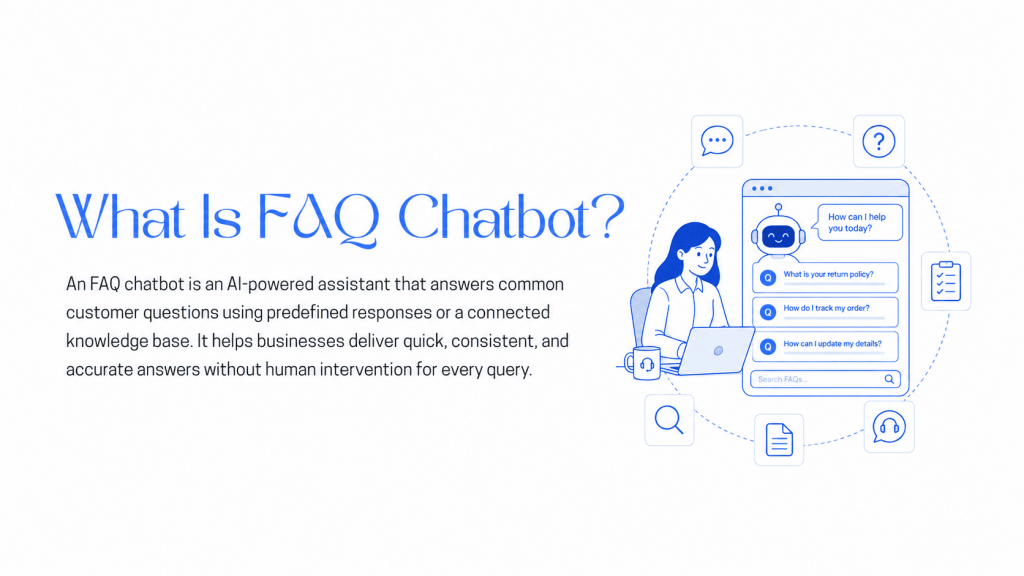
An FAQ chatbot is a conversational interface that answers common, repeatable questions by matching a user’s input against a defined set of questions and answers, either through fixed rules or through AI-based retrieval over a knowledge base. It exists to replace the experience of scanning a static FAQ page with the experience of asking directly and getting a specific answer.
- Match quality: what separates a useful FAQ chatbot from a frustrating one, meaning how precisely the system identifies which stored answer actually fits the question asked
- Scope: an FAQ chatbot only answers, without taking action, unlike a general AI agent that can book appointments, update customer records, trigger refunds, and escalate workflows across departments
- The payoff: a narrower scope keeps an FAQ chatbot easier to test and easier to keep accurate over time
Types of FAQ Chatbots
Not every FAQ chatbot works the same way. The options span a spectrum, from a fixed decision tree that never deviates from its script to an AI layer that adapts to how a question actually gets phrased. Here is what the choice comes down to.
1. Rule-Based FAQ Chatbots
Rule-based bots follow predefined rules, matching a question against fixed keywords or a decision tree and returning the same scripted answer every time the same trigger appears. They work best for narrow, predictable question sets, such as store hours or a single shipping policy, and are fast to build, easy to maintain, and require no training data or model. The tradeoff is flexibility. A rule-based bot breaks down the moment a question falls outside the predefined paths, and it cannot learn to answer it on its own.
2. AI FAQ Chatbots
This is the category most people mean by “AI chatbot.” These bots use a large language model to interpret intent and generate or retrieve a response instead of matching a fixed phrase. They understand varied phrasing, hold context across a conversation, and can handle a question the original FAQ document never explicitly listed. They work best for businesses that want context-aware answers and a response that feels natural instead of scripted. The tradeoff is source quality. An AI FAQ chatbot is only as good as the knowledge base behind it, and a weak or disorganized source produces weak, sometimes wrong, answers regardless of the model.
3. Hybrid FAQ Chatbots
Most modern support platforms now default to this model. A rule-based layer handles high-volume, predictable questions instantly, and an AI layer covers everything else. It works best for teams that want the speed of fixed rules on the questions that repeat constantly, plus AI coverage for the long tail a rule set alone could never handle. The tradeoff is setup complexity. Maintaining two systems means defining a clear rule for which questions go to which layer, and that takes more upfront configuration than either approach alone.
The Architecture of an FAQ Chatbot
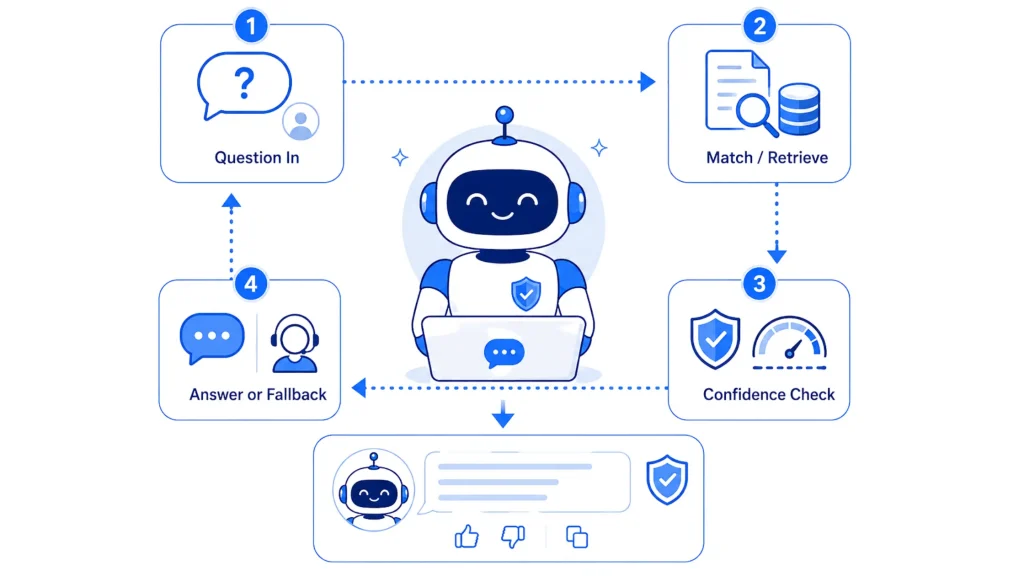
Every FAQ chatbot runs a version of the same four-stage loop, whether it is a decision-tree bot from 2018 or a RAG-based agent trained this month.
- Turn the question into something comparable. A rule-based bot scans the input for keywords or matches it against a fixed set of intents. An AI-based bot converts the question into a vector, a numerical representation of its meaning, using an embedding model. Language becomes something a machine can compare either way. The sophistication of that comparison is what differs.
- Search for the closest match. The rule-based bot checks the input against its decision tree or keyword rules. The AI-based bot runs a nearest-neighbor search against a vector database built from the knowledge base and returns the closest passages by cosine similarity.
- Score the confidence of that match. This is the step most explanations skip, and it is the one that determines whether a bot feels reliable. A well-built system does not just return the top match. It checks how confident that match is against a threshold before deciding whether to answer at all. One practitioner’s writeup on combining FAQ matching with RAG fallback sets the routing threshold at a cosine similarity of about 0.90, sending anything below that to a fuller retrieval pass instead of a direct answer.
- Answer or fall back. Above the threshold, the bot returns the matched answer, ideally grounded in and citing the specific source document rather than paraphrasing from general knowledge. Below the threshold, a well-designed bot has permission to say it does not know, then widens the search or hands the conversation to a human. Systems that skip this step are the ones that produce a confident wrong answer, which costs more trust than a bot that admits uncertainty and asks for a handoff.
Rule-Based vs AI and RAG Chatbots
The choice is less AI versus outdated technology and more a question of how predictable the questions are and how much ongoing maintenance a team can commit to.
- Rule-based fits narrow, stable question sets. Order status, store hours, shipping policy, and other questions with one correct phrasing of the answer are efficient to build as a decision tree or keyword-matched flow. Setup is fast, behavior stays fully predictable, and there is no model to monitor for drift. The tradeoff shows up the moment a question falls outside the predefined paths. A rule-based system cannot answer it and cannot learn to on its own.
- AI and RAG-based bots fit variable phrasing and multi-turn context. They interpret intent instead of matching exact strings, so a question phrased three different ways still resolves to the same answer. The tradeoff is setup and governance. Training data needs curation, and someone has to own the confidence threshold decisions described above.
- Hybrid systems are increasingly the default. A fast, rule-based path handles high-volume, unambiguous questions, and AI-based retrieval covers everything else. As a general guideline, static, low-ambiguity questions such as opening hours, return windows, and order tracking are efficient to hard-code. Questions involving context, account specifics, or varied phrasing benefit from AI-based matching, with a human handoff as the safety net for anything neither path resolves.
Usecases Across Industries
The retrieval and confidence mechanics stay identical across industries, but the volume of questions and the cost of a wrong answer shift depending on what is being asked.
- Ecommerce. A retail FAQ bot fields the same handful of questions on repeat: order status, return windows, sizing, shipping cost. Retail-focused FAQ bots typically front-load an order-tracking lookup ahead of general retrieval, since it is the single highest-volume question type and does not require language understanding to resolve.
- SaaS. Support volume in software products skews toward billing, feature availability, and integration setup. A SaaS FAQ bot trained on product docs and a changelog resolves these without a ticket, escalating account-specific billing disputes to a human agent.
- Healthcare. Health insurance and provider platforms carry a higher accuracy bar, since a wrong answer about coverage or appointment eligibility has real consequences. HealthBird, a health insurance platform, trained a YourGPT agent on its own knowledge base to handle routine questions about app navigation, insurance options, and platform features. The chatbot now resolves 90 percent of patient queries without a human agent, with the remainder routed to support.
- Education. Admissions and student-services questions repeat every semester: application deadlines, financial aid eligibility, registration steps. A well-trained FAQ bot on an admissions site absorbs that seasonal spike without adding staff.
- Internal HR and IT. The same pattern shows up inside a company. Employees ask the same questions about PTO balances, VPN setup, benefits enrollment, and expense policy on a loop. An internal FAQ bot trained on the employee handbook and IT runbooks answers those directly inside Slack or Microsoft Teams, and creates a ticket only when the question needs a human decision, such as approving an exception to policy.
FAQ Chatbot vs Traditional FAQ Page
A static FAQ page and an FAQ chatbot solve the same underlying problem, getting a customer to the right answer. The difference shows up in how much work the customer has to do to get there, and it traces directly back to the retrieval mechanics covered above. A page relies on the customer finding the right words, while a chatbot does that matching for them.
| Feature | FAQ Page | FAQ Chatbot |
|---|---|---|
| Searchability | Limited to keyword matches and manual scanning | High, matches by meaning even when phrasing differs |
| Conversational | No | Yes |
| Personalization | No | Yes |
| 24/7 Support | Partial, the page is always live but provides no active help | Yes |
| Follow-up Questions | No | Yes |
| Setup Effort | Low, just write and publish the content | Moderate, needs training, testing, and threshold tuning |
| Escalation to a Human | No built-in path | Built-in handoff with conversation history preserved |
| Accuracy Risk | None, the content is exactly what was written | Possible if the confidence threshold is not tuned well, since the bot can still answer when it should defer |
The gap widens most on follow-up questions. A page has no memory of what a customer already read, so a second question starts from zero. A chatbot carries the conversation forward, which is the same context-handling behavior described in the human handoff section below.
Building an FAQ Chatbot with YourGPT
An FAQ chatbot with YourGPT helps automate answers to common customer questions using your own business knowledge. You can add FAQs, train the agent, customise its behaviour, and deploy it across your preferred channels.
Step 1: Log In and Create Your Agent
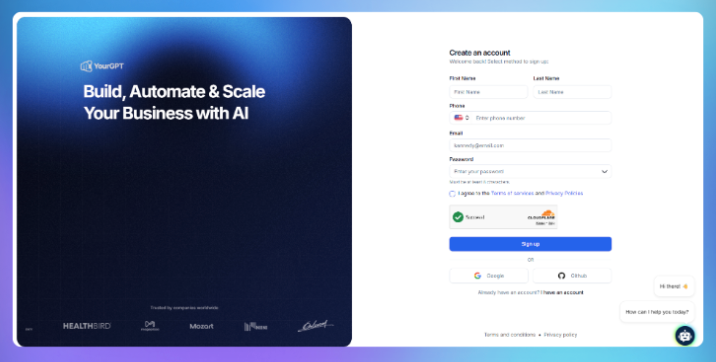
Sign up or log in to YourGPT, enter the dashboard, and create a new AI agent for your preferred use case or deployment channel.
Step 2: Customise Your AI Agent
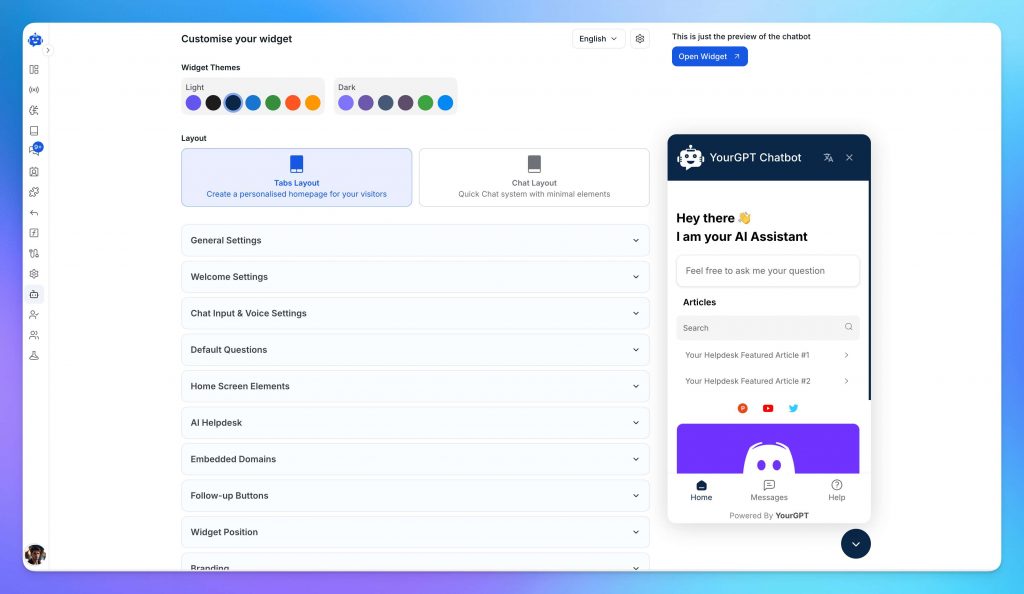
Set the agent name, model, appearance, welcome message, and basic settings so it matches your brand and intended use case.
Step 3: Add FAQs
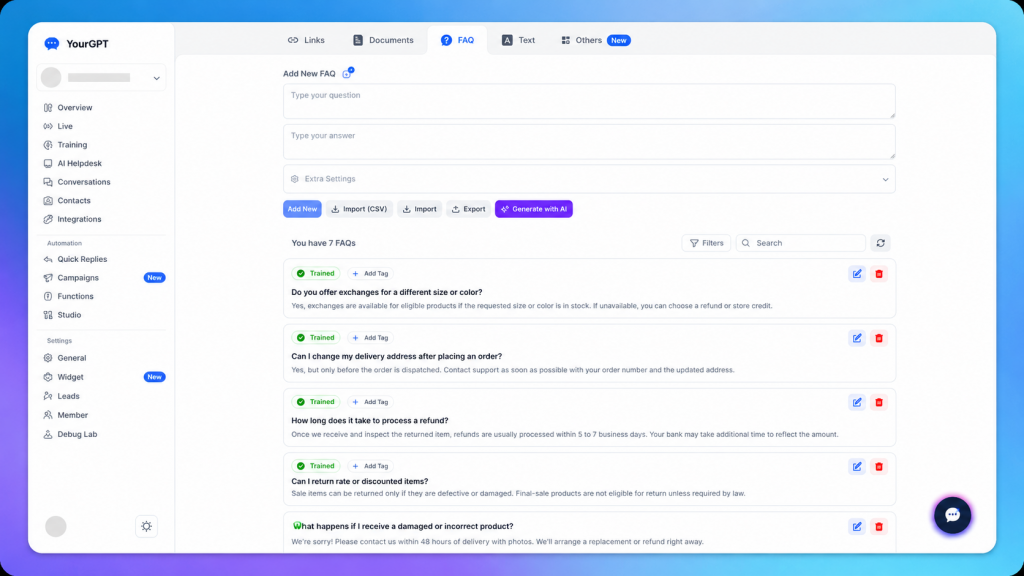
Add frequently asked customer questions and clear answers to help the agent handle common support and sales queries accurately.
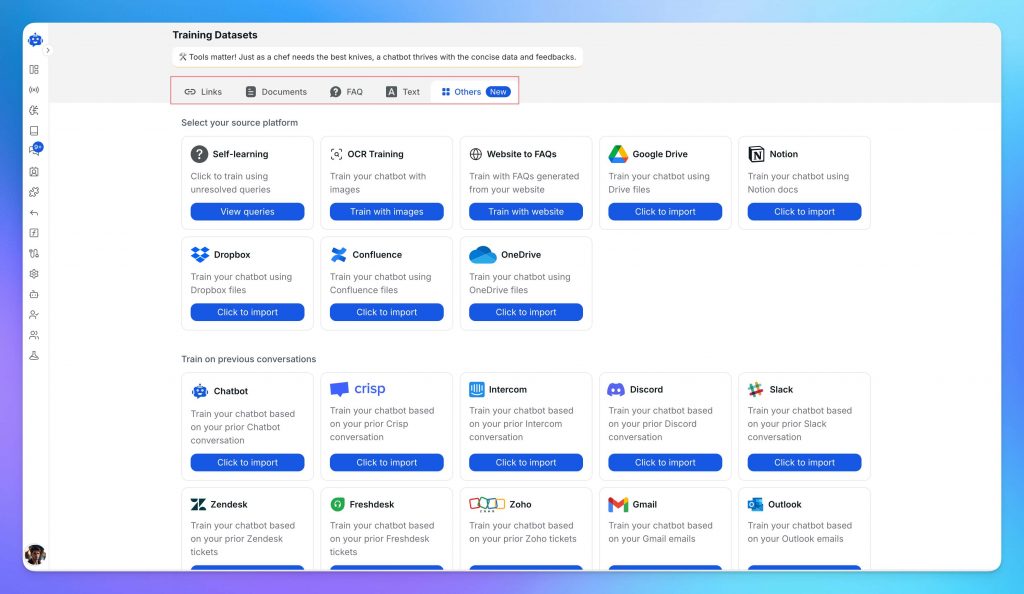
Step 4: Add Training Data
Train the agent using your website, support articles, documents, product information, past conversations, SOPs, and connected knowledge sources.
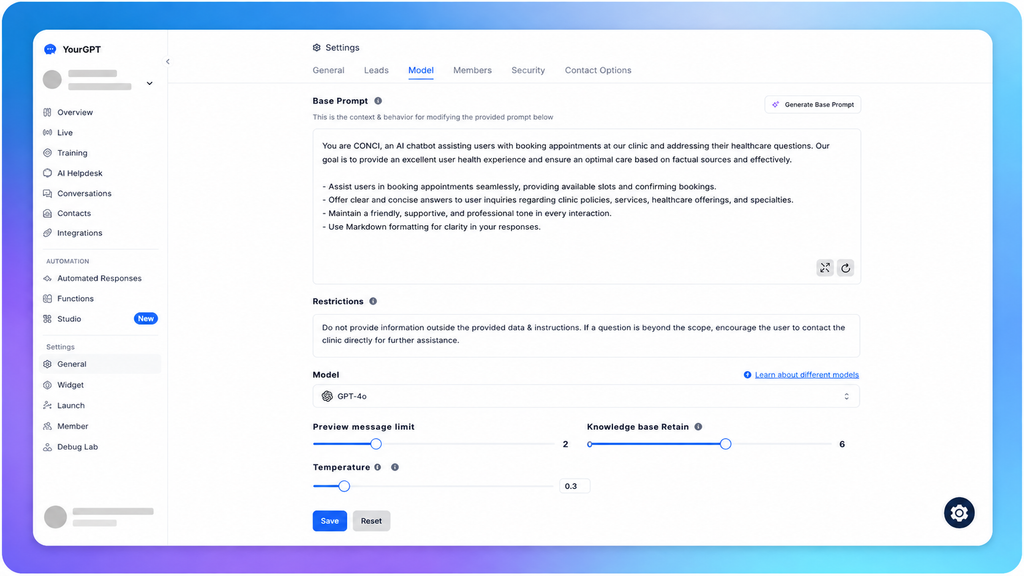
Step 5: Define the Agent Persona
Set the agent’s role, tone, response style, instructions, and behaviour so it communicates consistently with your customers.
Step 6: Build in AI Studio
Open AI Studio to create custom workflows using Autonomous Agent nodes, API or code skills, human handoff, web search, and rich messages such as images, videos, buttons, cards, and carousels.
Step 7: Test and Publish
Test the agent with real questions, edge cases, fallback scenarios, and human handoff. Once the responses and workflows work correctly, publish the latest version.
Step 8: Connect Channels and Go Live

Deploy your published agent on your website, WhatsApp, Instagram, Messenger, Telegram, or other supported channels and start handling live conversations.
From FAQ Answers to Human Support
No FAQ set covers every question a customer might ask. A well-designed bot treats the gap as a routing decision that sends the conversation somewhere useful before the customer gets frustrated.
Signals that it’s time to hand off:
- A low-confidence match from the retrieval step
- A direct request for a human agent
- A billing exception or other sensitive case
- A question that needs account-specific data the FAQ layer cannot see
What makes a handoff good:
- Full conversation history passed to the receiving agent, so the customer never has to repeat anything
- YourGPT’s human handoff feature does this automatically, giving the agent everything the bot already discussed
Account-specific routing goes a step further:
- A question such as “what is my renewal date” cannot be answered from a static FAQ, since it requires a lookup against the customer’s own account
- An FAQ bot on a platform with API and function support can call a CRM or billing system for that lookup, using the same agent and the same conversation
Framed this way, the FAQ layer becomes the entry point into a broader support system, with room to expand as the same agent takes on more account-specific and action-based work.
Measuring an FAQ Chatbot
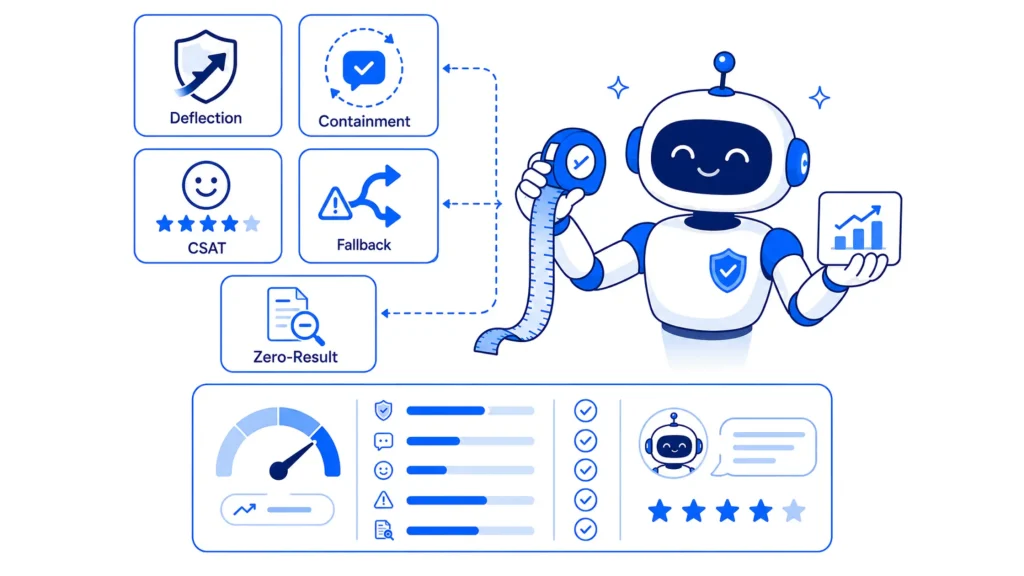
Three metrics together show whether an FAQ chatbot is actually working: deflection rate, containment rate, and CSAT.
- Deflection rate measures the share of questions that never reach a human agent at all, including questions a help-center article resolves before a chat even starts.
- Containment rate is narrower than deflection, since it measures only what happens inside the chatbot channel. Decagon’s chatbot glossary defines it as contained sessions divided by total sessions entering the channel.
Why CSAT has to sit next to both:
- A bot can post a high containment rate by giving a vague answer that discourages a customer from asking again, which still counts as contained without actually helping anyone
- Pairing containment with a lightweight thumbs-up or CSAT prompt after each resolved conversation catches that gap
What good benchmarks look like:
- A chatbot-vendor analysis published in May 2026 puts most deployments at 20 to 40 percent containment, with mature implementations reaching 70 to 90 percent
- A June 2026 analysis of chatbot KPIs notes that chatbot CSAT commonly lands 10 to 15 points under live-agent scores, which is expected for a channel handling high-volume, low-complexity questions and not a red flag on its own
The most useful early signal for an FAQ bot specifically:
- The rate of zero-result and fallback queries matters more than containment early on
- That rate is a direct list of what the knowledge base is missing, and closing those gaps is usually the fastest way to raise every other metric here
Frequently Asked Questions
What Is the Difference Between an FAQ Chatbot and a General AI Agent?
An FAQ chatbot answers questions from a fixed knowledge base and stops there. A general AI agent can also take actions, such as booking an appointment or updating a customer record, in addition to answering. FAQ chatbots trade that action range for simplicity, which makes them faster to set up and easier to keep accurate.
Do FAQ Chatbots Support Multiple Languages?
Most modern FAQ chatbots detect the language of an incoming question automatically and respond in the same language, provided the knowledge base has content available in that language or the underlying model can translate reliably. Language coverage varies by platform, so checking the specific list before launch avoids gaps.
How Long Does It Take to Set Up an FAQ Chatbot?
Setup time depends on how much content needs training and how much rule-based structure gets added on top. On a no-code platform such as YourGPT, training on an existing FAQ page or help center typically finishes within a few minutes, though testing and threshold tuning before launch usually take longer than the training step itself.
Does Building an FAQ Chatbot Require Coding Knowledge?
No. No-code platforms handle the underlying retrieval and matching logic, so building an FAQ chatbot mostly involves organizing content and testing responses rather than writing code. Development work becomes relevant only for custom actions beyond answering, such as calling an external API.
What Happens When an FAQ Chatbot Cannot Answer a Question?
A well-designed FAQ chatbot checks a confidence score before answering. Below a set threshold, it says it does not know rather than guessing, then either widens its search or hands the conversation to a human agent with the prior messages included. Bots that skip this step are more likely to produce a fluent, confident, wrong answer.
Can an FAQ Chatbot Work Across WhatsApp, Slack, and a Website at the Same Time?
Yes. Most FAQ chatbot platforms support deployment across multiple channels from a single trained agent, including a website widget, WhatsApp, Slack, and other messaging apps. The same knowledge base and confidence rules typically apply across every channel, so answers stay consistent regardless of where the question comes in.
Is a Rule-Based or AI FAQ Chatbot Better for a Small Business?
It depends on question volume and variety more than business size. A small business with a narrow, predictable set of questions, such as store hours or a single shipping policy, often does fine with a rule-based bot. A small business fielding varied phrasing or multi-step questions benefits more from an AI or hybrid setup despite the added setup work.
What Does an FAQ Chatbot Cost to Run?
Cost varies by platform and by how the vendor prices usage. Some charge per resolved conversation, others per credit or per seat. Most no-code platforms, including YourGPT, offer a free trial period to test setup and accuracy before committing to a paid plan, which is a more reliable way to estimate real cost than a published price list alone.
Conclusion
An FAQ chatbot comes down to a matching problem underneath the interface: turn a question into something comparable, find the closest answer, decide how confident that answer really is, and know when to stop guessing and ask for help. The model choice, the platform, and the deployment channel all sit on top of that core loop.
Teams that treat FAQ chatbots as a one-time setup task tend to plateau around whatever accuracy the initial training data supported. Teams that treat the fallback log as a running to-do list, reviewing what the bot could not answer and feeding those gaps back into the source content, keep improving without touching the model at all. The fastest way to find out where an FAQ bot currently stands is to pull the last hundred fallback conversations and read them. That list is usually a better roadmap than any dashboard.

Related posts
What is a good AI resolution rate for Shopify?