Vector Embeddings Explained: How AI Chatbots Actually Understand Text

TL;DR
A vector embedding is a list of numbers that represents meaning, placing similar concepts closer together in a mathematical space.
AI chatbots use embeddings to match questions by meaning rather than exact wording, which is a core part of retrieval-augmented generation (RAG).
Anthropic recommends Voyage AI for embeddings, while OpenAI, Google, and Cohere provide their own competing text-embedding APIs.
Chunking strategy can affect retrieval accuracy as much as the embedding model itself, and poorly structured chunks are a common cause of incorrect chatbot answers.
Raw embeddings also carry privacy risks, as research into embedding inversion shows that parts of the original source text may be reconstructed from stored vectors.
Vector embeddings are what let an AI chatbot understand a question even when it’s worded nothing like the source document. Instead of matching words, embeddings turn text into a list of numbers that captures what it means. Two phrases with the same meaning end up close together in that space, even if they don’t share a single word.
On its own, that fact doesn’t explain much. A chatbot can find the right answer, or the wrong one. What decides this happens in the steps between turning text into numbers and using those numbers to search. Three choices shape the outcome. How the pipeline splits a document into pieces, which model generates the numbers, and how many dimensions each piece carries.
The blog cover how embeddings get created. They also explain how a retrieval pipeline turns an embedding into a chatbot’s answer. They cover where the approach breaks down in production too. Finally, they cover a privacy risk around storing raw vectors that most introductions to this topic leave out.
What Is a Vector Embedding?
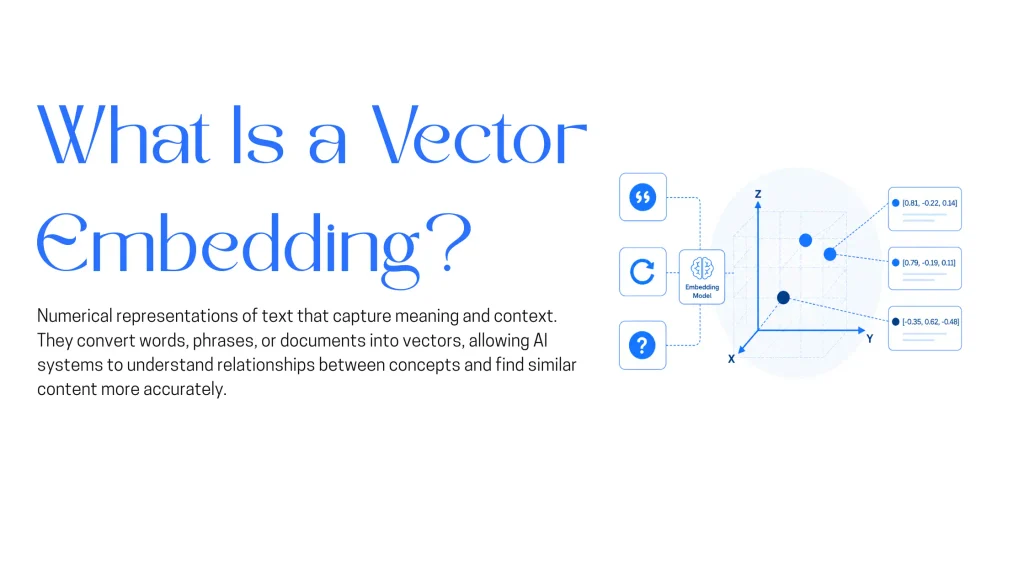
A vector embedding is a numerical representation of text (or an image, or audio). It is generated by a neural network trained to capture semantic meaning. Each piece of text becomes a list of numbers, typically hundreds to thousands of values long, called a vector.
The property that makes embeddings useful is spatial. Text with similar meaning ends up with vectors that sit close together in that numerical space, regardless of whether the wording matches. Text with unrelated meaning ends up far apart.
A simplified example, using just three dimensions instead of the hundreds a real model would produce, shows the pattern:
| Phrase | Simplified vector |
|---|---|
| “I can’t log into my account” | [0.81, -0.22, 0.14] |
| “Reset my password” | [0.79, -0.19, 0.11] |
| “What’s your return policy?” | [-0.35, 0.62, -0.48] |
Turning Text into Vectors
Generating an embedding follows a consistent pipeline, regardless of provider.
Step 1. Text enters an embedding model as tokens. The input first gets broken into tokens, the small word-piece units language models process. Common embedding model options include:
- OpenAI embedding models
- Cohere embeddings
- Voyage AI embeddings
- BGE models
- E5 models
Step 2. The model maps those tokens against what it learned during training. A trained neural network compares the input to the patterns of meaning it picked up from its training data. This places semantically related concepts near each other in vector space.
Step 3. The model outputs a numerical vector. OpenAI’s text-embedding-3-small produces 1,536 dimensions by default, while text-embedding-3-large produces 3,072. More dimensions generally mean more captured nuance, at the cost of storage and search speed. Some newer models use a technique called Matryoshka Representation Learning. It trains a single model to produce embeddings that stay useful even when truncated to a smaller size. OpenAI’s newer models support this through a dimensions parameter. It shortens a 3,072-dimension embedding to 1,024 or 256 dimensions with only a modest accuracy trade-off. This is useful when storage cost or query speed matters more than squeezing out the last percentage point of accuracy.
The RAG Workflow Behind AI Chatbots
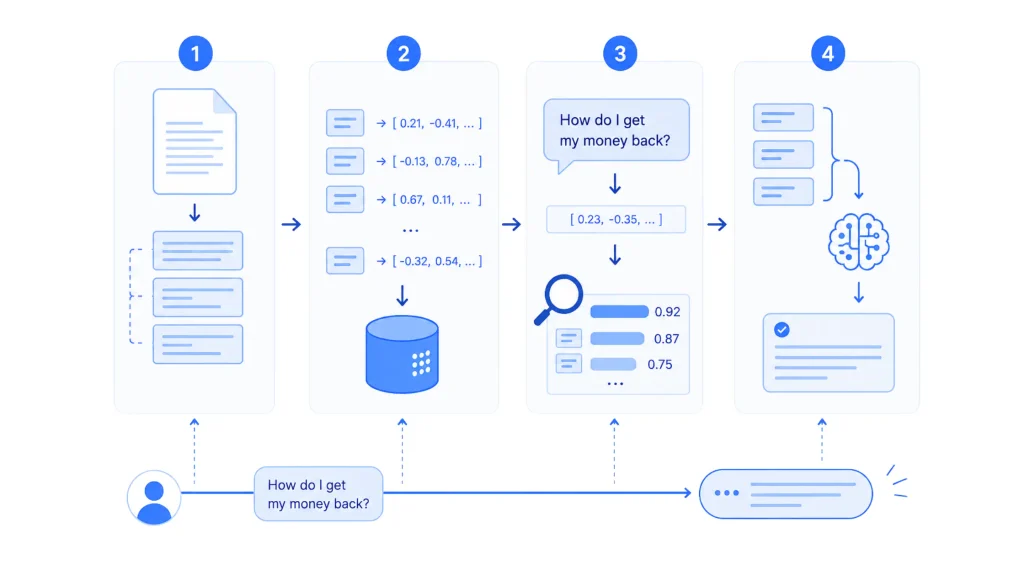
Embeddings alone don’t answer questions. They become useful inside a retrieval pipeline, most commonly retrieval-augmented generation, or RAG. Four stages connect a raw document to a chatbot’s response, and each one affects accuracy.
- Chunking: Source documents get split into smaller pieces before embedding, since embedding an entire manual as one vector would blur every topic together. Industry guidance generally recommends starting around 500 tokens per chunk with 10 to 20 percent overlap between chunks, so a sentence that falls near a chunk boundary still has a complete version somewhere in the index. YourGPT’s own breakdown of this stage covers parsing and metadata handling in more depth in its guide to AI document indexing.
- Embedding and storage: Each chunk gets converted to a vector and stored in a specialized vector database built for fast similarity search across millions of vectors at once.
- Query embedding and retrieval: When someone asks the chatbot a question, that question gets embedded using the same model, then compared against the stored chunk vectors. This is what lets a customer type “how do I get my money back” and still match a document titled “refund policy,” since retrieval works by meaning and not exact wording. The closest matches, typically a handful of chunks, get pulled back as candidates.
- Generation: The pipeline passes the retrieved chunks to a language model alongside the original question, and the model generates a response grounded in that retrieved context instead of relying only on what it learned during training. YourGPT’s guide to RAG chatbots covers this last stage in more detail, and YourGPT covers the broader RAG-versus-long-context debate separately in its guide to context windows and RAG.
The Role of Embeddings in RAG Systems
A language model on its own only knows what it learned during training. Ask it about a policy that changed last month, or a document it never saw, and it either says so or guesses. RAG closes that gap by giving the model access to a live knowledge base at the moment it answers, through the pipeline above.
In practice, that pipeline shows up in a few recurring jobs:
- Customer Support and Live Chat. Resolving a question without a human, using the retrieval step to catch differently worded versions of the same request.
- Internal Documentation. Employees finding a policy, wiki page, or onboarding document by describing what they need instead of knowing its exact title.
- Product and Contract Search. Locating a specific item, manual, or clause inside a large catalog or document set by description alone.
Embeddings find the right information for a given question. Generating the actual answer from that information is a separate job, handled by the language model itself.
The Need for Vector Databases
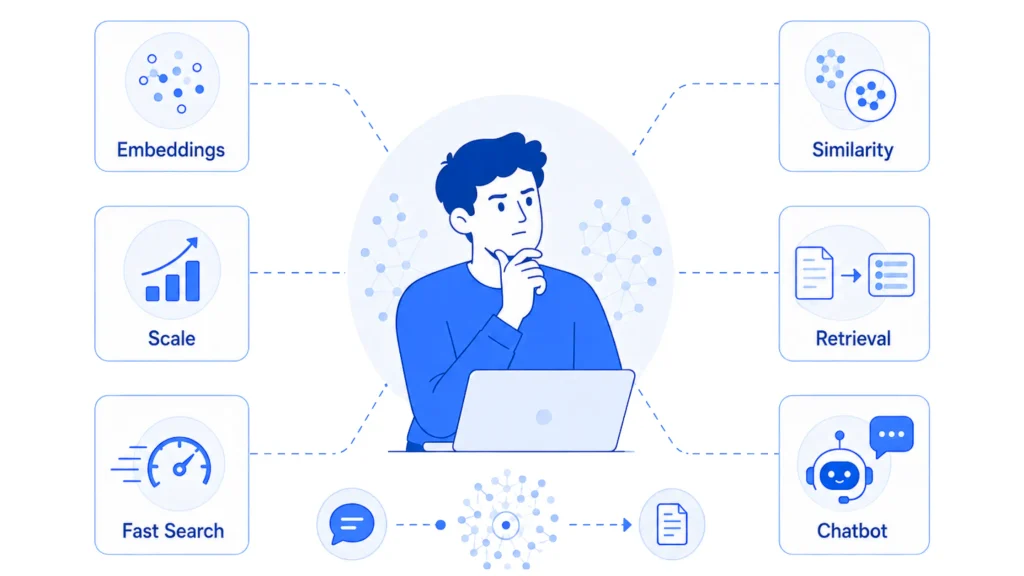
Generating embeddings solves half the problem. The other half of the problem is that millions of them must be searched fast enough for a live chatbot conversation, and that’s the job a vector database is built for.
- The scaling problem. Comparing a query vector against every stored vector one by one works fine for a few hundred documents, but breaks down at scale.
- The fix. Purpose-built vector databases such as Pinecone, Weaviate, Qdrant, Milvus, and Chroma use indexing methods that skip that exhaustive comparison, identifying the closest matches out of millions of vectors in milliseconds instead of checking each one manually. YourGPT’s own breakdown of those indexing methods lives in What is a Vector Database & How it Works?
- The analogy. A vector database works something like a GPS system for meaning. Rather than matching exact street names, it finds the closest point to where someone wants to go, then routes there directly without checking every possible address along the way. Vector search does the same thing with ideas, finding the closest concept instead of matching exact words.
Choosing an Embedding Model
The embedding model is a separate decision from the language model that generates the final answer, and the two don’t need to come from the same provider.
- OpenAI pricing. Text-embedding-3-small costs $0.02 per million tokens and text-embedding-3-large costs $0.13 per million tokens, both cheap relative to a full language model call. Text-embedding-3-small is the common default for general-purpose retrieval, with text-embedding-3-large reserved for cases where the extra accuracy justifies the higher dimensionality and cost.
- Anthropic and the wider field. Anthropic does not offer its own embedding model and instead recommends Voyage AI for teams building on Claude, including domain-tuned options for fields like finance and law. Google and Cohere compete in the same space with their own text-embedding APIs, and open-weight options such as BGE and Qwen3-Embedding are available for teams that want to self-host.
- Benchmarks. The MTEB leaderboard is the standard public benchmark for comparing embedding models, but it shifts often enough that a specific ranking goes stale within months. New multimodal and multilingual entries have reshuffled the top of the board multiple times in the past year alone, so the practical move is benchmarking a shortlist against actual data rather than picking whichever model currently tops a leaderboard.
- Fine-tuning. Fine-tuning an off-the-shelf embedding model on domain-specific text can meaningfully improve retrieval accuracy when a knowledge base is full of internal terminology, product names, or jargon a general-purpose model never saw during training. It’s a legitimate option, but not the first thing to try when a chatbot retrieves the wrong content, since chunking and metadata problems are more common causes and cheaper to fix.
The Limitations of Vector Embeddings
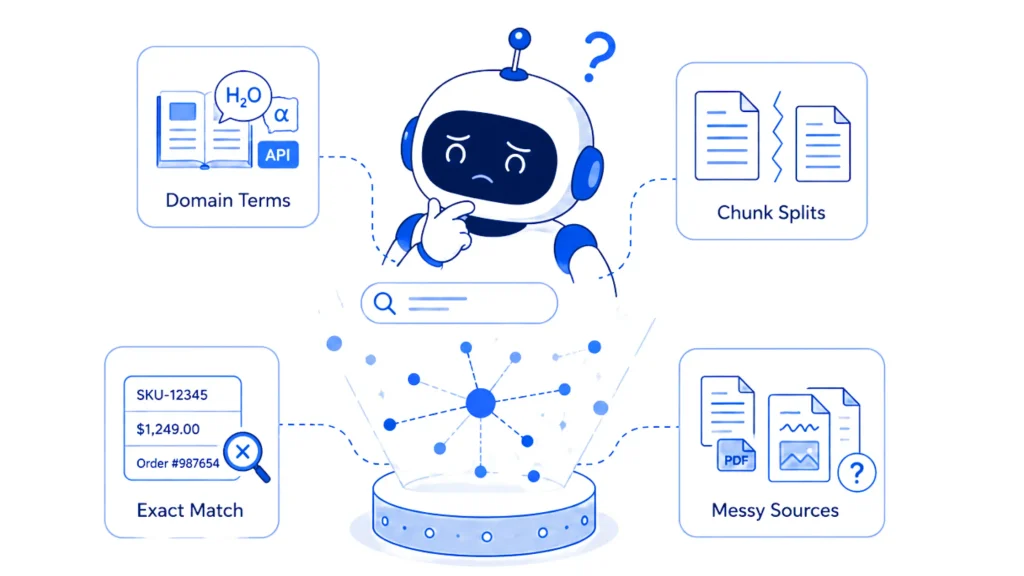
Embeddings solve the meaning-matching problem, but they introduce their own set of failure modes.
- Domain-specific vocabulary. A general-purpose embedding model trained mostly on public web text won’t reliably capture internal product codes, niche industry jargon, or company-specific terminology unless fine-tuned or supplemented with better metadata.
- Chunking mistakes. A chunk boundary that splits a sentence in half can scatter the answer across two separate vectors, so neither retrieval result contains the full picture. This is a common, boring, and easily overlooked cause of bad retrieval in production systems.
- Exact-match and numeric lookups. Embeddings capture meaning, not exact strings, so they’re a poor fit for retrieving a specific order number, SKU, or precise figure. Hybrid search that combines keyword matching with vector search handles these cases better than embeddings alone.
- Source quality. Retrieval accuracy depends on the quality of the underlying documents as much as the embedding model. A well-tuned embedding model searching a messy, outdated, or contradictory knowledge base. It still returns weak results, since the pipeline can only retrieve what it has actually indexed.
The Privacy and Security Risk of Storing Embeddings
Embeddings are often treated as an opaque, privacy-safe stand-in for the original text, since a list of floating-point numbers looks unreadable on its own. That assumption doesn’t hold up under research.
A body of academic work, most notably the technique known as Vec2Text, has demonstrated that source text can be reconstructed from its embedding vector with meaningful fidelity, particularly for shorter inputs with distinctive vocabulary. An attacker with access to the raw vector and knowledge of (or query access to) the embedding model used to generate it doesn’t need the original document. The vector itself carries enough signal to partially rebuild it.
This matters directly for anyone storing customer support transcripts, internal policy documents, or other sensitive material as embeddings in a vector database. A few practical mitigations follow from the research:
- Don’t expose raw embedding vectors through a public API. Return matched documents or summaries instead of the underlying vector, since a returned vector is a direct enabler of inversion.
- Keep untrusted, user-submitted content separate from sensitive internal knowledge base material in the ingestion pipeline. Since mixing the two creates an exfiltration surface if an attacker compromises the pipeline.
- Treat access to a vector database with the same seriousness as access to the source documents it was built from. A vector store is not a de-identified or anonymized version of the data. It’s a compressed, structured encoding of it.
Multimodal Embeddings
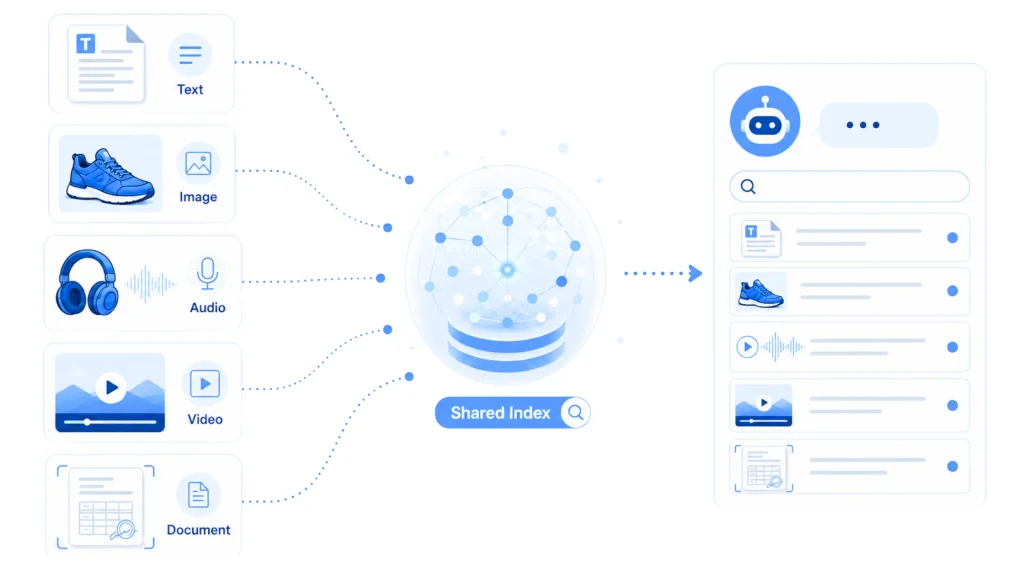
- Text isn’t the only modality that gets embedded.
- Models like OpenAI’s CLIP were trained by pairing images with their captions, so that image vectors and text vectors were placed in the same shared space.
- A text query like “a red sofa with wooden legs” can retrieve matching images this way, even when no product title uses those exact words.
- That approach has expanded well beyond text and images. Newer 2026 releases push into shared vector spaces spanning text, images, audio, and even video within a single embedding model.
- Multimodal releases from major providers have shifted the top of embedding benchmark leaderboards multiple times over the past year.
- For a business chatbot, product photos, screenshots, and scanned documents can increasingly sit in the same searchable index as written content. This happens without a separate image-specific pipeline.
Frequently asked questions
What is a vector embedding in simple terms?
A vector embedding is a list of numbers that represents the meaning of a word, sentence, or document. Text with similar meaning ends up with numbers that sit close together, even when the wording is completely different.
Does YourGPT use vector embeddings to train chatbots on business data?
Yes. YourGPT’s RAG pipeline uses embeddings to ground chatbot answers in a business’s own training sources, including website content, uploaded documents, and connected knowledge bases, instead of relying only on the model’s general training data.
Why do AI chatbots need vector embeddings?
Embeddings let a chatbot match a question to the right answer by meaning instead of exact wording. Without them, a chatbot only finds results when a customer’s question happens to share the same words as the source document.
What’s the difference between an embedding model and a language model?
An embedding model turns text into a vector for search and retrieval. A language model generates the actual response. They’re separate tools, and they don’t need to come from the same provider.
How is a vector database different from a regular database?
A regular database looks up exact matches, like an order ID or an email address. A vector database compares numerical vectors to find the closest meaning, which is why it can return a relevant result even when the search terms don’t match the stored text exactly.
Is it possible to switch to a different embedding model later without starting over?
Switching models usually means re-embedding the existing content, since vectors from one model aren’t directly comparable to vectors from another. It’s a one-time reindexing cost, not a full rebuild of the knowledge base.
Is it safe to store customer data as embeddings?
Embeddings carry a real privacy risk. Research on embedding inversion shows that source text can be partially reconstructed from a vector, so raw vectors need the same access controls as the original documents, not fewer.
Can YourGPT update its knowledge base when source documents change?
Yes. YourGPT supports ReIndex, a retraining step that runs manually or on a set schedule, so embeddings stay current as underlying content changes.
Conclusion
Vector embeddings let a chatbot match “I can’t log in” to a knowledge base article. That article can be titled “resetting your password” without either phrase sharing a word. That capability comes from a real pipeline with real failure points. Chunking decisions, embedding-model choice, and the quality of the source documents all shape whether retrieval works.
Introductory explanations often leave out the privacy risk tied to storing raw vectors. It deserves the same attention as the underlying technology’s benefits. Understood together, embeddings are less like magic and more like a well-defined, debuggable system. This is exactly what makes it possible to improve one.

Related posts

What is a good AI resolution rate for Shopify?