The Future of Enterprise AI (Customization, Collaboration, Control)
Artificial Intelligence has advanced quickly over the past five years, moving from an experiment to a standard component of modern business.
AI has become a central part of enterprise strategy. 88% of organizations are now using AI. This figure has increased from 78% the year before. This transformation is reshaping how companies run, communicate, and plan for growth.
Over the past three years, there has been a major shift with the Gen AI. Organizations are moving away from generic systems to AI that fits their unique workflows.
The current focus of enterprise AI is on flexibility and control. This guide covers how to build adaptable AI systems with smart governance. You’ll learn about global collaboration frameworks and custom tools that improve business outcomes. These approaches help organizations scale operations and increase efficiency.
The Problem with Rigid Enterprise AI Platforms
Most large companies have reached the limit of rigid platforms that expected every team to follow the same structure.
These tools slowed adoption. They created integration debt and increased manual effort.
Often, they locked teams into systems that could not adapt to new demands. Support queues grew longer, sales follow ups slipped, and operations relied on scattered tools with no shared intelligence.
Teams do not work the same way across the company.
- Support AI pulls from customer histories, knowledge bases, and billing systems while handling conversations across email and chat. It escalates based on SLAs and account priority.
- Sales AI works with CRMs like Salesforce. It tracks deal progress, add new leads, nuture leads, and suggests next actions based on what actually closes deals.
- Operations AI connects to ERPs like SAP. It monitors inventory, flags issues, and routes approvals. In finance it handles payments and reconciliation.
Each group has different data inputs, approval paths, and context. A rigid platform cannot solve all three with accuracy or speed.
This is why enterprises are moving toward platforms that provide one AI foundation with modular depth. Instead of forcing every team into a single template, a unified platform connects systems, channels, and data sources. It allows each function to build its own workflows. This avoids the fragmented tool stack that slows teams down but still respects the differences in how each department operates.
YourGPT follows this structure. The platform connects with CRMs, helpdesks, ERPs, communication channels, and internal apps. It uses multi source training, self learning, and controlled access rules so every team works with updated and accurate information.
- Support teams get clear next steps for each request. The system pulls the right customer details, applies internal knowledge, and moves toward automatic resolution without asking the user to repeat anything.
- Sales teams receive accurate qualification details, intent signals, and key data points that help them respond faster, update the deal correctly, and keep the pipeline aligned with real conversations.
- Operations teams run flows that follow internal rules, fetch required information from connected systems, and complete multi step tasks with the right checks in place.
The orchestration layer holds everything together. Workflows, actions, apps, channels, and data inputs operate through one system. A support conversation can trigger an internal action. A sales inquiry can generate follow through steps. An operations request can progress through policy checks and approvals. All activity remains auditable through logs, access rules, and governance controls.
When a user reaches out, AI system can identify the request type. It references internal knowledge and gathers needed details. Then, it prepares the next actions. It works alongside existing systems. It does not replace them. This keeps teams fast and consistent without losing structure or context.
A unified yet modular platform provides companies with a stable way to improve support. It enhances sales and operations without changing their entire stack. Support becomes clearer and faster. Sales becomes more consistent. Operations face fewer bottlenecks and maintain stronger control.
Modern enterprise AI succeeds when it connects systems correctly. One foundation with modular depth gives each department what it needs while keeping the entire company aligned.
Strengthening Enterprise AI Control and Governance
As AI spreads across teams, leaders want assurance that systems operate within policy even when hundreds of workflows run at once. This requires governance that functions as an active control layer rather than a checklist. Companies need visibility into how data is used, how models change over time, and how automated actions behave in real conditions.
Modern governance frameworks follow the full lifecycle. They track data inputs, review model updates, record decisions, and allow teams to confirm that each workflow aligns with internal rules. This visibility reduces unexpected outcomes and improves reliability across the organization.
AI observability provides the clarity needed for this oversight. It highlights behavior that deviates from expected patterns and helps teams correct issues early. Instead of creating noise, observability filters information so only meaningful signals reach IT and compliance teams.
A central control layer supports this effort by giving teams one place to monitor data handling, workflow actions, permissions, and system changes. This makes experimentation safer, improves response time when issues appear, and raises accountability across departments.
Governance does not slow progress. It allows companies to scale AI with confidence by ensuring every system operates within ethical, legal, and operational boundaries. The result is predictable performance and better returns from every AI tool in use.
Developing Resilient and Collaborative AI Operations
With the expansion of AI in organizations, security concerns grow. Every automated process involves data, actions, and user interactions. This raises a important question:
Can businesses grow AI without introducing new security risks?
Protecting these areas while still innovating is crucial. AI-driven safeguards are now common because they detect unusual behavior more quickly than traditional tools. They identify risk patterns, minimize distractions for security teams, and help address problems before they escalate.
Modern enterprises run on teams spread across functions, regions, and systems. AI is becoming the common layer that connects these teams by keeping information consistent, reducing repeated work, and enabling faster coordination.
Some people worry that automation may lead to less attention from teams. However, it actually enhances focus by highlighting only the important events.
Human judgment is still important. Automated systems can manage a lot of activity, but humans add nuance understanding. Many companies now use a mix of AI for detection and humans for daily operations.
Platforms built with deeper customization, human in the loop and structured controls, such as YourGPT, support this approach by offering clear access rules. They also provide oversight layers and transparent workflow behavior. This ensures that security remains part of everyday operations rather than an afterthought.
Enterprises that grow with confidence are often the ones that scale AI carefully. They treat security as part of every workflow, from model updates to cross-border collaboration. This builds trust, reduces operational uncertainty, and supports long-term adoption across the organization.
The Future of Enterprise AI
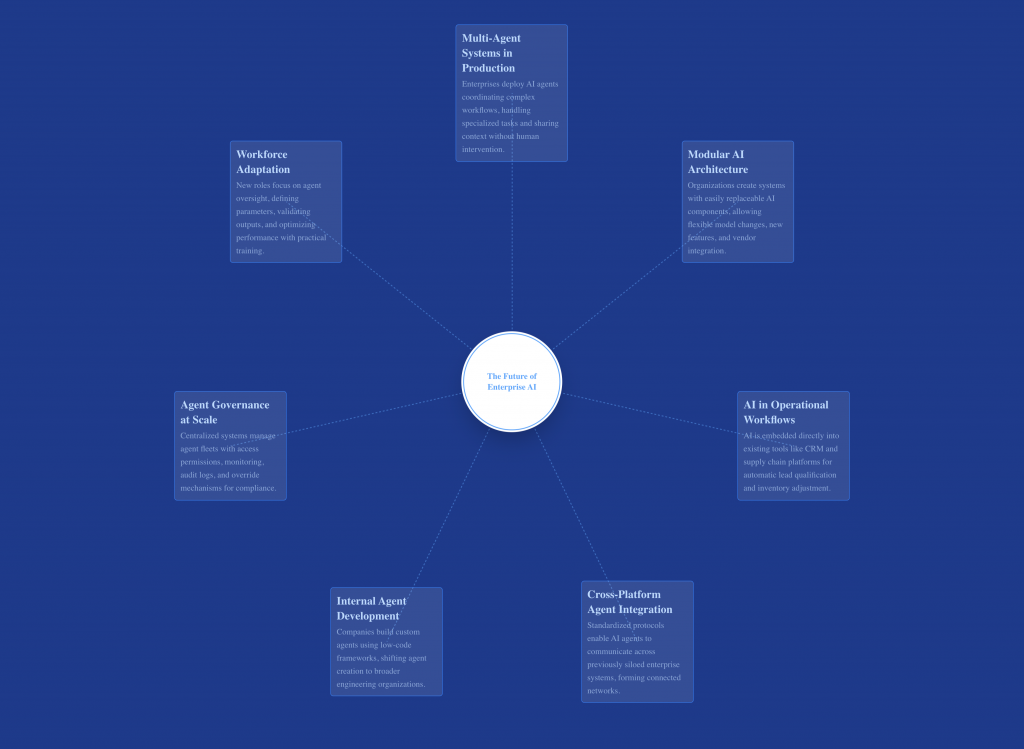
The field of enterprise AI is shifting from testing to real-world applications. Here are the key developments occurring:
1. Multi-Agent Systems in Production
Enterprises are deploying AI agents that coordinate on complex workflows. A customer service agent triggers inventory agents, which activate fulfillment agents, executing multi-step processes without human intervention. Each agent handles specialized tasks while sharing context across the workflow.
2. Modular AI Architecture
Organizations are creating systems where AI parts can be easily replaced. Teams can change poor-performing models, add new features, and connect various vendor solutions while keeping overall control. This avoids dependency on a single vendor and helps quickly adopt better technologies.
3. AI in Operational Workflows
AI is embedded directly where work happens. CRM systems qualify leads and forecast revenue automatically. Supply chain platforms adjust inventory based on demand signals. Finance systems flag transaction anomalies during processing. Workers interact with AI through existing tools, not separate interfaces.
4. Cross-Platform Agent Integration
Standardized protocols enable agents to communicate across enterprise systems. Service desk agents pull data from HR systems, inventory agents trigger procurement workflows, and analytics agents access financial databases. Previously siloed systems now operate as connected networks.
5. Internal Agent Development
Companies are building custom agents using low-code frameworks. Development teams define decision logic, set operational boundaries, and deploy agents for specific business processes. This shifts agent creation from specialized AI teams to broader engineering organizations.
6. Agent Governance at Scale
Enterprises manage agent fleets through centralized control systems. Access permissions define agent capabilities, monitoring tracks all decisions, audit logs record actions, and override mechanisms enable immediate intervention. Organizations know what every agent does and can prove compliance.
7. Workforce Adaptation
New roles focus on agent oversight: defining agent parameters, validating outputs, handling escalations, and optimizing agent performance. Training programs teach practical skills for working alongside automated systems rather than theoretical AI concepts.
Conclusion
Enterprise AI is moving toward a model where automation and human judgment strengthen each other. These systems adapt to real workflows. They help teams function across departments. They also build long-term reliability through clear governance. Global teams bring creativity and context. AI brings speed, consistency, and operational depth. Both are needed for sustainable progress.
Every component in this ecosystem plays a role. From AI ticketing systems that many organizations rely on to keep requests organized, to internal dashboards that give leaders greater visibility, the aim is not to replace people but to support them with tools that reduce friction and improve outcomes.
The companies that grow in this environment are those that treat AI as a companion to their strategy rather than a shortcut. Tools will evolve, models will improve, and workflows will expand, but the direction must remain the same. AI should help teams think clearly, act faster, and operate with confidence.
A balanced future is built on this partnership. AI provides scale. People provide direction. Together they create an enterprise that moves with clarity, discipline, and purpose.

Related posts
18 Lead Generation Strategies & Tactics That Work in 2026