Clawdbots Explained: Turning AI Agents Into Real workers
In 2026, “How many AI agents work at your company?” is not a thought experiment.
It is a practical question about capacity. About how much work gets done without adding headcount, delays, or handoffs.
Most teams have already discovered the limits of chatbots. They answer questions, then stop. The real opportunity is in AI agents that finish the job.
That is where the Clawdbot comes in. A Clawdbot is an autonomous AI agent built to act. It logs into tools, follows multi-step workflows, coordinates across systems, and completes tasks from start to finish. Less hand-holding. More momentum.
YourGPT is built for bussiness that care about outcomes. It is a complete AI suite for customer support, sales, and operations, centered around a production-ready Builder that works inside real systems.
This guide shows how to deploy AI agents in four weeks and, more importantly, how to make sure they actually reduce workload and improve response times once they are live.
What is Clawdbot?
A Clawdbot (now often referred to as Moltbot) is an opensource AI agent platform designed to take ownership of specific pieces of personal work. Instead of assisting a human step by step, it is responsible for moving tasks forward on its own. The focus is execution, not conversation.
The Local Clawdbot with memory idea captures something people have been waiting for. An AI agent that can receive a request, remembers, decide what to do next, and take action without being guided step by step. Not just answering questions, but completing tasks.
This shift signals a broader change. AI is moving from being an assistant that offers suggestions to something closer to a worker that owns parts of a process. That promise is compelling, especially for teams overwhelmed by repetitive requests, manual handoffs, and growing workloads.
What separates a Clawdbot from earlier chatbot tools is how it operates. It is not limited to answering questions or suggesting next steps. It works directly inside your stack, following defined rules and adapting as conditions change.
A Clawdbot typically includes:
- Task ownership, meaning it stays with a request until it is resolved or escalated
- Workflow execution, moving through multiple steps based on business logic
- System access, allowing it to read from and write to tools like CRMs, helpdesks, or internal databases
- Controlled autonomy, operating continuously while respecting guardrails and escalation paths
The practical benefit is operational. Work that once required several manual handoffs can be completed automatically, response times drop, and teams regain time to focus on higher-impact problems. A Clawdbot shifts AI from being a helper on the sidelines to being an active participant in how the business runs.
Clawdbot vs YourGPT: Scopes & Use Cases
| Aspect | Clawdbot | YourGPT |
|---|---|---|
| Primary focus | Personal AI assistant | Business AI agent platform |
| Core use case | Automating individual or personal tasks | Automating business workflows across teams |
| Typical users | Individuals, developers, power users | Support, sales, operations, and enterprise teams |
| Deployment model | Requires manual setup and deployment | Everything managed for business |
| Task scope | Personal productivity and lightweight automations | Customer support, sales qualification, operations workflows |
| System integrations | Scripts, local tools, personal environments | CRMs, databases, internal tools, SaaS platforms |
| Workflow complexity | Moderate | Multi-step, conditional, enterprise-grade workflows |
| Reliability expectations | Best-effort automation (user-managed) | Deterministic, production-ready execution |
| Governance and auditability | Limited or user-managed | Built-in audit logs, access control, and operational visibility |
| Human handoff | Not a primary design focus | Native escalation to humans with full context |
| Multi-channel support | Typically single interface or environment | Web, messaging platforms, internal tools, and integrations |
| Target outcome | Save time on personal tasks | Reduce operational load and improve response times |
How They Fit Together
Clawdbot works well as a personal assistant that automates individual tasks and experiments with agent-based workflows. It is flexible and powerful for users who are comfortable deploying and managing their own setup.
YourGPT is designed for a different problem. It focuses on running AI agents inside real business environments, where reliability, governance, integrations, and team workflows matter. Instead of automating tasks for one person, it helps organizations move work end to end across systems and teams.
Seen together, they reflect the same direction. AI agents owning work. The difference is scale, structure, and responsibility.
How YourGPT Makes Clawdbots Work in Real Business Environments
The interest around Clawdbots is practical. Teams want AI to handle parts of the work, not just respond to it. Answering questions helps, but it does not move tasks forward or reduce operational load.
YourGPT is built for that reality. It gives teams a way to run Clawdbot-style agents inside real systems, with clear responsibilities and the structure needed to make them reliable in day-to-day operations.
Rather than treating autonomy as an abstract capability, YourGPT focuses on how autonomous agents actually function day to day inside support, sales, and operations workflows.
1. Task Ownership Instead of Partial Assistance
A YourGPT Clawdbot is assigned a specific job with a defined start and end state. Once triggered, the agent is responsible for moving that task forward until it is completed or explicitly escalated. This eliminates the common pattern where work stalls between systems or waits for manual follow-up.
Ownership changes the behavior of the system. Context is gathered once, actions are taken in sequence, and outcomes are reached without unnecessary handoffs.
2. Structured Automation for Customer Support
Most customer support interactions follow predictable paths. YourGPT Clawdbots are designed to resolve these cases automatically by interacting directly with internal systems and applying business rules consistently.
When a request falls outside defined parameters, escalation is intentional rather than reactive. The agent passes the full history and current state to a human, allowing the issue to be resolved without starting over. This hybrid model allows AI to handle the majority of requests while humans focus on edge cases and judgment-based decisions.
3. Autonomous Lead Qualification and Routing
In sales workflows, speed and accuracy matter more than volume. YourGPT Clawdbots manage the early stages of lead handling by collecting information, evaluating fit, and taking action based on predefined criteria.
Leads are scored and routed automatically, systems are updated in real time, and meetings are scheduled when appropriate. Human involvement begins only when a lead has met qualification thresholds, allowing sales teams to spend time on conversations that are more likely to convert.
4. Deterministic Workflows Over Probabilistic Behavior
YourGPT prioritizes predictable execution over improvisation. Each Clawdbot operates through defined workflows where every step, condition, and failure path is explicitly modeled.
This approach ensures that the same inputs produce the same outcomes, which is critical for business processes that require consistency, traceability, and reliability. Workflows can be tested across all branches before deployment, reducing risk once agents are live.
5. Built-In Governance and Operational Visibility
Every Clawdbot action in YourGPT is logged and traceable. Teams can see when a workflow was triggered, what data was used, which systems were accessed, and how the task was resolved.
Access controls ensure that only authorized users can modify or deploy workflows, and sensitive data is protected throughout the process. This level of visibility makes it possible to operate AI agents within regulated or high-accountability environments.
6. Centralized Logic With Multi-Channel Reach
YourGPT allows teams to design automation once and deploy it across multiple customer and internal channels. The underlying logic remains consistent, while the platform adapts execution to the requirements of each channel.
This reduces duplication, simplifies maintenance, and ensures that behavior remains aligned regardless of where an interaction begins. The result is faster deployment and a more coherent experience across touchpoints.
How Teams Build Their First Agents With YourGPT
Creating an AI agent with YourGPT does not start with complex setup or technical decisions. It starts with clarity about what work you want the agent to own. From there, the platform is designed to move quickly without forcing teams into long implementation cycles.
1. Create your account and define the goal
Teams begin by setting up a YourGPT account and deciding what the first agent should handle. This is usually a narrow, high-volume task such as customer support triage, lead qualification, or internal request handling. Starting small makes results visible faster.
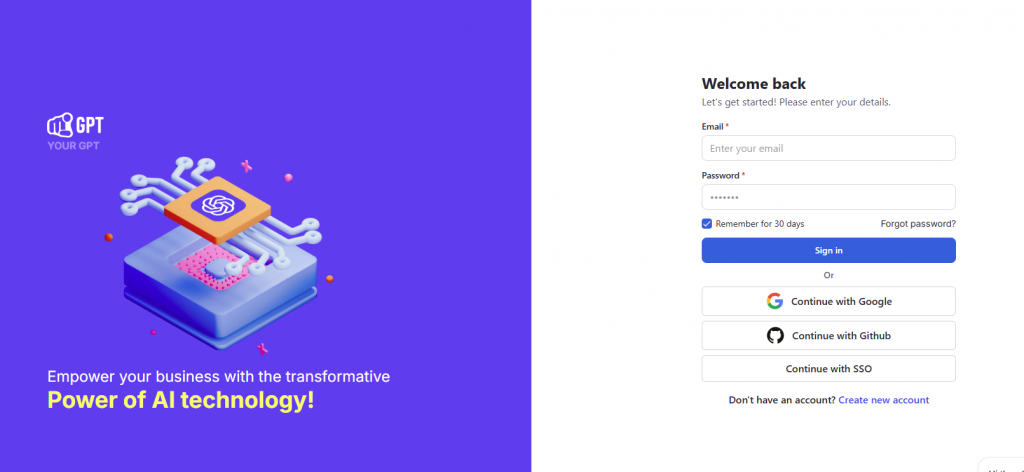
Once your account is ready, the next step is teaching your AI about your business.
2. Train the agent on your business knowledge
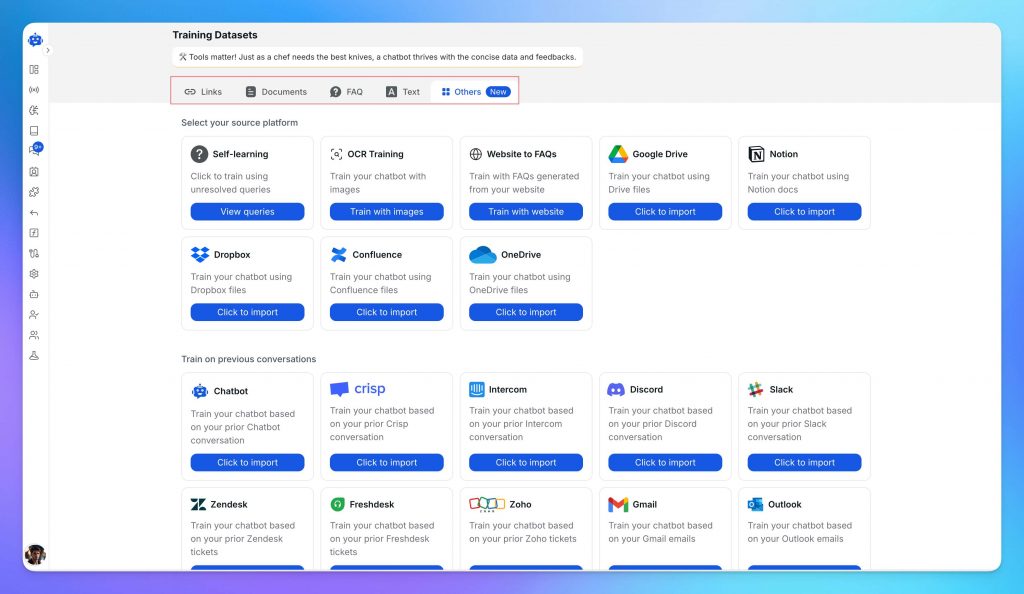
Upload your business content from multiple sources including website pages, documentation, PDFs, knowledge base articles, YouTube videos, multimedia content, and integrations with Notion, Dropbox, Confluence, and many more data sources.
YourGPT learns from your content, understanding your brand, products, and policies automatically.
With your AI trained, you’re ready to configure how it interacts with customers.
3. Align the agent with your brand and experience
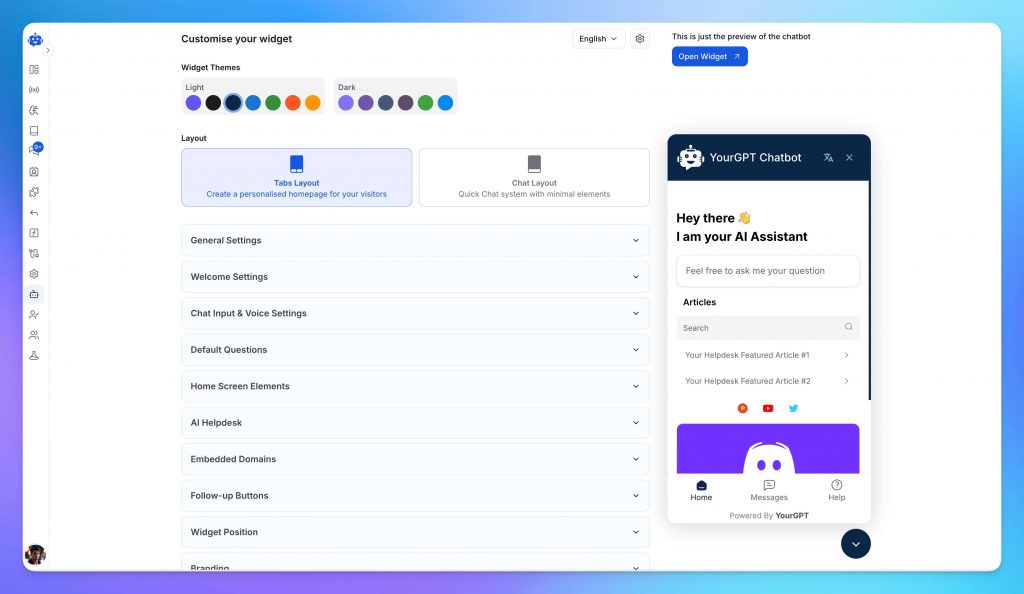
YourGPT gives you complete control over appearance, tone, branding, and domain so your AI agent fits your business perfectly.
- Custom Branding: Add your logo, brand colors, and typography to create a consistent visual experience across every user interaction. Easily adjust layout, position, size, corner radius, colors, and text styles to ensure the widget integrates naturally with your site or app.
- Custom Domain Hosting: Deploy your AI agent or helpdesk on your own domain or subdomain for a seamless, and branded user experience (e.g., support.yourdomain.com).
- Whitelabel Deployment: Remove all default branding and launch under your own name. Perfect for agencies, SaaS resellers, and enterprises that need full ownership of the experience.
4. Design workflows for task execution
For use cases that require high reliability, you can build custom multi-step processes using the AI Studio. This allows you to define business logic, design conditional workflows, and create automations tailored to your specific requirements. Studio provides enterprise-grade control while remaining accessible to teams without deep technical expertise.
Before launching to your customers, it’s important to test everything thoroughly.
5. Preview & Test
Agents are tested in preview mode to simulate real conversations and edge cases. Teams refine responses, verify workflows, and ensure escalation behaves as expected. This step reduces surprises once the agent is exposed to real users.
6. Deploy Across All Channels
Launch your AI agent wherever your customers are. Deploy on web and mobile through website widgets, web app embeds, and mobile SDKs. Connect to messaging platforms like WhatsApp, Instagram, Telegram, and Slack. Integrate with Shopify, WordPress, Crisp, Zapier, and 100+ tools via MCP. Add browser extensions for Chrome and Firefox.
Enable seamless handoff to human agents when needed for complex queries.
You’re now live with complete AI automation across support, sales, and operations. Your AI will continue learning and improving as it interacts with customers.
Common Mistakes Teams Make With AI Agents
As AI agents become easier to deploy, many teams move quickly, often before they have fully defined how the work should be owned and completed. The agents technically function, but the impact falls short. This usually has less to do with the technology itself and more to do with how the agent is designed and introduced into existing workflows.
- Giving the agent a vague role instead of a clear job: AI agents perform best when they own a specific task with a clear end state. When an agent is asked to “help with support” or “assist sales,” it tends to behave like a chatbot, offering guidance instead of completing work. Clear ownership leads to measurable outcomes.
- Prioritizing autonomy over structure: It is tempting to expect the agent to dynamically figure out every scenario. In practice, reliable automation comes from defined workflows, explicit decision points, and planned error handling. Structure is what makes autonomy dependable.
- Treating escalation as failure: Escalation is not a breakdown. It is a design choice. Well-designed agents know when a situation requires human judgment and escalate with full context. Forcing agents to handle every edge case usually increases risk and workload.
- Keeping the agent outside core systems: AI agents only reduce work when they operate inside the tools teams already use. Without direct access to CRMs, or internal systems, agents become an extra layer rather than a simplification.
- Launching without defining success metrics: Without clear measurements, teams cannot tell whether an agent is saving time or just moving work around. Effective deployments define success upfront and track operational outcomes after launch.
Teams that avoid these mistakes treat AI agents as part of their operational infrastructure, not as experiments. When agents are designed with clear ownership, boundaries, and accountability, they stop being impressive demos and start delivering consistent, real-world value.
FAQ
What is the Clawdbot platform? ▼
Clawdbot is a personal assistant platform that can automate a set of personal tasks once you deploy and configure it. It is commonly used by individuals and builders who want to run an agent in their own environment and connect it to the tools they use day to day.
What people usually mean by “Clawdbot” ▼
When most people talk about Clawdbots, they are often describing a concept or use case for Claude-powered AI bots. In that context, they mean an AI agent that can operate across tools, follow workflows, and act on behalf of a business or an individual.
Which platform is better: Clawdbot or YourGPT? ▼
It depends on what you are trying to do. Clawdbot is well-suited for personal assistant workflows and individual automation where you are comfortable deploying and managing the setup yourself. YourGPT is built for business use, where teams need production workflows, system integrations, governance, and reliable operation across customer support, sales, and operations. Both have advantages, they are designed for different scopes.
What does building an AI agent change compared to using a chatbot? ▼
A chatbot answers questions and stops. An AI agent is expected to carry a task forward, collect what is needed, follow steps, and complete actions when it can. In practice, users finish work instead of being told what to do next.
Who typically manages the AI agent once it is live? ▼
In most teams, ownership moves away from engineering quickly. Support, operations, or growth teams manage the agent because they understand the workflows and content best. YourGPT is designed so these teams can update knowledge and workflows without creating technical bottlenecks.
Can the AI agent use both public and internal documentation? ▼
Yes. Many teams train agents on help articles, internal guides, FAQs, and process documentation together. When sources are updated, the agent can be refreshed to keep answers and behavior aligned with current policy.
What happens when the AI agent cannot complete a request? ▼
The agent should stop and escalate rather than improvise. Teams define escalation rules based on missing information, repeated confusion, exceptions, or sensitive topics. When escalation happens, the full context is passed along so users do not need to repeat themselves.
Is Clawdbot suitable for business use from a security perspective? ▼
Clawdbot works well as a personal assistant, but business environments often require clearer security boundaries. Because it is open source and self-deployed, teams are responsible for access control, data handling, auditability, and ongoing maintenance. For many businesses, especially those handling customer or internal data, this can introduce additional complexity.
Conclusion
For most teams, the real constraint is no longer ideas or ambition. It is flow. How quickly work moves from request to resolution without piling up in queues or bouncing between systems.
Chatbots helped at the edges, but they rarely changed that flow. They answered questions and then stepped aside, leaving the rest of the process untouched. The real shift happens when AI stops assisting from the sidelines and starts carrying responsibility for the work itself.
That is where YourGPT fits. By treating AI agents as owners of defined tasks, work stops stalling between steps. Routine requests get handled end to end. Escalations happen intentionally, with context. Humans spend less time pushing things forward and more time solving the problems that actually need them.
Getting started does not require a large transformation or months of engineering effort. It usually begins with one repetitive task that quietly drains time every day. When that task is handed to an agent built for execution, the impact is immediate. Work moves faster, teams breathe easier, and the business becomes easier to scale without adding friction.
Put AI Agents to Work, Not Just on Your Website
Build Clawdbot-style AI agents for your business with YourGPT to handle support, sales, and operational work.
- ⚡️ Deploy your first agent in days
- 🔄 Automate workflows end to end
- 🌍 Run one agent across all channels
- 🔐 Secure By Default
No credit card required • Full access • Limited time offer

Related posts
18 Lead Generation Strategies & Tactics That Work in 2026

AI Customer Service Platform: Complete 2026 Guide for Support Teams