RAG vs Fine-Tuning: Which One Does Your AI Agent Actually Need?

TL;DR
The core distinction is retrieval versus training. RAG pulls outside documents into a prompt when an answer is generated, while fine-tuning changes a model’s weights during a separate training step.
The 2026 shift matters because OpenAI’s wind-down of its self-serve fine-tuning platform, announced in May 2026, closed off the default path many teams expected to use for GPT models.
In practice, RAG works best for changing facts and knowledge, while fine-tuning is better suited to stable behavior, formatting, and tone.
For most support or sales agents, RAG is the default. Fine-tuning makes sense mainly for narrow, high-volume, stable tasks where consistent behavior justifies the extra training step.
Every AI agent needs to answer questions correctly. Some of those answers depend on facts the agent can look up. Others depend on how the agent is built to behave, like its tone or the format of its replies. RAG and fine-tuning are the two main ways to handle each kind of need, and picking the wrong one can leave a business with an agent stuck on outdated facts, or a training bill nobody needed to spend.
The choice has gotten more pressing lately too. In May 2026, OpenAI started closing its self-serve fine-tuning platform to new users, and the access window keeps narrowing from there. That change means fine-tuning a flagship model is not automatically on the table anymore, depending on which provider a business already uses.
This guide breaks down what RAG and fine-tuning actually do, when each one is worth the cost, and how the 2026 changes affect that decision for AI agents built to handle support, sales, or operations, the kind running in production instead of staying research demos.
What is RAG?
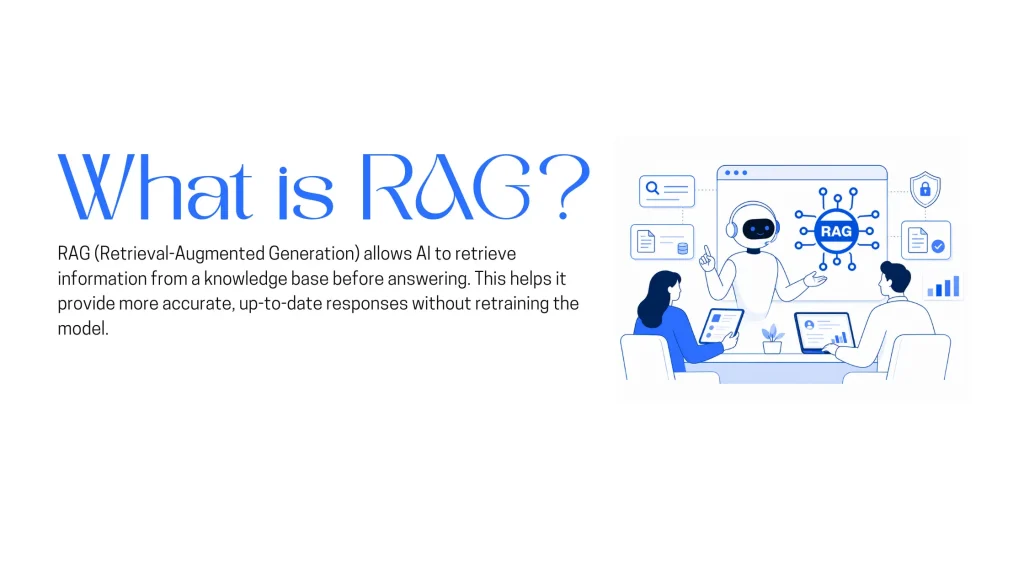
Retrieval-Augmented Generation (RAG) lets a language model pull in outside information at the moment it answers, instead of relying only on what it learned during training.
- Retrieval. A retriever searches a knowledge base, usually a vector database built for meaning-based search, and finds the passages closest to the question using embeddings.
- Context injection. Those passages get placed directly into the prompt, so the model answers from real source material without its own weights ever changing.
- No retraining. Update the source document, reindex it into the knowledge base, and the next query pulls the new version. A RAG-based agent can cite a policy that changed an hour ago with no training job required.
- The tradeoff. Retrieval quality matters more than model quality here. A Stanford RegLab study found two leading RAG-based legal research tools, Lexis+ AI and Westlaw AI-Assisted Research, produced hallucinated or incorrect citations in 17 to 33 percent of cases. Some of those errors came from pulling the wrong document. Others came from citing the right case and then describing it incorrectly, a failure the researchers labeled misgrounding. Either way, most wrong answers from a business AI agent trace back to what got retrieved, not a hallucination in the strict sense.
What is Fine-Tuning?
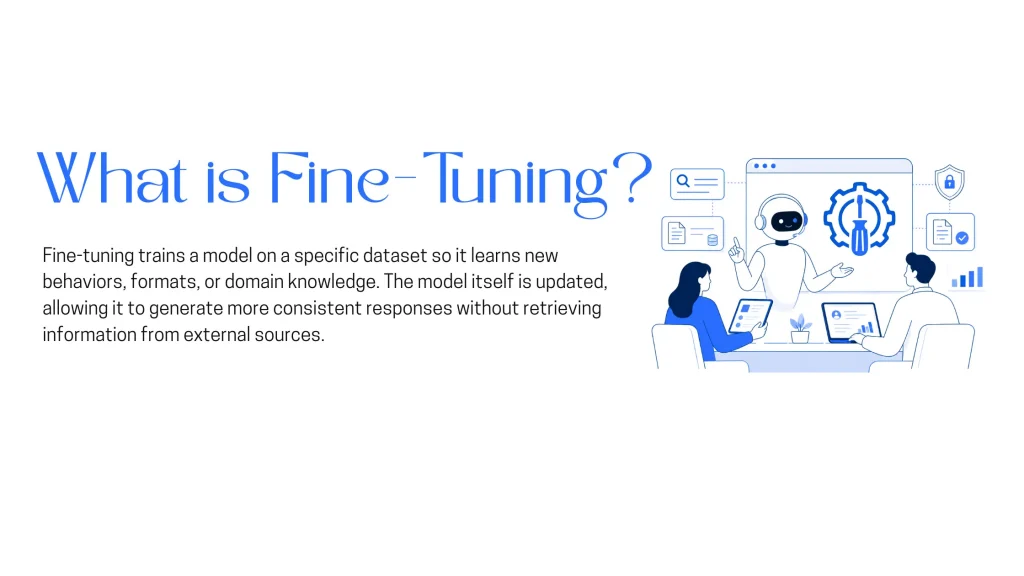
Fine-tuning changes the model itself, continuing training on a smaller, labeled dataset built for one task, instead of adding a retrieval step on top of it.
- How it works. Each training example nudges the model’s internal parameters until that dataset is baked directly into how it generates responses. It learns to reproduce patterns on its own, the way a support-specific fine-tune can format every refund answer the same way without a prompt spelling it out.
- The result. Once training finishes, the model answers differently on every future query without needing anything retrieved or injected into the prompt.
- Where it’s strong. Consistent tone, a fixed output format like a JSON schema, and lower latency, since there’s no retrieval step to wait on.
- The risk. Catastrophic forgetting. Research on continual fine-tuning shows a model fine-tuned heavily on a narrow dataset can lose ground on tasks outside that slice, including general reasoning. The effect worsens with fine-tuning depth and is not fully solved even by methods like LoRA.
RAG vs Fine-Tuning: The Core Distinction
Most confusion in this comparison comes from treating RAG and fine-tuning as competing ways to answer the same question. They usually answer different questions. Fine-tuning is not primarily a knowledge tool. It’s a behavior tool, teaching a model to act a certain way every time. RAG works the other way, supplying knowledge while leaving behavior and voice largely as they were.
The table below breaks down where each one actually earns its keep:
| Fine-Tuning | RAG | |
|---|---|---|
| What it actually changes | The model’s weights, through additional training | Nothing in the model. Only the information placed in the prompt at answer time |
| What it’s strong at | Teaching a specific writing style, classification task, or reasoning pattern reliably, without a prompt spelling it out every time | Giving an existing model access to information it wasn’t trained on, updated as often as the source documents change |
| What it’s weak at | Staying current. A model fine-tuned on this quarter’s pricing knows only this quarter’s pricing until someone runs another training job | Forcing a specific output shape or a deeply internalized domain vocabulary |
| What it can’t do on its own | Add facts the model wasn’t trained on without a new training run | Teach a model new skills or a new voice. A retrieved passage about insurance underwriting supplies facts to reason with, without turning a general-purpose model into an underwriter |
For an AI agent handling live customer conversations, this split usually points toward RAG first. Support policies, pricing, product specs, and order data change constantly. Brand voice and escalation behavior matter too, but those are frequently solvable through system prompts and Studio-level rules without a full training run.
Six Factors That Should Drive the Choice
Weigh these six factors against the specific agent being built, separate from the topic in general. Together they usually point clearly toward one approach over the other.
- How often the underlying information changes. Product docs, pricing, and policy pages update weekly or monthly in most businesses. RAG absorbs that by reindexing. Fine-tuning needs a new training run for every update, which very few teams can sustain.
- What “correct” actually means for the task. If correctness means matching current facts, RAG wins. If correctness means matching a specific tone, structure, or classification schema that stays stable, fine-tuning earns its cost.
- Latency tolerance. RAG adds a retrieval step before generation starts. For most chat interfaces that is negligible, but for high-throughput or voice-latency-sensitive agents, a fine-tuned model answering directly from its weights can be measurably faster.
- Volume at inference. Fine-tuning has high upfront cost and lower per-query cost once trained. RAG has low upfront cost and an ongoing retrieval and context cost per query. At very high, stable query volumes for a narrow task, that math can flip toward fine-tuning.
- Explainability and audit needs. RAG can point to the exact source passage behind an answer, which matters in regulated fields like healthcare, finance, and legal. A fine-tuned model’s outputs come from its weights instead of documents and cannot be traced back to a specific source the same way.
- Access to a fine-tuning path at all. As of mid-2026, this factor has become less theoretical than it used to be. Depending on the model provider, fine-tuning may not be an option without switching to open-weight models or a specific managed path.
Combining RAG and Fine-Tuning
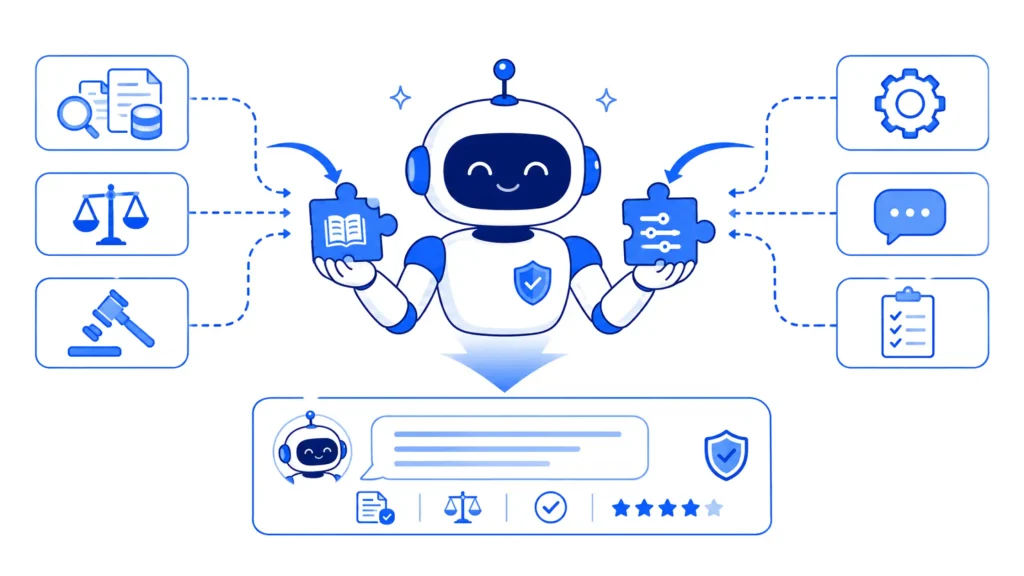
The two are not mutually exclusive, and most mature production systems end up running both, each handling a different half of the job. Knowledge goes to RAG. Behavior goes to fine-tuning.
- RAG layer. Keeps the model grounded in current documents, supplying the facts behind every answer as they change.
- Fine-tuning layer. Runs on the same model and enforces a fixed output format, a specific tone, or domain vocabulary the base model would not use on its own, without needing those instructions repeated in every prompt.
- Legal research example. A tool might retrieve the actual statute text for every query through RAG, while running on a model fine-tuned to always cite sources in a specific format and flag confidence level the way in-house counsel expects. Plain RAG alone would produce inconsistent formatting from response to response. Plain fine-tuning alone would answer confidently from stale training data instead of the current law. Combined, each technique covers the other’s gap.
- RAFT. A more tightly coupled version of this pattern trains the model on questions paired with both relevant and irrelevant retrieved documents, teaching it to reason over what it retrieves instead of simply pairing an off-the-shelf fine-tune with a separate RAG layer.
Cost Comparison: RAG vs Fine-Tuning
RAG costs show up mostly at query time:
- Embeddings get generated for every document chunk during setup, and again for every incoming query at answer time.
- The vector database needs hosting, and cost scales with how much content gets indexed, so a larger knowledge base means a larger recurring infrastructure bill.
- Retrieval runs on every single query, unlike a training pass that happens once, so this cost accrues continuously instead of upfront.
- Inference costs more per query than a bare prompt would, since the model has to read every retrieved passage in addition to the original question.
Fine-tuning costs show up mostly before anything ships, then again every time something changes:
- Data preparation means collecting, cleaning, and labeling a dataset large enough to teach the model the target behavior reliably.
- GPU training is the compute-heavy step itself, and cost scales with model size and how many passes the training run needs.
- Evaluation requires testing the fine-tuned model against held-out examples to confirm it improved on the target task without breaking anything else.
- Deployment means hosting the resulting custom model, which can cost more per query than the base model it was built from.
- Retraining repeats the entire process any time the underlying task or dataset changes.
- Versioning adds overhead too, since every retrain produces a new model that needs its own testing and rollout plan before it can replace the last one.
RAG usually costs less to start, since no training run has to finish before an agent can answer its first question. Fine-tuning flips that. The upfront training cost gets followed by an ongoing maintenance cycle, since evaluation, retraining, and versioning do not stop once the first model ships.
Common Mistakes to Avoid
These are the mistakes that show up most often once an agent moves from a demo into production. Some come from picking the wrong approach, others from executing the right one poorly.
- Fine-tuning for FAQs. A FAQ list changes constantly and needs almost no behavior shaping. RAG handles it directly, and fine-tuning adds training overhead without solving anything RAG does not already solve for free.
- Training on documents that keep changing. Fine-tuning a model on content that gets revised weekly means the model goes stale again almost immediately, and the fix is another full training run instead of a quick document edit.
- Ignoring retrieval quality. Tuning prompts and model settings while retrieval keeps surfacing the wrong passages means optimizing the wrong half of the pipeline.
- Skipping evaluation benchmarks. Shipping a fine-tuned model without a held-out test set means nobody notices when it quietly gets worse at something it used to handle.
- Poor chunking. Splitting documents at arbitrary length instead of natural topic boundaries produces passages that cut off mid-thought, leaving the model to interpret missing context.
- Weak embeddings. A generic, low-quality embedding model saves a little on cost but can undermine retrieval accuracy more than any other single decision in the pipeline, since every downstream answer depends on finding the right passage first.
- Expecting fine-tuning to reduce hallucinations automatically. Fine-tuning shapes behavior. It does not add a source-checking mechanism, so a fine-tuned model can still generate a confident, wrong answer the same way its base model could.
- Running RAG without document governance. A knowledge base with no owner, no review cycle, and no way to flag outdated pages will feed an agent contradictory or stale information no matter how good the retrieval mechanism underneath it is.
Data Security and Model Risk Considerations
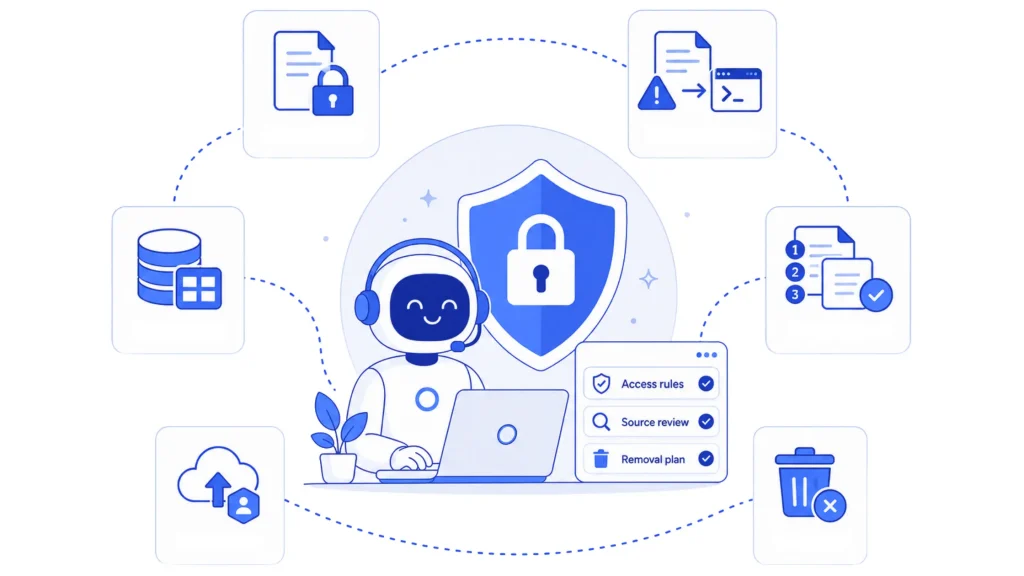
RAG and fine-tuning introduce different risk profiles, and both deserve attention before either goes into production.
- RAG and fine-tuning introduce different risk profiles, and both deserve attention before either goes into production.
- RAG’s attack surface is the knowledge source itself. Anyone who can write to a connected document, sitemap, or shared drive can potentially inject instructions that the agent later retrieves and treats as trustworthy context, a pattern generally described as retrieval-based prompt injection.
- Access control on the knowledge base, beyond the chatbot itself, is the actual security boundary.
- Knowledge-conflict detection and source-priority rules matter too, since a poisoned or simply outdated document competing with a correct one can produce confidently wrong answers that look identical to a real one.
- Fine-tuning’s risk shifts to the training data and the resulting weights. Sensitive customer data included in a training set can resurface, verbatim in some cases, in the model’s outputs later, a different exposure path than RAG’s retrieval leak.
- Third-party fine-tuning pipelines raise the same data-handling questions any vendor contract would, around retention, regional processing, and who can access training data once it is uploaded.
- Revoking access to fine-tuned knowledge is far harder than deleting a document from a vector store, since a fine-tuned model bakes domain knowledge into its weights instead of an external, revocable source. That matters most if a partnership ends and that access needs to be pulled.
- Neither approach is inherently safer. Both need explicit access control, source review, and a removal plan for when information has to come out, on top of the usual plan for adding it in.
A Decision Framework for RAG vs Fine-Tuning in AI Agents
A simple way to work through the decision for a specific agent:
- Start with RAG if the agent needs to answer from information that changes on any regular cadence, needs to cite sources, or handles more than a handful of distinct topics.
- Consider fine-tuning only after RAG plus prompt engineering has been tried and specifically falls short on tone, format consistency, or a narrow classification task at high, stable volume.
- Reach for a hybrid like RAFT when the domain is narrow, the stakes are high, and plain RAG’s retrieval-reasoning errors show up as a specific, measured problem instead of a vague sense that answers could be “smarter.”
- Check the access question early. Confirm which fine-tuning path is actually open for the chosen model provider before scoping a project around it, since that has changed materially in 2026.
- Revisit the decision as the agent’s scope grows. A narrow internal tool that starts as a fine-tuning candidate can outgrow that fit fast once it needs to answer questions the training set never covered.
Building Reliable AI Systems with YourGPT
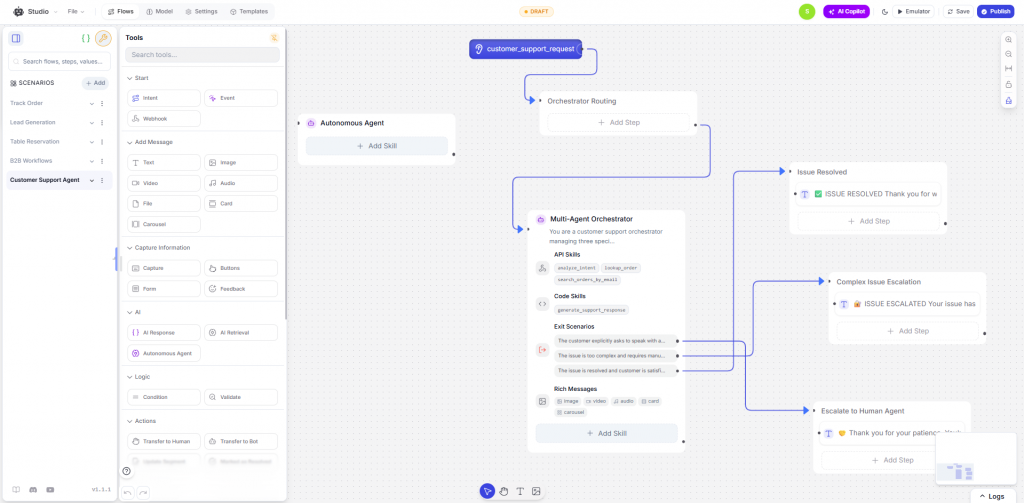
YourGPT built its own agent platform around one side of this tradeoff. Here’s how that architecture handles it in practice.
- AI Studio is built RAG-first. Its core architecture grounds every agent in retrieval-augmented generation by default, pulling from connected sources like a website, help center, Notion, Google Drive, or uploaded documents, instead of requiring a training run before an agent can go live.
- Content updates flow through reindexing rather than retraining, which fits the reality that most support, sales, and operations knowledge changes far more often than any fine-tuning schedule could keep pace with.
- Model choice across OpenAI, Anthropic, Google, xAI, and DeepSeek lets a team pick a base model suited to a task, instead of offering fine-tuning as a separate track.
- Studio-level rules and conditional logic shape tone and escalation behavior without training data.
- Self-learning improves answer quality from real conversations and human feedback over time.
- Knowledge Conflict Detection addresses part of the security discussion above directly, flagging contradictory training sources before they reach a customer instead of leaving the agent to guess which document is current.
- The free trial covers a full RAG-based agent setup, with no paid tier required to see whether retrieval alone closes the gap before spending on anything else.
This is an honest tradeoff. It is not a universal answer. A business with a narrow, extremely high-volume, stable classification task might still get more value from a fine-tuned open-weight model running elsewhere. For the far more common case, an agent that needs to answer from a knowledge base that changes weekly and stay auditable about where its answers came from, RAG-first is the better starting point.
Real-World Examples
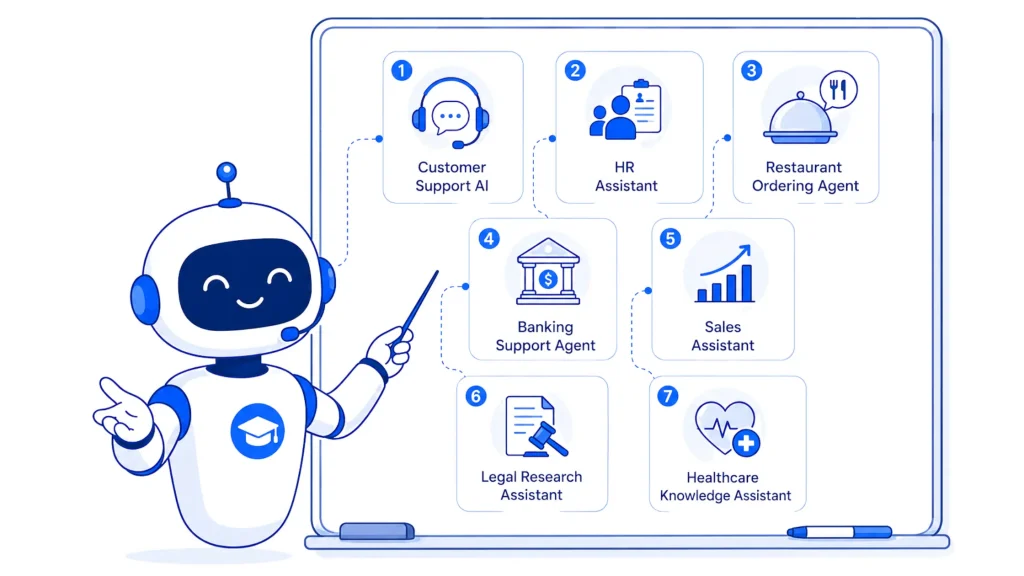
The pattern holds across seven common AI agent scenarios, using the factors covered above. The customer stories referenced below are all YourGPT deployments, cited here as concrete examples of the pattern, without functioning as independent benchmarks.
1. Customer Support AI
A support agent answering questions about pricing, refunds, and account issues needs facts that change on a normal support-team schedule. RAG is the clear fit. Talkmore, a Norwegian mobile operator, and Shockbyte, a game-server hosting provider, both built their support agents this way, training on subscription plans, billing guidance, and hosting documentation that gets updated as policies change instead of baked into a model that would need retraining every time something did.
2. HR Assistant
Leave policies, benefits windows, and payroll rules update every time a handbook gets revised, which points toward RAG for the knowledge itself. The one case worth a hybrid layer is a high-volume HR inbox that also needs to route every inquiry into a fixed set of categories, like benefits, leave, or compliance, a narrow, stable classification task that fine-tuning handles well on top of that RAG-grounded base.
3. Restaurant Ordering Agent
Menus, prices, and daily specials change more often than any training run could track, so RAG covers the knowledge side directly, while order-taking structure gets handled through Studio-level forms, no fine-tuned model required.
4. Banking Support Agent
A regulated field like banking needs every answer traceable to a real policy document. SKNANB, a Caribbean bank, uses this pattern to keep responses aligned with its own current banking policies instead of a fixed set of trained-in rules that would drift out of compliance the moment a policy changed.
5. Sales Assistant
A sales agent needs current inventory, pricing, and promotions, which is a RAG job, plus a consistent, on-brand pitch across every conversation, which leans toward behavior shaping. Most teams get there with RAG plus Studio-level persona rules instead of a full fine-tune, and fine-tuning only earns its cost at volume high enough to justify baking a fixed qualification script directly into the model.
6. Legal Research Assistant
This is the scenario where the RAFT-style hybrid covered earlier actually earns its keep. Legal research needs both the current statute or case text, a retrieval problem, and reliable reasoning over exactly what that text says, the piece RAFT specifically trains for. Plain RAG can retrieve the right document and still misread it, and a narrow, high-stakes domain like this is where that gap justifies the extra training investment.
7. Healthcare Knowledge Assistant
Coverage details, plan rules, and clinical guidelines change often enough that a fine-tuned model would need constant retraining to stay accurate, and getting this wrong carries real consequences. HealthBird, an insurance access platform, uses RAG for exactly this reason, training its agent on current plan information so answers stay traceable to what is actually covered instead of a snapshot from whenever the model was last trained.
Frequently Asked Questions
FAQ
Is RAG better than fine-tuning for AI agents? ▼
Neither wins universally. RAG tends to be the better fit for agents that need current facts, source citations, or coverage across many topics. Fine-tuning tends to be the better fit for a narrow, high-volume, stable task where tone or output format matters more than the facts involved. Most production support and sales agents lean on RAG first and add fine-tuning only where it earns its cost.
Is fine-tuning still available for GPT models in 2026? ▼
Partially. OpenAI began winding down its self-serve fine-tuning platform in May 2026, closing new-job creation to organizations that hadn’t already run one, with the access window narrowing further on a set schedule through January 2027. Existing fine-tuned models keep working until their base model gets deprecated. Open-weight models remain fully tunable through techniques like LoRA regardless of what any single API provider does.
How does YourGPT handle the RAG vs fine-tuning decision? ▼
YourGPT’s AI Studio is built RAG-first, grounding every agent in retrieval by default instead of requiring a training run before it can go live. Behavior gets shaped through model choice across OpenAI, Anthropic, Google, xAI, and DeepSeek, Studio-level rules and conditional logic, and self-learning that improves from real conversations over time.
Does RAG require training data the way fine-tuning does? ▼
No. RAG needs documents to index instead of labeled training examples. There’s no dataset curation, no training run, and no GPU cost tied to teaching the model new behavior. What it needs instead is a well-organized, current knowledge base and a retrieval pipeline that can search it accurately.
Can an AI agent use RAG and fine-tuning together? ▼
Yes. Many mature production systems run both, using RAG to keep answers grounded in current facts while a lighter fine-tuning pass enforces a consistent tone, output format, or domain vocabulary. The “Can You Combine Both?” section above covers a concrete example of that pattern in a legal research tool.
Is RAG cheaper than fine-tuning? ▼
Usually cheaper to start. RAG carries low upfront cost since no training run has to finish before an agent can answer its first question, though it adds an ongoing retrieval and inference cost to every query. Fine-tuning carries a higher upfront training cost that can pay back at very high, stable query volumes for one narrow task.
What happens to a fine-tuned model when the information it learned changes? ▼
It goes stale until someone retrains it. A model fine-tuned on this quarter’s pricing keeps answering with that pricing until another training job runs, since there’s no way to update just the facts baked into a fine-tuned model’s weights. That gap is the main reason fast-changing information usually points toward RAG instead.
Is there a free way to test YourGPT’s RAG-based approach? ▼
Yes. The free trial covers a full RAG-based agent setup, with no paid tier required to see whether retrieval alone closes the gap before spending on anything else.
Conclusion
RAG and fine-tuning solve different problems, and the 2026 shift in fine-tuning access makes that distinction more consequential than it was a year ago. RAG keeps an agent current without a training cycle. Fine-tuning locks in behavior at the cost of flexibility and, for several major providers now, a much narrower on-ramp than before.
A fast way to settle the question for a specific agent: pull the last month of source material and count how many times it actually changed. Frequent changes point straight to RAG. A handful of stable, high-volume tasks, like formatting refund responses the same way every time or routing tickets into a fixed set of categories, are where fine-tuning starts to earn its cost.
Before scoping a project around fine-tuning a frontier model, confirm the provider still offers that path and check whether prompt engineering on top of RAG can close the gap first. For most support, sales, and operations agents, it will.

Related posts