AI Chatbots for Education: Use Cases for Schools & EdTech

TL;DR
Real deployments show measurable results. Georgia Tech’s Jill Watson achieved 78.7% classroom question accuracy compared with 30.7% for a stock OpenAI Assistant, while Georgia State’s Pounce chatbot improved enrollment outcomes in a randomized controlled trial.
The strongest use cases are admissions, student services, and staff workload reduction rather than homework assistance.
Guardrails matter more than the underlying model. Chatbots that guide students, limit direct answers, and use clear escalation rules are more likely to earn trust.
FERPA, COPPA, and hallucination risks make a written escalation policy essential before launch, when gaps are still easier and cheaper to fix.
Education has turned into one of the more crowded proving grounds for AI chatbots, and every pitch to schools sounds the same, less staff workload, faster answers, calmer inboxes. What the pitch leaves out is that two very different products get sold under that promise, and the gap between them has nothing to do with which subject they cover.
One kind of chatbot answers logistics. Deadlines, enrollment steps, password resets, the kind of question a front desk handles a hundred times a semester. Another kind answers coursework, and whether that goes well comes down to how tightly the job is scoped, not what topic it touches.
Both still get called a chatbot for education, and a tutor built to guide a student and a tutor built to hand over the answer fall under that same label, with the difference in outcome coming entirely from which one a school deployed. What follows is where the well-scoped version is already working, by name, and the design choices that keep it from becoming the other kind.
What is an AI Chatbot for Education?
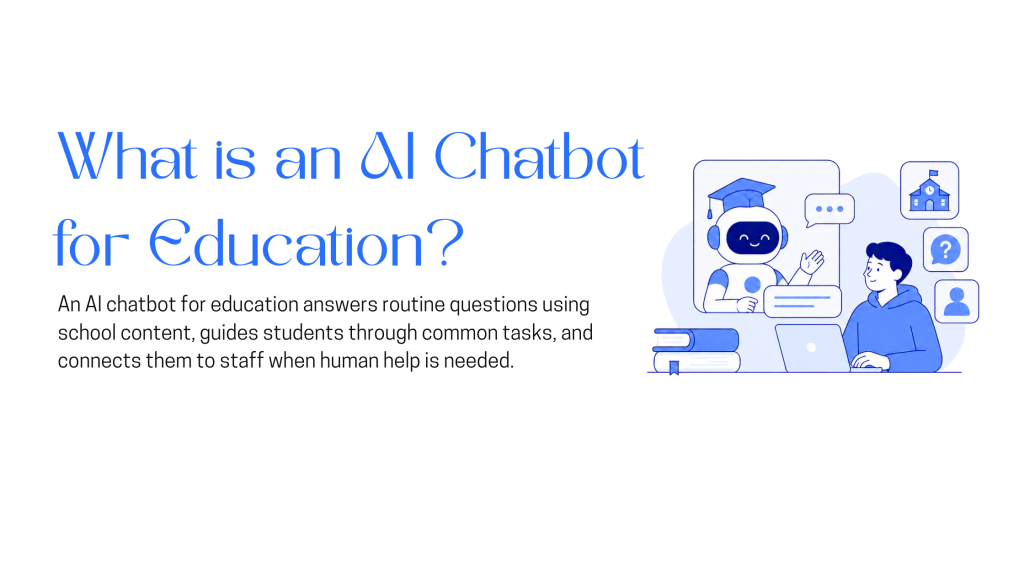
An AI chatbot for education is software trained on a school’s or platform’s own content, not the open web. That’s the same principle behind an AI help desk built on a business’s own knowledge base, just applied to a school’s policies instead of a company’s support docs. It works through three things:
- Grounded answers. A knowledge base built from the institution’s own material, handbooks, course pages, FAQs, policy documents, so responses reflect actual policy instead of generic web content.
- A defined handoff. The bot resolves routine questions directly and brings in a staff member, advisor, or counselor once a question needs human judgment, unlike a search box, which only returns links.
- A narrow job. Georgia State’s Pounce is built for one task, getting admitted students to show up in the fall, while Khan Academy’s Khanmigo sits closer to a tutor, walking a student through a problem without giving the answer away.
What ties them together is how narrowly each one defines its own job before a student or applicant ever sends a message.
Competitive Advantage of AI in EdTech
Adoption didn’t happen because chatbots became fashionable. It happened because the operational pressure on schools and EdTech platforms built up faster than staffing could keep pace with it.
- High inquiry volume. The same handful of questions, deadlines, document requirements, password resets, arrive hundreds of times a semester, and answering each one individually doesn’t scale.
- Limited support staff. Admissions and student services teams rarely grow at the same rate as enrollment or course offerings, so the gap between demand and headcount keeps widening.
- Admission season overload. A June 2026 U.S. News survey found that 61% of admissions officers at top colleges already use some form of chatbot or automated messaging to handle the seasonal spike in applicant questions.
- Student engagement. Students already live on WhatsApp, SMS, and web chat, channels that also reach students without a laptop or reliable broadband, which is the approach Darsel uses to deliver math practice to students across Jordan, Thailand, and Egypt.
- Growing online education. Remote and hybrid programs remove the physical front desk entirely, so the support load shifts online whether a school has planned for it or not.
- Rising support costs. Hiring and training additional staff for a seasonal spike costs more than a chatbot that absorbs the same volume year-round.
12 Practical AI Chatbot Use Cases in Education
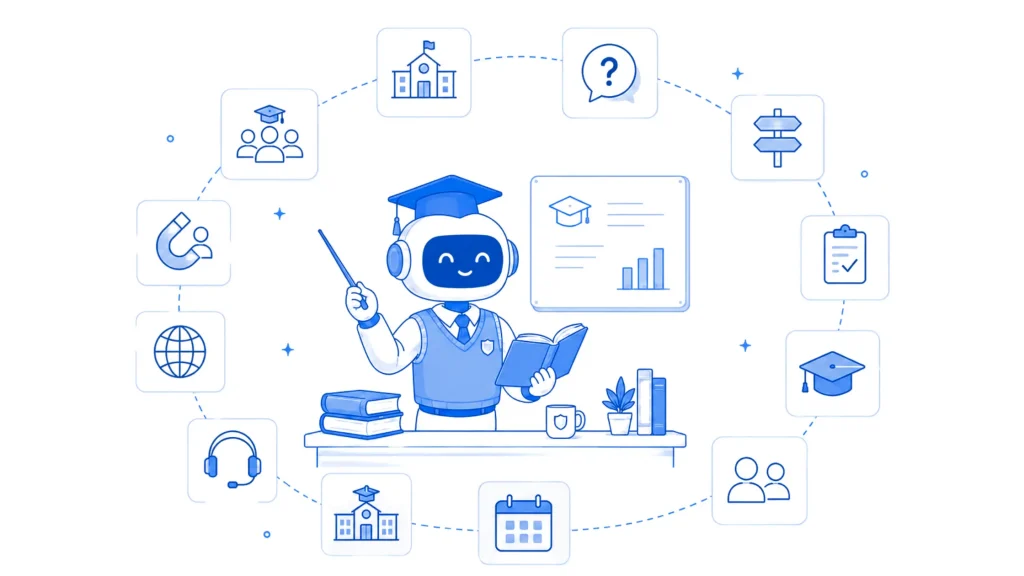
Each entry below breaks a specific problem down into the AI solution that addresses it and the concrete benefit it produces.
1. Student Admissions Support
- Problem. Applicants ask the same eligibility, deadline, and document questions on repeat, and admissions staff can’t staff every hour they arrive in.
- AI solution. A chatbot trained on admission criteria answers eligibility, deadline, and required-document questions directly, and with AI Studio connected to an application-tracking API, it reports status too instead of a staff member checking a spreadsheet.
- Benefit. Fewer applicants stall out waiting for a reply, the same mechanism behind Pounce’s effect on Georgia State’s summer melt numbers.
2. Student FAQ Automation
- Problem. Academic calendar dates, timetables, fee amounts, and course details live somewhere on the school website, usually buried a few clicks deep.
- AI solution. A chatbot grounded in the school’s own pages, the kind AI Helpdesk turns into a searchable knowledge base, answers these instantly instead of routing students to a search bar.
- Benefit. This is close to what Cara does at the University of Galway, resolving the bulk of routine questions without a staff member touching them.
3. Course Recommendations
- Problem. Students often don’t know which electives, certifications, or learning paths fit their goals, and advisors have limited one-on-one time to walk through the options.
- AI solution. A chatbot can match a student’s stated interests or completed courses against the program catalog and suggest relevant electives, certifications, or paths.
- Benefit. Students arrive at an advising appointment with a starting point instead of no direction, which makes the appointment itself more useful.
4. Enrollment Assistance
- Problem. Registration, documentation, and payment steps span multiple systems, and one confusing step can stall the whole process.
- AI solution. A chatbot walks a student through registration, required documentation, and payment, and reports enrollment status on request instead of making the student check a portal.
- Benefit. Fewer half-finished enrollments and fewer calls to the registrar’s office asking what’s still missing.
5. Learning Assistance
- Problem. Students often don’t know where to find the right study material or forget assignment deadlines until they’ve already passed.
- AI solution. A chatbot, YourGPT included, can point students to the right resource, send assignment reminders, and offer practice questions grounded in the course material, the same scoped approach behind Khanmigo and Jill Watson.
- Benefit. Support is available outside office hours without turning into the kind of open-ended homework helper that raises academic integrity concerns.
6. Parent Support
- Problem. Parents ask about attendance, fees, events, policies, and transport, questions that don’t always reach the right staff member quickly.
- AI solution. A chatbot trained on the school’s own policies and schedules answers these directly, running on WhatsApp or whichever channel parents already check.
- Benefit. Front-office staff spend less time relaying the same information to different parents throughout the week.
7. Appointment Booking
- Problem. Scheduling time with a teacher, counselor, advisor, or admissions officer usually means email back-and-forth or a phone call during business hours.
- AI solution. A chatbot, like YourGPT’s dedicated appointment-booking setup, checks availability and books the appointment directly, then confirms and reminds both sides.
- Benefit. Fewer missed appointments and less staff time spent coordinating calendars manually.
8. Campus Help Desk
- Problem. Questions about hostel, library, sports facilities, Wi-Fi, ID cards, and general IT support arrive across every channel a campus operates.
- AI solution. A single chatbot trained on facilities and IT documentation answers these directly, and escalates anything it can’t resolve to the right department.
- Benefit. Students get one place to ask instead of guessing which office handles which question.
9. Internal Staff Support
- Problem. Teachers and staff have their own repeat questions, HR policies, leave requests, IT help, payroll, that pull time away from actual teaching.
- AI solution. A chatbot trained on internal HR and IT documentation answers these directly, the same teacher-facing model MagicSchool uses to stay out of student-facing territory entirely.
- Benefit. Staff get faster answers without opening a ticket, and HR and IT spend less time on repetitive requests.
10. Multilingual Student Support
- Problem. International students, regional schools, and diverse learner communities don’t all operate in the same language a school’s default support does.
- AI solution. A chatbot that detects and responds in a student’s language automatically, the way Darsel delivers bilingual math support across Jordan, Thailand, and Egypt, removes language as a barrier to getting an answer.
- Benefit. Fewer students go without support simply because the help desk doesn’t operate in their language.
11. Lead Qualification for EdTech
- Problem. EdTech companies field inbound interest at a volume sales teams can’t personally qualify fast enough, and slow follow-up loses leads.
- AI solution. A lead generation chatbot like YourGPT’s sales use case captures lead details, recommends relevant courses, schedules demos, and routes qualified inquiries to the right sales rep automatically.
- Benefit. Sales teams spend their time on qualified conversations instead of manually sorting inbound interest
12. Alumni Engagement
- Problem. Alumni offices manage event invitations, donation requests, certificate reissues, and transcript requests for a population that’s grown far beyond what a small team can track individually.
- AI solution. A chatbot handles routine alumni requests directly, events, donations, certificates, transcripts, and routes anything unusual to staff.
- Benefit. Alumni get faster service on routine requests, and the alumni office can focus on relationship-building instead of paperwork.
Benefits of AI Chatbots in Education
The upside shows up in both the numbers schools track and the experience students have.
- 24/7 student support. Deadlines and password resets don’t wait for office hours, and a chatbot answers them the moment they’re asked.
- Faster response times. A routine question gets resolved instantly instead of waiting out a 48-hour email turnaround.
- Reduced administrative workload. At the University of Galway, Cara has been credited with a 40% drop in repetitive manual work and more than 2,300 staff hours saved.
- Improved student satisfaction. Cara resolves 91% of its 30,000-plus queries instantly, with no wait and no ticket number.
- Increased enrollment conversions. Georgia State’s Pounce chatbot has been linked to a measurable drop in summer melt, the point where admitted students quietly never show up in the fall.
- Better resource utilization. Staff time that used to go toward answering the same question repeatedly gets redirected to the judgment calls that actually need a person.
- Consistent information delivery. A chatbot grounded in a school’s own policy documents gives the same accurate answer every time, regardless of which staff member would otherwise have picked up the phone.
- Scalable support during peak periods. Application season and the first week of term spike inquiry volume at once, exactly the kind of surge a chatbot absorbs without adding temporary staff.
Challenges and Best Practices
None of this works without deliberate limits. The same platform that saves staff time can just as easily erode trust if it’s deployed without guardrails.
- Hallucination prevention. Ground every response in the school’s own approved content through retrieval, and route anything the knowledge base doesn’t cover to a person instead of letting the model guess.
- Keeping knowledge updated. Policies change every semester and financial aid deadlines shift, so a knowledge base that isn’t reindexed regularly starts giving confidently wrong answers.
- Privacy and student data protection. FERPA and COPPA compliance needs to be confirmed directly with any vendor before launch, not assumed from a marketing page.
- Clear escalation to staff. Every deployment needs a written list of what the bot never attempts alone, crisis situations, academic integrity questions, and anything involving another student’s records.
- Avoiding over-automation. Not every interaction should be automated. A chatbot that tries to handle judgment calls it isn’t built for erodes trust faster than a slow human response would.
- Testing before deployment. Running the bot against edge cases and adversarial questions before it goes live catches gaps a demo conversation won’t.
Data Privacy and Safety Risks for Schools
Every workflow and benefit above assumes the school got this part right first. A chatbot that mishandles a FERPA-protected record or gives a wrong answer about a financial aid deadline fails in front of the student it was meant to help.
- FERPA. Schools stay responsible for student records even when a vendor built the chatbot.
- COPPA. K-12 deployments need parental consent before collecting a child’s personal information.
- Hallucination. Accuracy concerns made up 26% of student-named risks in one survey, just behind academic integrity at 28%.
- Academic integrity. Most teens believe AI-assisted cheating is common at their school, so a policy needs to exist before the bot launches.
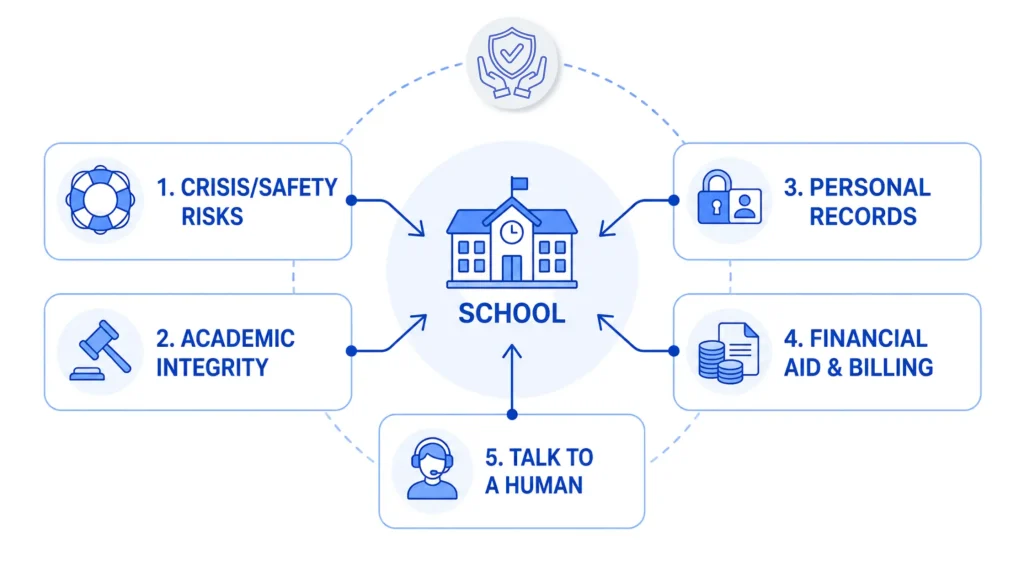
A working escalation policy routes these to a human by default:
- Any message suggesting self-harm, crisis, or safety risk
- Academic integrity questions, including grading disputes and misconduct accusations
- Requests involving a student’s personal records or someone else’s information
- Financial aid, billing, and refund questions above a low dollar threshold
- Any explicit request to speak with a person
The fix is scope. Narrow the bot’s job and write the escalation rules down before the first student sends a message.
Frequently Asked Questions
FAQ
What Defines an AI Chatbot for Education? ▼
The label gets used loosely. The real test is whether the chatbot only draws from a school’s own material and hands off once a question goes beyond it. Ask vendors to demonstrate what happens when a student asks something outside the training content. A chatbot that guesses instead of escalating has not earned the label.
Can AI Chatbots Replace Teachers or Advisors? ▼
No. A person should remain involved whenever a situation requires judgment. A chatbot cannot approve disability accommodations, grant academic exceptions, or counsel students in crisis. Its role is to absorb repetitive questions so teachers and advisors can focus on decisions that require human responsibility.
Are AI Chatbots Safe for Homework Help? ▼
They can be safe when designed to guide students rather than provide direct answers. For example, a tutoring chatbot can ask guiding questions, offer hints, and help students understand the process without completing the work for them.
How Do Schools Protect Student Data? ▼
Schools should review where data is hosted, whether it is used to train vendor models, how long it is retained, and who can access it. They should also review the vendor’s data processing agreement carefully. FERPA keeps the school accountable, while COPPA adds parental consent requirements for children under 13.
Do AI Chatbots Support Multilingual Students? ▼
Yes. Multilingual chatbots can answer questions in the languages students and families already use. This is especially useful for international admissions, student services, and schools serving communities where English is not the first language.
How Much Does an AI Chatbot for Schools Cost? ▼
Pricing depends on the use case, number of users, knowledge-base size, required integrations, and support level. Teacher-facing tools may offer free or low-cost plans, while district-wide and higher-education deployments are commonly priced through custom contracts.
What Is the Difference Between a Chatbot and an AI Agent? ▼
A chatbot answers questions within a defined scope. An AI agent can also complete actions, such as updating a student record, submitting a form, checking an application status, or triggering a workflow. AI agents are more suitable for operational, multi-step processes.
How Long Does It Take to Deploy an Education Chatbot? ▼
A focused administrative chatbot can be deployed once the school’s FAQ pages, policies, and escalation rules are organized. A student-facing tutoring chatbot usually takes longer because it requires more extensive guardrail testing and careful decisions about when it should guide, answer, or escalate.
Can Schools Build an Admissions or FAQ Chatbot Without Developers? ▼
Yes. A small admissions or student-services team can use a no-code platform to train a chatbot on FAQ pages, policy documents, and admissions criteria. Platforms such as YourGPT also let teams create visual workflows, connect application-tracking APIs, and configure escalation rules without writing code.
What Should Schools Look for in an Admin-Facing Chatbot? ▼
Schools should prioritize grounded answers from approved content, built-in human handoff, clear data controls, and a setup process that does not require an engineering team. The platform should also make it easy for staff to update knowledge sources whenever policies change.
Conclusion
The best AI chatbots for education are not the ones with the most features. They are the ones built around a clear purpose, whether that’s answering admissions questions, supporting students, reducing administrative workload, or helping staff work more efficiently. When responses stay grounded in verified school content and every high-risk scenario has a clear path to a human, chatbots become a reliable extension of the education team rather than another system to manage.
If you’re planning to introduce an AI chatbot, start with one repetitive workflow instead of trying to automate everything at once. Build a trusted knowledge base, define escalation rules before launch, and measure the impact on response time, staff workload, and student satisfaction. A focused rollout is easier to improve, earns trust faster, and creates a solid foundation for expanding AI across more educational services over time.

Related posts