7 Things to Verify in Any AI Agent Platform Before You Go Live
Every AI agent looks impressive in a demo. The real test begins after launch.
Within days, things can go wrong. The agent may give incorrect policy information, trigger unintended actions, or rely on outdated data. These are not edge cases. They are common failure patterns in real deployments.
There is a clear gap between adoption and success. While many enterprises experiment with AI agents, only a small percentage run them reliably in production. Failed projects often come with high costs, not just financially, but in lost trust and missed opportunities.
What separates success from failure is rarely the AI model itself. It is the platform behind it. The guardrails, integrations, and controls determine how the agent behaves in real-world conditions.
Recent incidents have made this clear. In one case, a chatbot provided incorrect policy information and the company was held accountable. In another, an AI agent invented rules that led to customer churn. In both situations, the issue was not fluency. It was lack of control.
The takeaway is simple. The biggest risk is not the model. It is the platform.
Why Most AI Agent Launches Go Wrong
The root cause is almost always the same: teams evaluate the model, then trust the platform.
A documented real-world example: Cursor’s AI support agent – named “Sam,” with no indication it was a bot – invented a company policy about “one device per subscription as a core security feature” and delivered it to paying customers as fact. Developers began cancelling subscriptions before anyone noticed. Cursor’s co-founder had to publicly apologize on Hacker News. The model wasn’t broken. It was fluent and confident. The platform had no mechanism to validate that agent responses were grounded in actual policy.
This is the central insight that separates mature AI agent deployments from failed ones: the model is not the primary risk surface. The platform is.
Platforms that lack what engineers now call “reliability contracts” – validated context, enforced action boundaries, observable behavior, and recovery mechanisms – produce incidents, not just inaccurate outputs. With traditional software, a bad output is a bug logged in Jira. With an AI agent that takes actions, a bad output is a customer tribunal, a cancelled subscription, or a compliance violation on the record.
With that framing in place, here are the seven checkpoints that matter before go-live.
1. Context Grounding and Hallucination Controls
An AI agent that confidently makes up facts is worse than an agent that says “I don’t know.” Uncontrolled deployments have documented inaccuracy rates as high as 27%. In regulated industries, finance, healthcare, legal, a single fabricated response can create legal liability. In e-commerce or SaaS, a single bad answer can damage trust during early customer support interactions.
The root cause is almost always the same: the agent is responding from its training data rather than being trained on your own data and grounded in verified, up-to-date company content on modern AI chatbot deployments. The platform’s job is to make that structurally impossible through a disciplined retrieval layer.
WHAT TO VERIFY
- RAG pipeline quality: The agent must be constrained to respond based on verified source content. This means purpose-built retrieval models, not generic embedding models repurposed from unrelated tasks. Ask for benchmark retrieval precision scores.
- Hallucination detection and scoring: Production-grade platforms include real-time hallucination detection, contextual grounding checks, and trust scoring on every output. Ask vendors for their measured hallucination rate, how they define it, and how it trends over time, not just a point-in-time figure.
- Source attribution: Can your team audit individual answers and see exactly which knowledge source they came from? Without attribution, debugging is impossible and compliance is a fiction.
- Knowledge base refresh cadence: Stale data is a hidden hallucination risk. Verify how often indexed content is updated, whether staleness alerts exist, and what happens to agent responses when a source document is deleted or superseded.
- Confidence thresholds: Does the platform allow you to configure a minimum confidence score below which the agent defers to a human instead of answering? This is a non-negotiable control for high-stakes domains.
PRE-LAUNCH TEST
Construct a “golden question set,” a curated list of 50-100 queries with known correct answers, known incorrect answers the agent might plausibly generate, and known out-of-scope queries. Run it before launch and re-run it after every knowledge base update. Track grounding rate, not just accuracy.
2. Security, Access Controls, and Data Privacy
AI agents don’t just return answers. They take actions.
They access databases, call APIs, process sensitive user data, and in many cases operate with elevated system permissions. That power demands airtight security architecture designed specifically for agentic systems, not retrofitted from traditional software controls.
Prompt injection remains one of the most widely discussed security risks in AI systems. Any agent that processes user input needs safeguards to reduce the chance of unsafe instructions reaching tools, data, or downstream actions.
WHAT TO VERIFY
- Role-based access controls (RBAC): The agent should access only the data and systems strictly necessary for its defined task. Principle of least privilege applies and must be enforced at the platform level, not just documented in policy.
- Prompt injection defences: Ask vendors specifically what architectural controls they use to prevent prompt injection in RAG pipelines, tool call chains, and multi-agent workflows. “We monitor for it” is not an architecture.
- Audit trails: Every action the agent takes, every API call, every database query, every customer interaction, must be logged with full traceability. Without this, accountability is impossible and regulatory compliance cannot be demonstrated.
- PII redaction and data handling: Look for AES-256 encryption at rest, TLS 1.2+ in transit, and zero data retention policies with third-party LLM providers. Verify that PII is redacted before it reaches model context.
- Compliance certifications: At minimum: SOC 2 Type II, ISO 27001, and GDPR compliance. For AI-specific governance, ISO 42001 is the emerging benchmark. Verify these proactively, not post-launch, and verify they cover agentic deployments, not just model API access.
- Kill switches and override mechanisms: Can you immediately halt agent behaviour across all active sessions if a threat is detected? How long does that take? Has it been tested?
3. Human-in-the-Loop (HITL) Controls
Human review should not be treated as a backup step. It should decide when the AI can act on its own and when a person needs to step in.
This matters because not every task carries the same risk. In customer support automation, a wrong reply can often be fixed later. But if the AI is handling refunds, account changes, or sensitive customer data, a mistake can create bigger problems before anyone notices. In those cases, review needs to happen before the action is taken.
A strong platform should let teams set these limits based on the task. Low-risk tasks can run with more freedom. Higher-risk tasks should be sent to a person for review. If a platform only brings in a human after something has already gone wrong, that is not real control.
WHAT TO VERIFY
- Configurable escalation thresholds: You should be able to define when the agent escalates to a human, based on confidence score, topic sensitivity, regulatory domain, or explicit trigger words, and these should be configurable per workflow, not globally.
- Human review queues: Is there a real-time dashboard where reviewers can see flagged interactions, review agent reasoning, and either approve or override before action is taken?
- Override and correction mechanisms: Can a supervisor immediately override agent actions mid-session? What happens to downstream processes that have already been initiated?
- Agent reasoning visibility: Can the support team see why the agent produced a response, not just what it said? Chain-of-thought visibility is critical for debugging, trust-building, and compliance demonstration.
- Deterministic mode for regulated workflows: High-stakes workflows, financial transactions, medical data access, legal document generation, should be able to run in a mode where specific steps follow pre-approved deterministic scripts, not open-ended model inference.
THE CALIBRATION TEST
Map every task your agent will perform to a risk tier: low (FAQ answering, content summarisation), medium (form completion, appointment scheduling), high (financial decisions, regulated data access, customer commitments). Your HITL thresholds should match each tier’s stakes, not default to a single organisation-wide setting.
4. Data Quality, Integration Depth, and Pipeline Freshness
An AI agent can only work with the information it can access and trust. If the data is outdated, incomplete, or spread across disconnected systems, the agent will still respond, but the response may be wrong or based on only part of the picture.
This is where many deployments break. The issue is not that the model cannot answer. The issue is that it is asked to act without enough context. A support agent may see the help center but not the order system. A sales agent may see CRM notes but not recent emails. An operations agent may trigger a workflow without seeing the document or approval that changes the decision.
In practice, bad data and no integrations turn hallucinations only.
That is why teams need to look closely at how the platform handles data. It should connect cleanly to the systems where real work happens, keep that information up to date, and show where each answer comes from. In areas like AI in ecommerce, where context is spread across products, orders, policies, and customer conversations, this becomes even more important.
If the platform cannot reliably handle both structured data and unstructured content like documents, emails, and conversations, the agent will always operate with gaps.
WHAT TO VERIFY
- Integration breadth: Does the platform connect natively to your existing stack, helpdesk, CRM, ERP, communication tools, document stores? Native integrations with maintained connectors are fundamentally different from API workarounds that break when upstream systems update.
- Data freshness monitoring: Are there automated alerts when indexed content becomes stale, when upstream sources fail to sync, or when a document the agent is citing has been deleted or superseded?
- Lineage and provenance tracking: Can you trace exactly which source informed a specific agent output? Without lineage, debugging hallucinations is guesswork and compliance documentation is impossible.
- Governance on data access: Does the platform enforce which data the agent can read based on user role, session context, and data classification, not just at the account level, but at the row and field level?
- Unstructured data handling: Most enterprise knowledge lives in PDFs, email threads, meeting transcripts, and slide decks. If the platform can only index structured databases, it will chronically underperform on the real-world queries your users will actually ask.
RED FLAG
If the platform requires you to migrate all your data into a proprietary silo before deployment, interrogate the long-term lock-in implications and the security surface you are creating. Federation, accessing data in place with appropriate controls, is the architecturally sound approach for enterprise deployments.
5. Observability, Monitoring, and Alerting
AI agents are non-deterministic. Their behaviour can shift depending on context, prompt design, model version changes, or data drift. You cannot manage what you cannot see, and the consequences of invisible drift in an agentic system are categorically different from drift in a traditional application.
Observability is now common in production agent deployments, while evaluation is still less mature. In LangChain’s 2025 survey of more than 1,300 AI practitioners, nearly 89% of teams with agents in production said they had observability in place, compared with 52% for evaluation.
The gap matters.
Many teams are watching whether the system is running, but far fewer are measuring whether it is performing well in live conditions. Only 37% reported running online evaluations on production data.
The distinction matters. Monitoring tells you the agent is running. Evaluation tells you whether it is correct. You need both.
WHAT TO VERIFY
- Full reasoning-path traceability: Every step from prompt to tool invocation to final output should be captured and queryable. This is what allows teams to answer “why did the agent say that?” and what allows regulators to verify compliance.
- Behavioural drift detection: Automated alerts when the agent’s output patterns shift meaningfully from its baseline, not just error rates, but semantic drift in response quality, topic distribution, and escalation frequency.
- Hallucination rate trending over time: Not point-in-time detection but longitudinal tracking. Is accuracy improving or degrading as the knowledge base ages? As the underlying model updates?
- Latency and token usage tracking: Without spending controls, AI agents can generate significant runaway API costs. Real-time cost monitoring and configurable budget caps are not optional features.
- Anomaly detection on live interactions: Real-time flagging of outputs that violate policy, expose sensitive data, reference documents the agent should not have accessed, or fall outside acceptable confidence bands.
- Online evaluation infrastructure: The ability to run automated quality assessments on live production interactions, not just offline test sets, is the difference between knowing your agent is working and hoping it is.
INDUSTRY STANDARD
Quality issues are the single biggest barrier to production, cited by 32% of practitioners in the LangChain State of Agent Engineering survey. Latency has emerged as the second (20%). A platform without granular observability on both cannot help you diagnose either.
6. Scalability, Reliability, and Failover Architecture
Your agent might work perfectly with 100 concurrent users. The question is whether it survives 10,000, or a Monday morning when your biggest campaign lands simultaneously with a model API outage. Scalability is not a technical checkbox; it is a revenue and reputation concern with measurable business consequences.
This checkpoint is often where the gap between vendor demos and production reality is widest. Demos are conducted on isolated infrastructure, with scripted user flows, at low concurrency. Production introduces state management complexity, concurrent session conflicts, upstream API rate limits, and the emergent failure modes that only appear when multiple components under load interact with each other in unexpected ways.
WHAT TO VERIFY
- Horizontal scaling architecture: Can the platform automatically provision additional compute when load increases? Ask for documented load test results, not projections. Specifically: what were the response time and accuracy metrics at 10x normal traffic?
- Session and memory persistence: Does the agent maintain short-term memory (context within a conversation) and long-term memory (user history across sessions) reliably at scale? Memory corruption under load is a common failure mode that demos never reveal.
- SLA commitments: What uptime guarantees does the vendor provide, in writing? What is their average and p99 response time under production load? What happens to your users during maintenance windows?
- Graceful degradation: When the model API is unavailable or slow, does the agent fail safely, routing to a human handoff and displaying a clear status message, or does it silently return degraded responses that users will interpret as accurate?
- Multi-region and data residency support: For global deployments, agents need regional routing to maintain low latency and comply with local data residency laws. GDPR, India’s DPDPA, and Brazil’s LGPD all carry implications for where data is processed and stored.
BENCHMARK QUESTION TO ASK
“Show me a production stress test result from a customer deployment at comparable scale. What happened to response quality and latency at 10x normal traffic?” Any vendor that cannot answer with data is asking you to be their production test case.
7. Governance, Auditability, and Regulatory Alignment
Regulators are no longer catching up. They are arriving. The EU AI Act’s most consequential enforcement date is 2 August 2026, when full requirements for high-risk AI systems become enforceable. Organisations using AI in employment, credit decisions, education, healthcare, and law enforcement contexts must have quality management systems, risk management frameworks, technical documentation, conformity assessments, and EU database registrations complete by that date. Non-compliance carries penalties of up to €35 million or 7% of global annual turnover, materially larger than GDPR-level fines.
Even for organisations outside the EU: if you serve EU customers or process data of EU individuals, you are in scope. And the EU AI Act is widely expected to function as a de facto global standard, much as GDPR did for data protection.
| Date | What Happens |
|---|---|
| Feb 2025 | Prohibited AI practices and AI literacy requirements became enforceable across all 27 EU member states. |
| Aug 2025 | General-purpose AI model obligations became applicable. Foundation model providers must comply with transparency, copyright, and systemic risk assessment obligations. |
| Aug 2026 | Full enforcement begins for high-risk AI systems. Requirements for risk management, data governance, technical documentation, human oversight, and post-market monitoring come into effect. Penalties begin. |
| Aug 2027 | Extended transition deadline for AI systems embedded in regulated products covered by EU harmonisation legislation. |
WHAT TO VERIFY
- Policy enforcement at runtime: Governance rules should shape how the agent behaves in practice, not just exist in documentation. For regulated deployments, teams should be able to show that controls are applied during live operation, not only reviewed after the fact.
- Decision trace logging: Every significant agent decision must be logged with enough context to explain it to a regulator, auditor, or customer, including the reasoning path, sources consulted, confidence score, and any escalation triggers evaluated.
- Incident response protocols: The Act mandates incident reporting to authorities within 72 hours for serious incidents, and 15 days for significant deviations from expected system performance. Does the platform support automated incident detection and reporting workflows?
- Bias and fairness monitoring: Regular evaluation of agent outputs for disparate impact across user demographics, required for high-risk AI systems under the EU AI Act and increasingly expected by financial regulators in most jurisdictions.
- Explainability mechanisms: For high-stakes decisions, can the platform produce a human-readable explanation of why the agent took a specific action? Explainability is not a nice-to-have for regulated deployments. It is a legal requirement.
- AI system inventory: Over half of organisations lack a systematic inventory of AI systems currently in production. The EU AI Act makes this untenable. You cannot risk-classify what you cannot find.
CRITICAL NOTE ON TIMING
As of April 2026, you have roughly four months before EU AI Act high-risk enforcement begins. The regulation has no grace period for organisations “working on it.” Compliance planning must treat August 2026 as a hard deadline, not a target. If your platform vendor cannot demonstrate compliance readiness today, that is a deployment risk that needs to be resolved before go-live, not after.
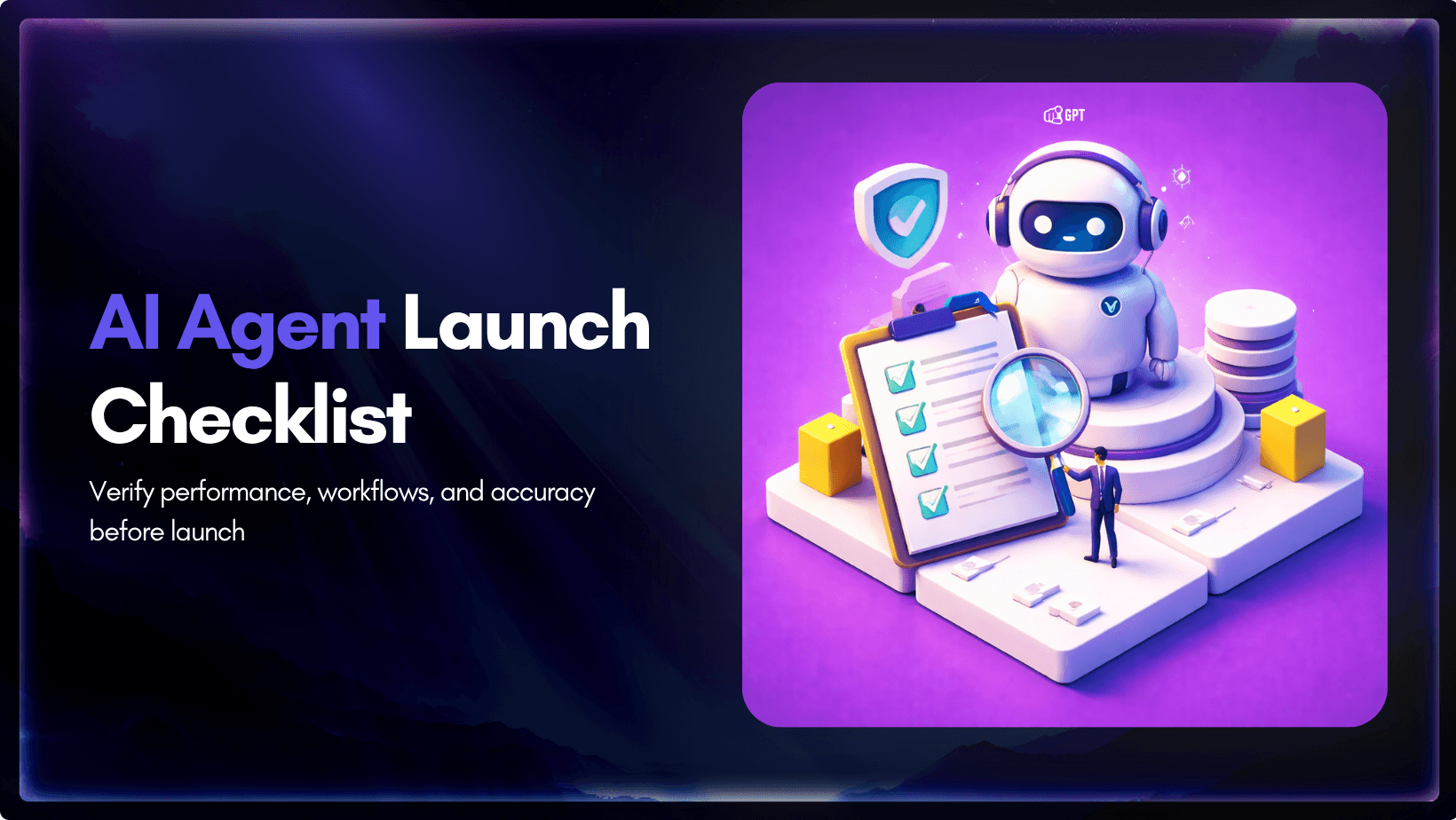
Pre-Launch Verification Checklist
| # | Domain | Checkpoint | Key question to answer |
|---|---|---|---|
| 1 | Grounding | Context grounding & hallucination controls | What is the measured hallucination rate, how is it defined, and does it trend over time? |
| 2 | Security | Security, access controls & privacy | How does the platform prevent prompt injection architecturally, not just monitor for it? |
| 3 | Oversight | Human-in-the-loop controls | Can escalation thresholds be configured per workflow, per risk tier, per regulatory domain? |
| 4 | Data | Data quality, integration & freshness | Can the agent access unstructured data in place, with lineage tracking, without proprietary lock-in? |
| 5 | Observability | Observability, monitoring & alerting | Does the platform run online evaluations on live production data, not just offline test sets? |
| 6 | Scale | Scalability, reliability & failover | What do documented stress test results show at 10x normal traffic, on quality, not just uptime? |
| 7 | Governance | Governance, auditability & regulatory alignment | Can the platform demonstrate EU AI Act readiness for every high-risk workflow today? |
Frequently Asked Questions
Conclusion
Launching an AI agent is more than a technical step. Success depends on the platform around the model, including how it controls hallucinations, enforces security, manages data, supports human oversight, and maintains visibility at scale.
Teams that succeed treat platform discipline as essential. They test grounding, simulate failures, enforce guardrails, and monitor performance continuously. They map workflows to risk tiers and configure human-in-the-loop thresholds based on stakes, not defaults.
Platforms like YourGPT provide the infrastructure, governance tools, and observability features needed to manage AI agents effectively. Agents that reach stable production deliver measurable ROI, lower workload, and better customer experiences.
Use this checklist before committing to a platform and revisit it whenever your agent’s scope changes, your data updates, or new regulations apply. Following these seven checks ensures consistent performance, reduced risk, and faster value from AI agents.
Ensure Your AI Agents Work Safely and Reliably
YourGPT helps you verify platform readiness, enforce guardrails, and monitor AI agents so they perform correctly in real-world conditions.
Full access for 7 days · No credit card required

Related posts