Which GPT-5.6 Model for Your Support Bot? Sol vs Terra vs Luna (2026)
TL;DR
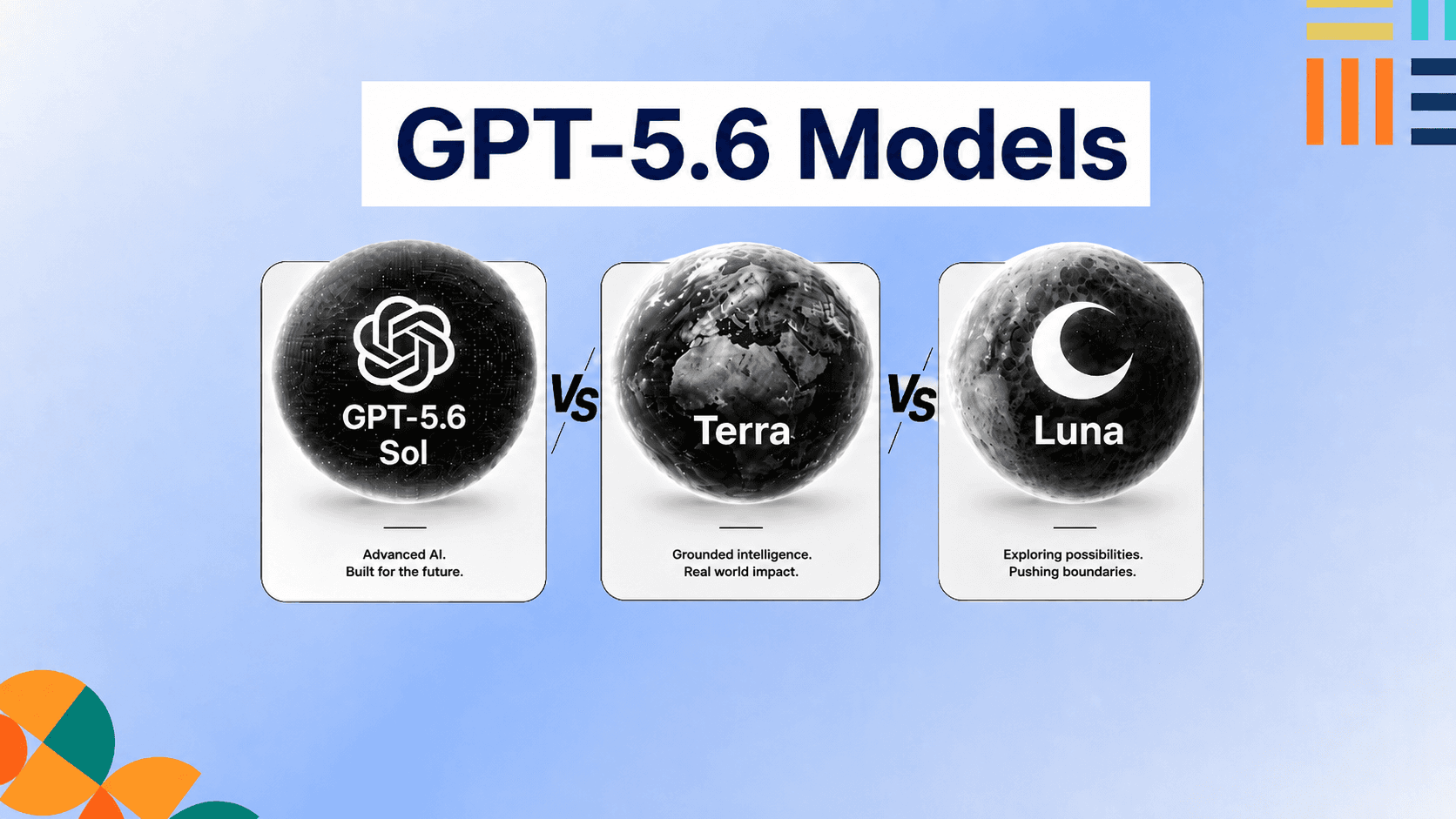
GPT-5.6 Sol is the top-tier option for the hardest support work, including complex reconciliation, multi-step agentic tasks, refunds, account changes, and other high-risk cases where a wrong answer creates real downstream cost.
GPT-5.6 Terra is the practical default for most support bots, handling order-status queries, product questions, returns, onboarding, and policy answers without spending Sol-level budget on every ticket.
GPT-5.6 Luna works best as the high-volume layer for intent classification, language detection, ticket routing, one-line FAQ answers, and post-conversation summaries.
Access is still the first constraint: GPT-5.6 launched as a limited preview for around 20 partner organizations through the API and Codex, while ChatGPT still runs GPT-5.5.
The best support setup is model routing, not a single-model deployment. Different ticket types need different tiers, and the biggest gains come from matching each layer of the queue to the right model.
Support teams spent the last two years learning that model choice is a cost lever, not a magic dial. Now OpenAI is handing them three levers instead of one, and the marketing copy alone is not enough to pick between them.
The launch has a specific shape worth understanding before spending. GPT-5.6 previewed on June 26, 2026 with three tiers named Sol, Terra, and Luna. The number identifies the generation, the name identifies the capability tier, and OpenAI plans to update each tier on its own cadence. That structural change turns “which model?” into “which tier for which workflow?” That is a routing question, and support workloads are exactly the kind of traffic where routing pays off.
This blog walks through what each tier is, where it fits inside a support bot, what it costs to run at realistic volume, what compliance flags to plan for, and where the risks show up. If the team is already deploying AI on tickets, chats, WhatsApp, or voice, the decision comes down to three questions. What tier handles the query well enough? What does that cost per resolved conversation? And what stops the model from doing something no one asked for.
What Is Actually Known About GPT-5.6
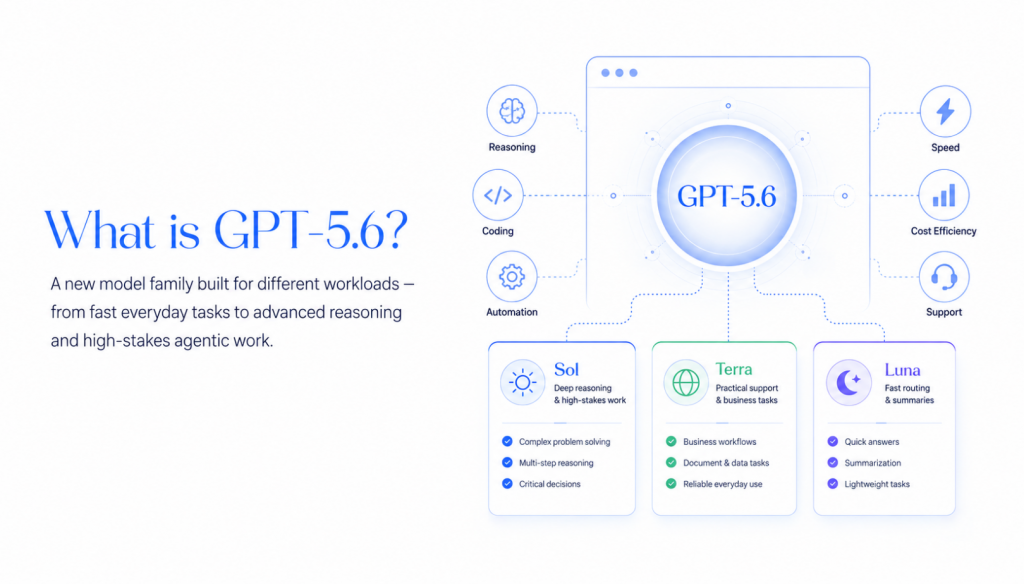
GPT-5.6 Sol vs Terra vs Luna is not just a branding question. OpenAI’s June 26, 2026 preview announcement describes GPT-5.6 as a three-tier model family with controlled rollout, stronger agentic capability, and a special access process shaped by U.S. government review of frontier cyber capability.
That caveat matters. Public details are moving fast, and OpenAI’s own model docs will lag the launch cycle for a while. Treat exact availability, per-model context windows, and Sol Ultra pricing as moving targets until OpenAI publishes stable developer documentation.
Access Is Still Limited
VentureBeat reported that OpenAI made GPT-5.6 available to roughly 20 vetted partner organizations through the OpenAI API and Codex, after coordination with the Trump administration on a cyber executive order framework. That means the first question is not only “which tier is best for a support bot?” It is also “can the team use it yet, and under what limits?”
If a production support workflow is being planned around GPT-5.6, build it so models can be swapped. A good agent stack should survive preview limits, rate limits, pricing changes, or a delayed public launch. On a platform where the model is a single configuration setting, a switch takes minutes, not a rebuild.
Pricing Changes the Decision
OpenAI’s help center confirms API pricing for Sol at $5 per million input tokens and $30 per million output tokens, with Terra at $2.50 input and $15 output, and Luna at $1 input and $6 output. Those numbers make the tiering easy to understand. Sol is not the model a team casually runs for every incoming ticket, and the reason has less to do with token math than with how support workloads actually behave. More on that below.
GPT-5.6 Model Comparison at a Glance
Three tiers under one generation. One flagship for the hard cases, one balanced model for the working queue, one budget tier for the top of the funnel.
| Model | Input / 1M tokens | Output / 1M tokens | Best For | Tier |
|---|---|---|---|---|
| GPT-5.6 Sol | $5.00 | $30.00 | Complex reasoning, agentic coding, high-stakes support actions, cybersecurity research | Flagship |
| GPT-5.6 Terra | $2.50 | $15.00 | High-volume customer support, internal tools, document analysis | Mid-tier |
| GPT-5.6 Luna | $1.00 | $6.00 | Fast everyday work, summarization, routine automation, classification, translation | Budget |
Prices verified against OpenAI’s help center and the launch announcement as of July 2, 2026.
The short version. Start with the cheapest tier that can complete the task reliably. Move up only when the ticket needs deeper reasoning, longer context, better tool use, or careful judgment on a high-risk action. This is the same model-choice logic that applies whenever a support platform lets teams pick between OpenAI, Anthropic, Google, and xAI in a single config.
Which GPT-5.6 Model Should You Choose for a Support Bot?
The right choice depends on the cost of a wrong answer. Ask what happens if the bot is slow, expensive, or wrong on this specific ticket type.
Choose Sol When the Answer Has to Be Right
Reserve Sol for support work where a weak answer creates real downstream cost.
- Complex ticket resolution. B2B billing disputes that span three linked invoices. Account reconciliation across multiple products. A tricky return-eligibility question that requires stringing together policy, order history, and a partial refund calculation.
- Long-horizon agent tasks. Multi-step workflows where the model has to hold many constraints across a chain of tool calls before it decides anything. Draft a resolution plan, verify against policy, calculate a partial refund, log the ticket, and send the summary email.
- High-stakes reviewer. Sol as the final approver in a model chain. Luna pulls context, Terra drafts the resolution, Sol reviews before a refund executes or an account change goes through.
- Regulated-industry casework. Financial services, healthcare, or life-sciences support where a policy misstep has compliance consequences.
Sol’s two new inference features matter here. The max reasoning effort setting gives the model additional time for deep analytical work. Ultra mode fans complex tasks out across coordinated subagents rather than running one long chain of thought. Both burn more output tokens, so wire them to specific escalation reasons, not to every Sol call.
Choose Terra for the Working Queue
Terra is the sensible default for the top 70 to 80 percent of a support queue. OpenAI positions it explicitly for customer support, internal tools, and document analysis, and prices it at approximately half the cost of GPT-5.5 with competitive performance on most business workloads.
- Order and shipping questions. Standard status lookups, delivery ETAs, tracking issues.
- Returns and refund workflows. Standard eligibility checks, RMA generation, refund processing where the rule is unambiguous.
- Product usage help. How-to questions grounded in one or two retrieval passages, in the tone of the brand.
- Onboarding walkthroughs. Guided setup, first-time-user support, account activation.
- Standard policy answers. Cancellation windows, warranty terms, subscription changes, upgrade paths.
- Cross-department internal support. HR, IT helpdesk, finance ops tickets that would have worked on GPT-5.5 in production.
Test Terra first when a ticket type needs judgment but not maximum reasoning. If Terra resolves the case cleanly and consistently, spending Sol-level budget on the same workload is a leak, not an upgrade.
Choose Luna for Triage and Volume
Luna belongs at the top of the funnel and at the end of every conversation.
- Intent classification and routing. Every incoming message hits Luna first. Classify intent, detect language, score sentiment, tag priority, pull the most likely retrieval passages.
- One-liner FAQ answers. Known short answers like store hours, tracking links, refund windows, business hours. Luna resolves and closes the turn.
- Real-time summarization. Ticket summaries at handoff, meeting-transcript recaps, long-thread compression for a human agent taking over.
- Bulk translation. Multilingual chats where a non-English message needs a clean English pass-through to the resolver, or the reverse.
- Post-conversation tasks. CSAT prompts, disposition tagging, drafting the follow-up email, generating internal notes.
- High-throughput prototyping. Any development or staging environment where token cost is the blocker to iteration speed.
At $1 per million input tokens and $6 per million output tokens, Luna is the tier that makes tiered routing economically obvious.
Sol vs Terra vs Luna: Feature-by-Feature Comparison
Pricing is one axis. Real deployment decisions need the full picture. Here is how the three tiers stack up on the technical dimensions that matter for a production support bot, starting with the benchmark that got the most attention at launch.
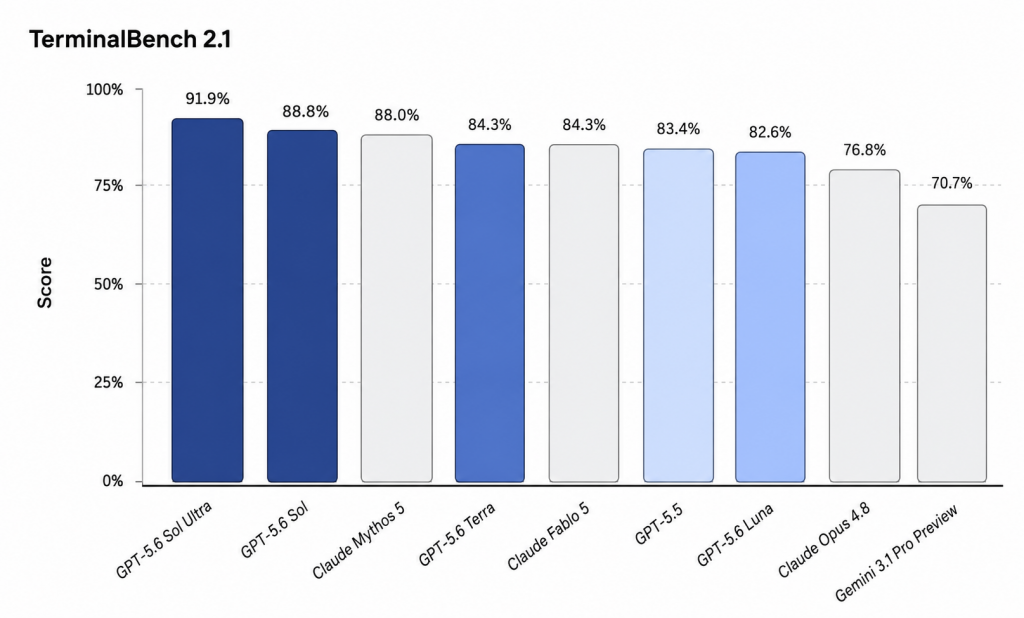
TerminalBench 2.1 scores as published by OpenAI. Sol Ultra leads the frontier at 91.9%, Sol at 88.8% sits ahead of Claude Mythos 5 at 88.0%, and Terra at 84.3% is essentially at GPT-5.5 level (83.4%). Luna at 82.5% lands slightly below GPT-5.5, which matches OpenAI’s framing of Luna as the fast, lowest-cost tier, not the accuracy tier.
The chart makes the tier logic obvious. For a support bot, Sol is the model to reach for when the answer has to be right, Terra is the model that gives GPT-5.5-class quality at half the price, and Luna is the fast triage layer that trades a small accuracy delta for the lowest cost per token in the family.
| Feature | Sol | Terra | Luna |
|---|---|---|---|
| Reasoning depth | Max reasoning + ultra/subagent mode | Standard | Standard |
| Coding benchmark (Terminal-Bench 2.1) |
88.8% base, 91.9% ultra (frontier-leading) |
GPT-5.5-class | Near GPT-5.5 |
| Cybersecurity capability | Mythos Preview-level on ExploitBench with ~1/3 the output tokens | High (per Preparedness Framework) |
High (per Preparedness Framework) |
| Biology and genomics (GeneBench v1) |
Stronger than GPT-5.5 with fewer tokens | Good | Good |
| Context window | Not officially published at preview | Not officially published at preview | Not officially published at preview |
| Token efficiency | ~1/3 fewer output tokens than Mythos Preview on ExploitBench | 2x cheaper than GPT-5.5 at similar quality | Lowest cost per token in the family |
| Agentic / multi-step tasks | Ultra mode (parallel subagents) |
Yes, standard multi-step | Lighter, better as a routing layer |
| API availability | Limited preview | Limited preview | Limited preview |
| Prompt caching | Yes, 30-min minimum cache life | Yes, 30-min minimum cache life | Yes, 30-min minimum cache life |
| Risk classification (Preparedness Framework) |
High (cyber + bio/chem) |
High (cyber + bio/chem) |
High (cyber + bio/chem) |
Benchmarks verified against OpenAI’s launch page and cross-referenced with VentureBeat. Context window is not stated as fact because OpenAI has not published one for the preview.
Three practical takeaways from this table. First, the token-efficiency story is real. Sol’s ~1/3 output-token advantage on ExploitBench means the effective per-task cost is often lower than the sticker price implies, especially in agent loops. Second, Terra’s “GPT-5.5-class at half the price” is the quietly important part of the launch for any team currently running GPT-5.5 in support. Third, the “High” risk classification on all three tiers is not a Sol-only concern. It shapes the governance conversation for the whole family.
Cost Matters More for Support Bots Than Chat
A chat session ends when the user stops typing. A support conversation keeps moving until it resolves. Support automation reads the ticket, checks context, pulls policy, calls an API to fetch the order, drafts the reply, waits for the follow-up, and often loops through two or three more turns before the case closes. That amplifies the difference between tiers.
That is why the best GPT-5.6 setup for support is not “always use Sol.” It is task routing.
A Practical Routing Pattern for a Support Bot
- Layer 1, Luna. Every incoming message hits Luna first. Classify intent, detect language, pull the most likely retrieval passages, and answer known one-liners directly.
- Layer 2, Terra. If the query needs a real answer grounded in policy, product docs, or an account lookup, hand off to Terra. This is the workhorse layer for the majority of a normal support queue.
- Layer 3, Sol. When Terra flags low confidence, the ticket touches a complex reconciliation, or the workflow needs multi-step agent behavior across several tool calls, escalate to Sol.
- Layer 4, Human. If Sol flags low confidence or the customer asks for a human, hand off with the full ticket context preserved.
Two operational levers move the bill further.
Cache the stable prefix. Support bots run a huge stable system prompt and a moderately stable retrieval prefix on every conversation. GPT-5.6 introduces explicit cache breakpoints, a 30-minute minimum cache life, and a 90 percent discount on cache reads. That turns the input side of the bill into a small fraction of what it would be uncached, from the second message onward.
Reserve max and ultra for specific triggers. These modes on Sol burn more output tokens. Wire them to a specific escalation reason, like “multi-account reconciliation” or “high-risk refund calculation”, so the escalation layer does not become the new cost problem.
Inside a platform like YourGPT AI Studio, this routing pattern maps to a small number of Logic and Trigger nodes plus a confidence-based Human Handoff node. The pattern is the same regardless of platform. The tools around the model do the work.
The Risk Section Every Support Team Has to Read
Skipping this part is how support bots end up in a screenshot on X.
OpenAI’s own system card for GPT-5.6 notes that the model is more likely than GPT-5.5 to act beyond what the user asked for, taking unrequested actions, though absolute rates remain low. For a coding sandbox, that trait is livable. For a bot answering customers unsupervised, an “occasionally does more than asked” model is the specific failure mode teams build guardrails against. The mitigation is not to avoid the model. It is to constrain the tool surface the model can call, tighten what actions can execute without human review, and log every tool call.
There is also a second layer to know about. OpenAI’s layered safeguards include real-time classifiers that can pause generation or slow responses in dual-use areas like biological and cybersecurity requests. Most support queries never touch those categories. A minority of legitimate requests may. OpenAI has been explicit that feedback during the preview will help reduce unnecessary blocks, so test the real ticket distribution against a preview endpoint before promoting a tier to production.
The safest pattern is old-school and works with every frontier model.
- Ground the answer in retrieval passages the team controls.
- Limit tool-call scope by conversation state.
- Require a confidence threshold before any write action (refund, cancellation, account change).
- Route every low-confidence case to a human with full context preserved.
That pattern is exactly what a well-configured AI helpdesk and Studio workflow layer exist to enforce, and it is why a platform-level deployment outperforms a raw API integration on the same underlying model.
AI Compliance and Governance for GPT-5.6 Support Deployments
Enterprise procurement teams will ask harder questions about GPT-5.6 than they asked about GPT-5.5. The compliance story shifted with the launch, and support leaders in regulated industries need to plan for it.
- Preparedness Framework classification applies to all three tiers. OpenAI’s system card rates Sol, Terra, and Luna at “High” capability in both cybersecurity and biological/chemical categories under its Preparedness Framework. Terra and Luna are not exempt because they are cheaper. Support teams in security, financial services, healthcare, or life sciences should assume new governance obligations may apply and factor them into vendor review.
- Government-coordinated rollout is the new normal. GPT-5.6’s staggered release, beginning with a small group of about 20 trusted partner organizations before broader availability, was coordinated with the U.S. government following a June 2, 2026 executive order on frontier AI safety review. This is the first time a major AI release has been structured around government oversight before public access. Businesses evaluating AI compliance for regulated workflows should track how this framework evolves as broader access is granted, and expect similar patterns from future frontier releases.
- Human-in-the-loop remains the responsible standard. For any GPT-5.6 deployment in regulated or high-stakes workflows, a human review stage before AI-generated output reaches customers or decision-making systems remains the responsible pattern. This is not GPT-5.6-specific. AI model output, from any provider, is an input to a decision, not the decision itself. Support platforms should support confidence-scored handoff, complete conversation logging, audit trails on tool calls, and role-based access control on sensitive actions.
- Adversarial testing is stronger, not perfect. OpenAI reports spending over 700,000 A100-equivalent GPU hours on automated red-teaming and multiple weeks of adversarial pressure testing before the limited preview. This is meaningful, and it is not a guarantee. No universal jailbreak was found in the reported testing, but no vendor claims total coverage. Support deployments should still design as if the model can be pushed off-policy in a small minority of interactions.
The practical shape of a compliant GPT-5.6 support deployment is the same shape a compliant GPT-5.5 support deployment already has. Grounded answers in company data. Guardrails on write actions. Confidence-based human handoff. Complete audit logging. What changes with GPT-5.6 is the seriousness of the procurement conversation and the paperwork burden in regulated verticals.
Turn Better Models Into Better Support
When broader GPT-5.6 access opens, the biggest upgrade will not be a smarter chatbot. It will be stronger models working inside a support workspace that already knows the brand, the policies, the integrations, and the escalation rules.
Step 1: Start With the Ticket Type, Not the Model
Name the actual support workflow before choosing a tier. Order-status lookups. Return processing. Subscription cancellations. Onboarding walkthroughs. Multi-account billing reconciliation. Then decide how much reasoning and risk control each workflow needs. Most queues have a long tail of routine cases and a small head of hard ones. That distribution is what tier routing is for.
Step 2: Give the Agent a Real Support Workspace
Put the workflow somewhere persistent, with access to the knowledge base, the helpdesk integration, the CRM, the order database, and the human handoff queue. A stronger model is more useful when it can act, check its work, and continue from context. Inside YourGPT AI Studio, that workspace is a set of nodes for API calls, custom Python or JavaScript, rich interactive messages, persistent memory across turns, and a one-click Human Handoff node with the full conversation preserved.
Step 3: Measure What the Bot Actually Resolves
The cheapest tier is not cheaper if it fails often. The strongest tier is not better if it is slow, gated, or unnecessary for the task at hand. The useful metric for a support bot is completed resolutions per dollar, not raw model benchmarks. Track deflection rate, escalation accuracy, CSAT on bot-resolved tickets, average handle time, and the retry rate when a tool call fails. Track them separately by tier, and the right home for each ticket type becomes obvious. That measurement loop is what turns any no-code AI agent into a system that gets cheaper to operate as volume grows.
Which GPT-5.6 model is best for a customer support bot? ▼
Terra is best for most of the support queue. It handles order-status queries, returns, onboarding, product questions, and standard policy answers at roughly half the cost of GPT-5.5. Reserve Sol for high-stakes cases like refunds, multi-step reconciliation, and long-horizon agent tasks where a wrong answer creates real downstream cost. Use Luna at the top of the funnel for intent classification, routing, translation, and one-line FAQ answers.
Is GPT-5.6 Sol, Terra, or Luna available in ChatGPT yet? ▼
Not during the preview. All three tiers launched on June 26, 2026 as a limited preview to about 20 vetted partner organizations through the OpenAI API and Codex only. ChatGPT still runs GPT-5.5, and OpenAI has not published a public waitlist. Broader availability is expected in the coming weeks.
How much cheaper is GPT-5.6 Terra than GPT-5.5? ▼
Terra runs at $2.50 per million input tokens and $15 per million output tokens, which OpenAI positions as roughly half the cost of GPT-5.5 with competitive performance on most business workloads. For a support bot currently deployed on GPT-5.5, migrating the working queue to Terra is the single biggest cost lever the launch offers.
Can I use different GPT-5.6 tiers for different parts of the same support conversation? ▼
Yes. Luna can classify intent and answer known one-liners, Terra can handle the resolution work, and Sol can review or take over high-stakes actions like refunds and cancellations. On an AI agent platform like YourGPT, this maps to a small number of Logic and Trigger nodes plus a confidence-based Human Handoff, so the tier for each ticket type becomes a settings-level decision, not a rebuild.
Is GPT-5.6 safe to run in an unsupervised customer-facing support bot? ▼
Only with proper guardrails. OpenAI’s own system card notes that GPT-5.6 is more likely than GPT-5.5 to act beyond what the user asked for, though absolute rates remain low. For support deployments, ground answers in retrieval passages the team controls, limit tool-call scope by conversation state, require a confidence threshold before any write action like a refund or cancellation, and route every low-confidence case to a human with the full ticket context preserved.
How does GPT-5.6 prompt caching cut support-bot costs? ▼
Support bots run a large stable system prompt and a moderately stable retrieval prefix on every conversation. GPT-5.6 introduces explicit cache breakpoints, a 30-minute minimum cache life, and a 90 percent discount on cache reads. That turns the input side of the bill into a small fraction of what it would be uncached, from the second message in a session onward. Cache writes are billed at 1.25x the uncached input rate, which is easily recovered by the first cache hit.
How do I migrate my support bot from GPT-5.5 to GPT-5.6 Terra without rebuilding it? ▼
On a platform where the model is a single configuration setting, the migration is a config change, not a rebuild. YourGPT already lets teams pick between OpenAI, Anthropic, Google, and xAI models in one setting and switch tiers inside AI Studio without touching the underlying workflow, retrieval sources, or channel deployment. The practical pattern today is to build the routing logic on GPT-5.5 on the platform, then flip the tier configuration to Terra when broader GPT-5.6 access opens.
Conclusion
The best answer is not really Sol vs Terra vs Luna. It is all three, used deliberately. Terra is the safest default for the working queue, Sol backstops the hard cases where judgment is the product, and Luna runs the triage layer at the top of the funnel. The model is a lever, not a decision.
That lever only pays off inside an agent platform that can actually route the traffic. YourGPT already lets teams pick between OpenAI, Anthropic, Google, and xAI models in a single setting, wire the tiered routing pattern inside AI Studio, ground answers with built-in RAG, and deploy across web, WhatsApp, Instagram, voice, and native mobile SDKs.
One caveat. GPT-5.6, including Luna, is not yet available to the general public. All three tiers are in a limited preview to about 20 partner organizations through the OpenAI API and Codex, with no ChatGPT access and no public waitlist. Broader availability is expected in the coming weeks. Until then, build the routing pattern on GPT-5.5 today, on a platform where flipping to Terra later is a settings change. Start a free trial and be ready the day access opens.

Related posts

Top 6 Yuma Alternatives & Competitors in 2026