Chatbase Review 2026: Pricing, Pros & Cons
TL;DR
Chatbase is a no-code AI agent builder trained on your own content, with plans at $0, $32, $120, and $400 per month on annual billing, plus a custom Enterprise tier.
Every self-serve plan includes exactly one AI agent. Extra agents cost $300 per agent per year, and removing the “Powered by Chatbase” badge costs $1,188 per year.
Billing runs on message credits that vary by AI model, so one reply can use 1 to 6 credits. The agent stops responding once credits run out unless auto-recharge is enabled at $40 per 1,000 credits.
Review platforms show a split picture: Capterra lists 4.3/5 and G2 lists 4.8/5 from a smaller review base, while Trustpilot has stayed near 2 stars due to billing and support complaints.
In 2026, Chatbase expanded beyond a simple website Q&A widget with voice agents, telephony, outbound WhatsApp campaigns, and a helpdesk module.
Chatbase built its reputation on one promise. Upload your docs, paste your website URL, and get a working support bot in about ten minutes. That promise still holds in 2026, and it explains the 10,000+ businesses on the platform, including names like IHG, Miele, and National Grid.
The harder questions start after setup. Message credits drain at different rates depending on the AI model you pick. The bot goes silent when they run out. A single AI agent is included on every plan, even the $400 one. And the gap between Chatbase’s software-review ratings and its Trustpilot score is wide enough to deserve its own section.
This Chatbase review breaks down the 2026 pricing structure, the features that actually shipped this year, where the platform delivers, and where teams tend to hit its ceiling.
What Is Chatbase in 2026
Chatbase is a no-code platform for building AI customer support agents trained on your own business content. You feed it website URLs, PDFs, Notion pages, or raw text, pick an AI model, and deploy the agent to your website widget, WhatsApp, Messenger, Instagram, Slack, or email. Founded in 2023 by Yasser Elsaid, the company grew as a bootstrapped one-founder project to roughly $8 million in annual recurring revenue by late 2025 with a team of about 18 people, without venture funding.
The product has moved well past its “ChatGPT for your PDFs” origins. In 2026 alone, the changelog shows voice AI agents launched in April, outbound WhatsApp campaigns in May, HIPAA-eligible workspaces for Enterprise customers, and a steady stream of new models, including Claude Opus 4.8 and Gemini 3.5 Flash. Chatbase now positions itself as a complete AI customer support platform rather than a chat widget.
The 2026 Vendor Stability Question, Broken Down
Status. Independent and bootstrapped. Chatbase has taken no venture funding and faces no acquisition, running at roughly $8 million ARR with a team of about 18 people as of late 2025.
What that buys you. No acquirer-driven roadmap shifts or migration deadlines of the kind Intercom Fin customers are currently navigating. The changelog shows near-weekly releases, so the small team is shipping, not stalling.
What’s actually unknown. How stable your plan terms are over time. AppSumo lifetime-deal buyers report being migrated to plans with fewer features than they purchased, and Chatbase’s own reply to a long-term customer on Trustpilot confirms pricing has been updated as the platform expanded.
What to do about it. Run the 7-day trial before any annual prepay, keep a record of the plan terms you signed up under, and treat multi-year commitments with the same caution you would apply to a vendor mid-acquisition.
Key Features of Chatbase
- Multi-source training. Agents learn from website crawls, PDF/DOCX/TXT/CSV uploads, Notion, Q&A pairs, and, on the Pro plan, historical Zendesk and Salesforce tickets. Auto-retraining is available from the Standard plan up.
- Model choice. The pricing page lists advanced models from OpenAI, Anthropic, Google, DeepSeek, Meta, Moonshot AI, Mistral, and Z.ai, and the company cites 35+ models across its providers. You can switch models per agent.
- AI Actions. The agent executes tasks rather than only answering. It can look up Stripe billing, check Shopify orders, book Calendly meetings, create Zendesk tickets, and hit custom webhooks. Plans cap enabled actions per agent at 5, 8, or 12.
- Chatbase Voice. Launched April 2026, the voice agent answers inbound phone calls over a Twilio integration using the same knowledge base, actions, and escalation rules as the chat agent, in 95+ languages.
- Helpdesk module. The Standard plan and up include a built-in helpdesk, plus native integrations with Zendesk, Intercom, Freshdesk, HubSpot, Salesforce, and Zoho Desk for teams that already run one.
- Analytics and improvement loop. Chat logs, confidence scoring, missed-question detection, and an “improve answer” workflow let you correct the agent over time. Pro adds source suggestions that flag gaps in your knowledge base.
Chatbase Pricing in 2026
Chatbase sells four public plans plus Enterprise. The prices below are the annual-billing rates verified against chatbase.co/pricing as of July 2026. Monthly billing removes the 20% yearly discount, which puts the monthly rates at roughly $40, $150, and $500 per third-party pricing trackers.
| Plan | Price Annual Billing | Message Credits/mo | AI Actions per Agent | Training Content | Seats |
|---|---|---|---|---|---|
| Free | $0 | 50 | 0 | 1 MB | 1 |
| Hobby | $32/mo | 500 | 5 | 10 MB | 2 |
| Standard | $120/mo | 4,000 | 8 | 20 MB | 3 |
| Pro | $400/mo | 15,000 | 12 | 40 MB | 5 |
| Enterprise | Custom | Custom | Custom | Custom | Custom |
Every self-serve plan includes one AI agent. The Standard tier is the step-up that matters, adding the helpdesk module, voice, telephony, outbound campaigns, API access, and auto-retraining. Enterprise adds SSO, white-labeling, custom roles, audit logs, SLAs, and HIPAA eligibility. Paid plans come with a 7-day free trial, and free-plan agents are deleted after 14 days of inactivity.
How Message Credits Actually Bill
Credits are the layer that turns a simple price list into a budgeting exercise. Every AI reply consumes credits, and the rate depends on the model. Economy models cost 1 credit per response, while premium models like Claude Opus burn around 5 credits per reply, with third-party testing putting the realistic range at 2 to 6 credits. A Standard plan running a premium model delivers closer to 800 replies a month, well short of the 4,000 the headline suggests.
Unused credits expire monthly. When the balance hits zero, the agent stops responding entirely unless auto-recharge is on, which bills $40 per 1,000 extra credits.
The Add-On Layer
Three add-ons routinely change the real monthly cost:
- Auto-recharge credits at $40 per 1,000
- Extra AI agents at $300 per agent per year (about $25 a month each)
- Removing the “Powered by Chatbase” badge at $1,188 per year (about $99 a month)
Here is a realistic scenario. A small support team on Standard wants a second agent for a separate product line and no vendor branding in front of customers. That stack runs $120 + $25 + $99, or $244 a month before any credit overages, roughly double the advertised plan price. Teams that outgrow Standard’s credit allowance face a jump straight to $400, since there is no tier in between.
Pros of Chatbase
- Genuinely fast setup. Hands-on reviewers consistently report a working FAQ bot live in under 15 minutes from doc upload to embedded widget, and Capterra’s ease-of-use sub-score sits at 4.6 out of 5. For a non-technical team, this is the platform’s core strength.
- Broad model selection. Few competitors let you switch between OpenAI, Anthropic, Google, DeepSeek, Meta, Mistral, Moonshot AI, and Z.ai models per agent, or compare them side by side in the playground before committing.
- AI Actions move beyond Q&A. Order lookups, billing checks through Stripe, Calendly bookings, ticket creation, and custom webhooks give the agent real task execution, and Zapier extends the reach to thousands of apps.
- Voice arrived without a separate product. The 2026 voice launch reuses the chat agent’s knowledge base, actions, and escalation logic for inbound calls, so teams avoid maintaining two configurations for the same questions
. - Wide channel coverage at one price. Website widget, WhatsApp, Instagram, Messenger, Slack, and email all deploy from a single agent, plus one-click installs for Shopify and WordPress.
- Privacy posture that holds up. SOC 2 Type II, GDPR compliance, and a stated policy that customer data is never used to train AI models address the most common objection to content-trained bots.
- Active shipping cadence. New frontier models typically land within weeks of release, and 2026 brought voice, telephony, outbound WhatsApp, a helpdesk module, and HIPAA eligibility. The product is clearly still accelerating.
Cons of Chatbase
- Credit billing makes costs hard to forecast. Model choice changes reply cost by up to 6x, credits expire monthly, and the agent goes silent when they run out. A successful bot that handles more conversations directly inflates the bill, or stops working at the worst time.
- One AI agent per plan. Even at $400 a month, a second agent costs extra. Agencies and multi-product companies feel this immediately at $300 per additional agent per year.
- Branding removal is priced like a plan. At $1,188 a year, hiding the Chatbase badge costs nearly as much as the entire Hobby subscription, and white-labeling proper is Enterprise-only.
- AI-driven flows only. There is no visual flow builder for deterministic conversation paths, which matters for compliance checks, structured intake, or multi-step booking flows where “the LLM will probably handle it” is not good enough.
- Answer quality depends entirely on your docs. Verified reviewers report the bot sometimes fabricates URLs on their own domain, and a Product Hunt user described an agent that invented facts instead of sticking to uploaded data. Messy or outdated content surfaces as confident wrong answers.
- Support is the weakest sub-score. Capterra rates Chatbase 3.8 out of 5 for customer service, its lowest category, and slow or unresolved responses are the most repeated complaint across platforms.
- Billing disputes recur in reviews. Trustpilot includes reports of continued charges after cancellation and denied refunds, and AppSumo lifetime-deal buyers describe plan migrations that stripped features they had paid for. Individually anecdotal, collectively a pattern worth checking against your own risk tolerance.
- Steep tier jumps. The path from $120 to $400 has no intermediate stop, so a team that outgrows Standard’s credits pays more than triple or leans on per-credit recharges.
Security and Risk
Chatbase agents ingest company documentation and, through AI Actions, can touch billing systems, order data, and CRM records. That makes the security layer a first-order evaluation item rather than a footnote.
- Certifications. SOC 2 Type II and GDPR compliance are displayed on the live site, with documentation in the self-serve trust center.
- Data handling. Chatbase states customer data is never used to train AI models. Retrieval happens at query time against your own content. Infrastructure runs on AWS with US data hosting, which EU-based teams should weigh against their data-residency requirements.
- HIPAA. As of a 2026 changelog update, Enterprise customers can sign a Business Associate Agreement, which automatically enables Zero Data Retention on the workspace. Regulated healthcare teams on self-serve plans are out of scope.
- Access controls. Domain allowlisting, rate limiting, and role-based permissions are available, with SSO and audit logs reserved for Enterprise.
- The operational risk nobody lists. Credit exhaustion is effectively an availability risk. If the balance hits zero without auto-recharge, the customer-facing agent stops answering. Treat the auto-recharge threshold as a production setting, not an optional add-on.
Chatbase Reviews and Ratings
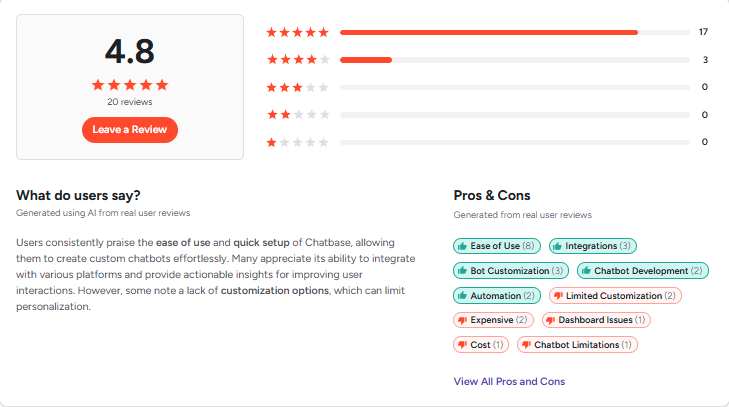
The rating spread on Chatbase is unusually wide, and reading it correctly matters more than the averages.
On software-comparison platforms, the picture is positive. Capterra shows 4.3 out of 5 across 73 reviews, with ease of use at 4.6 and value for money rated well, but customer service down at 3.8. G2 shows 4.8 out of 5, though from a small base of around 19 reviews, so treat it as directional. Praise clusters around setup speed, model flexibility, and lead qualification results.
Trustpilot tells a rougher story. The score has hovered near 2 stars across roughly 43 reviews, and the negative reviews concentrate on billing, refunds, disappearing training data, and slow support rather than core bot quality. The gap between platforms follows a familiar pattern. Buyers evaluating features review on G2 and Capterra, while existing customers reacting to a billing or support incident head to Trustpilot.
The practical takeaway is to test the specific failure modes reviewers describe before committing. Run the free trial with your real documentation, deliberately ask questions your docs answer poorly, and watch whether the bot admits uncertainty or invents something. Then check how fast support responds to a real ticket during the trial window.
How We Evaluated Chatbase
This Chatbase review draws on published sources rather than a hands-on trial account, so here is exactly what informed each judgment:
- Pricing and plan limits were verified directly against the live chatbase.co pricing page on July 9, 2026, including the plan comparison table and add-on prices.
- Feature claims were checked against Chatbase’s own changelog and press announcements, with third-party hands-on reviews used to confirm how features behave in practice.
- User sentiment combines Capterra, G2, Trustpilot, Product Hunt, and AppSumo, read together because the platforms attract different reviewer populations.
- Cost modeling uses Chatbase’s published credit and add-on prices plus independent teardowns of real deployment costs.
- Vendor performance claims, such as the marketed 80% ticket-resolution figure, are treated as vendor-reported ceilings rather than independent benchmarks, since no third-party audit of that number exists.
We did not assign a single weighted score. That would require a live test account running against real support traffic, and a desk-research review should not pretend otherwise.
Chatbase Alternatives
Chatbase fits best for small and mid-sized teams that want a docs-trained support agent live this week, can tolerate credit-based billing, and mostly need answers plus a handful of actions. Outside that profile, these alternatives come up most often:
- YourGPT for teams that want agentic workflows on top of Q&A. Its AI Studio adds a visual workflow builder with conditional logic, API calls, and custom Python or JavaScript, and plans start at $39 per month on yearly billing ($59 monthly) with multiple chatbots included on every tier rather than one.
- Botpress for developer teams that need deterministic conversation flows, deep customization, and an established platform, at the cost of a steeper build curve.
- Tidio for small ecommerce teams that want live chat and human agents in the same tool as the bot, since Chatbase leans automation-first.
- Intercom Fin for support organizations that want a mature helpdesk suite with per-resolution AI pricing, accepting a much higher total cost.
Chatbase Alternatives by Priority
The list above explains where each tool performs best. This table is designed for quicker decision-making, matching your main priority with the platform that fits it best.
| If Your Priority Is | Choose | Why |
|---|---|---|
| Multi-step workflows, multiple agents included, and voice plus chat in one platform | YourGPT | Visual AI Studio with code-level flexibility, 2 to 10 chatbots included per plan, and PhoneAI voice agents built in |
| Deterministic flow control and developer-grade customization | Botpress | Visual flow builder plus full API control for complex conversation logic |
| Live chat with human agents alongside the bot | Tidio | Built for SMB support teams working the inbox themselves |
| A full helpdesk suite with premium AI resolution | Intercom Fin | Deep ticketing and inbox maturity, billed per seat plus per AI outcome |
| The fastest possible docs-to-bot path with minimal configuration | Chatbase | Best-in-class setup speed if credit billing and single-agent plans fit your model |
For a wider field, the roundup of 10 Chatbase alternatives compares options across pricing, escalation, and workflow depth, and this buyer’s checklist for support AI agents covers what to verify in any platform before going live.
Frequently Asked Questions
Does Chatbase have a free plan?
Yes. Chatbase has a free plan that includes 50 message credits per month, one AI agent, 1 MB of training content, and no AI Actions. Treat it as a sandbox rather than a production bot, because agents on the free plan are deleted after 14 days of inactivity. Paid plans also include a 7-day free trial.
How much does Chatbase cost per month?
Chatbase costs $32 per month for Hobby, $120 per month for Standard, and $400 per month for Pro on annual billing. Monthly billing is about 25% higher, at roughly $40, $150, and $500. Real deployments can cost more once add-ons stack up, including branding removal at $1,188 per year and extra AI agents at $300 per year each.
What happens when my message credits run out?
When message credits run out, the Chatbase agent stops responding to customers until credits renew or you top up. Auto-recharge, billed at $40 per 1,000 credits, automatically adds credits when your balance falls below a threshold you set. If the bot is customer-facing, enable auto-recharge from day one and treat the threshold as a production setting.
Is Chatbase safe for customer data?
Chatbase holds SOC 2 Type II certification, is GDPR compliant, and states that customer data is never used to train AI models. Enterprise customers can sign a BAA for HIPAA-eligible workspaces with zero data retention. Data is hosted on AWS in the United States, which teams with EU data-residency requirements should factor into their evaluation.
Can Chatbase answer phone calls?
Yes. Since April 2026, Chatbase Voice can route inbound calls through a Twilio integration into the same agent that handles chat. It uses the same knowledge base, AI Actions, and escalation rules, with real-time conversations in 95+ languages. Voice and telephony features start on the Standard plan at $120 per month.
When is Chatbase the wrong choice?
Chatbase is a weaker fit if you need deterministic conversation flows, because it does not include a visual flow builder. It can also be limiting for teams running multiple products or clients, since every plan includes a single agent. For high-volume teams that need predictable billing, credit-based pricing can become harder to manage as traffic and model usage increase. Workflow-first platforms like YourGPT or Botpress may fit those cases better.
Is Chatbase Worth It in 2026
For a small team whose support questions live in reasonably clean documentation, Chatbase remains one of the fastest routes from nothing to a working AI agent, and the 2026 additions of voice, telephony, and a helpdesk module make the platform meaningfully more complete than it was a year ago. The $32 Hobby tier is a low-risk way to prove the concept.
The evaluation gets harder as usage grows. Credit-based billing rewards low traffic and punishes success, every plan includes a single agent, and the add-ons that make a deployment look professional can double the advertised price. Before committing to an annual plan, run the 7-day trial against your real content, calculate your credit burn with the model you actually intend to use, and price the full stack including branding removal and any extra agents. If the total starts approaching what a workflow-capable platform charges, compare the head-to-head with YourGPT before signing, because at that budget the single-agent, answers-first model stops being the obvious choice.
[IMAGE: Chatbase pricing page screenshot showing the four self-serve plans, no visible text overlay needed] [IMAGE: Illustration of message credits draining at different rates for economy vs premium AI models] [IMAGE: Side-by-side rating comparison graphic, Capterra 4.3 and G2 4.8 vs Trustpilot near 2 stars]

Related posts

Top 6 Yuma Alternatives & Competitors in 2026