Tidio Review 2026: Pricing, Lyro Limits & Who It’s Actually For
TL;DR
Tidio recently restructured its top paid plan, and many 2026 reviews still describe the old pricing model. Confirm current pricing directly on Tidio’s site before budgeting.
Lyro, Tidio’s AI agent, runs on Anthropic’s Claude rather than ChatGPT. Only the Premium tier carries a guaranteed resolution rate, well below the average Tidio advertises elsewhere.
Billing runs on three separate meters: billable conversations, Lyro AI conversations, and Flows visitors. Each carries its own quota and its own add-on cost.
Third-party reviews on G2 and Capterra are consistently strong, with pricing complexity as the most repeated complaint on both platforms.
Tidio fits small teams and e-commerce stores that want live chat plus a capable AI layer without enterprise procurement. Complex, multi-step support workflows tend to outgrow it fast.
Tidio has been the default answer to “cheap AI live chat” for small e-commerce stores for a few years now, and the reputation still mostly holds. What’s changed is the pricing underneath it. The platform quietly rebuilt its top self-serve tier sometime before March 2026, and a surprising number of 2026 reviews, some published within the last month, are still describing a plan structure that no longer exists.
That gap matters if a decision hinges on a specific number. This review works from Tidio’s own live pricing page rather than secondary aggregators, and it spends real time on the part most buyers skip past. That means what a Lyro conversation actually counts as, where the free tier runs out, and what happens to the bill once AI usage climbs past a demo.
The short version is that Tidio remains a better, low-friction pick for small teams. The complicated version is everything after this paragraph.
What Is Tidio?
Tidio is a customer communication platform built around live chat, a shared inbox, and Lyro, its AI agent. Tytus Golas and Marcin Wiktor founded the company in 2013 in Szczecin, Poland, and it now serves 300,000-plus businesses, most of them running Shopify, WooCommerce, or BigCommerce stores. Tidio raised a $25M Series B in May 2022, led by PeakSpan Capital with participation from Inovo Venture Partners and InPost founder Rafal Brzoska. Company trackers put current headcount at roughly 150 to 200 people, though they disagree on whether Szczecin or San Francisco is the main headquarters today. Treat any specific number here as an estimate.
Tidio’s product has three main parts, sold together or on their own. Customer Service covers live chat, ticketing, and a shared inbox. Flows is a no-code builder for scripted, rule-based automations. Lyro is the AI agent. A visitor might land in live chat, get passed to a scripted Flow for a simple question, or get an answer straight from Lyro, all inside the same widget.
The 2026 Lyro, Tidio’s AI Agent
Model. Tidio confirms that Lyro runs on Anthropic’s Claude combined with its own in-house models. It does not use ChatGPT, which Tidio presents as a deliberate choice focused on safety and reliability.
Resolution rate. Tidio states that Lyro reaches a 67% average resolution rate, often higher. That figure is a company-wide marketing average rather than a guaranteed result. The Premium plan carries a specific 50% Lyro AI resolution-rate guarantee, which is lower than the broader 67% headline figure commonly cited in Tidio reviews and marketing.
What counts as a conversation. A Lyro conversation starts when a customer interaction receives at least one AI reply. Multiple Lyro responses within the same issue still count as one conversation, even if the customer leaves the chat and returns later. Usage only increases when a genuinely new interaction begins.
Smart Actions. Lyro Smart Actions extend beyond text-based answers by letting the AI trigger connected workflows such as order lookups and lead qualification through integrated tools.
Standalone use. Lyro Connect lets teams use Lyro inside existing helpdesks such as Zendesk or Salesforce without moving their entire support operation to Tidio’s inbox. It is available on Plus and Premium plans and is billed separately from $0.50 per conversation, making it a different pricing model from the bundled Lyro AI Agent add-on.
Key Features of Tidio
Beyond Lyro, a handful of features round out the platform and shape day-to-day use.
- Lyro AI Agent. Trains automatically on a website, help center content, and uploaded files, then answers customer questions in natural language and hands off to a human when confidence drops.
- Flows. A visual, no-code automation builder for scripted, rule-based conversations, separate from Lyro and aimed at predictable, repeatable interactions like FAQ triage and lead capture.
- Unified inbox and ticketing. Live chat, email, Instagram, Messenger, and WhatsApp conversations land in one shared inbox, with tickets, tagging, and operator assignment built in.
- Shopify-native commerce tools. Cart preview, order history, product recommendations, and order management (cancel, update, refund) directly inside the chat widget, on Shopify specifically.
- Multilingual support. Automatic detection plus real-time translation across the conversations that flow through the inbox.
- Analytics dashboard. Conversation volume, resolution rate, and satisfaction scoring, with deeper reporting gated to higher tiers.
- Mobile and desktop apps. Native apps for responding to conversations away from a desk.
Tidio Pricing in 2026
Prices verified directly against tidio.com/pricing and tidio.com/faq as of August 19, 2026. Tidio’s pricing page defaults to annual billing (with 2 months free), so the headline numbers below are the annual-billed monthly rate, with the equivalent monthly-billed rate noted alongside. Confirm the toggle state before quoting a figure to a client, since the two numbers differ by roughly 17%.
| Plan | Price | Billable Conversations | Notable Inclusions |
|---|---|---|---|
| Free | $0/mo | 50/mo | Live chat, ticketing, 10 seats, and 50 Lyro conversations as a one-time allowance that does not renew |
| Starter |
$24.17/mo annual $29/mo monthly |
100/mo | 50 Lyro AI conversations as a one-off allowance, 100 Flows visitors, and basic analytics |
| Growth |
From $49.17/mo annual From $59/mo monthly |
From 250/mo | Advanced analytics, live typing preview, automatic chat assignment, and macros |
| Plus | $300/mo base, plus usage | Custom | Discounted usage rates, dedicated success manager, custom branding, and OpenAPI |
| Premium | Custom, contact sales | Custom | From 3,000 Lyro AI conversations, guaranteed 50% Lyro resolution rate, SSO, and compliance features |
The number worth sitting with is the Plus row. As of this writing, most 2026 pricing roundups, including several published within the past month, still list Plus at a flat $749/mo. That was accurate for most of 2025 and part of 2026. It stopped being accurate once Tidio restructured Plus to a $300/mo base plus usage-based billing sometime before March 19, 2026 (confirmed independently by a third-party pricing audit dated that day). A team quoting the old $749 figure from a review article, even a recent one, is working from stale data.
The Three-Meter Billing Structure
Three quotas run independently of each other, which is why Tidio’s actual monthly cost rarely matches the plan price on the page:
- Billable conversations. Any live chat, ticket, or social message that gets a human agent reply. Flows and Lyro responses don’t count against this meter.
- Lyro AI conversations. The AI Agent add-on starts at $32.50/mo annual ($39/mo monthly) for 50 conversations and scales up to 1,000. On the free tier, those 50 conversations are a one-time allowance, not monthly.
- Flows visitors. The automation add-on starts at $24.17/mo annual ($29/mo monthly) for 2,000 visitors reached.
Removing the “Powered by Tidio” branding costs an additional $16.67/mo annual ($20/mo monthly) on Growth, and comes included free starting on Plus.
A Starter-plan store that wants meaningful Lyro coverage is realistically paying $29 (Starter) plus $39 (Lyro, 50 conversations) before touching branding removal or Flows, which is the gap that shows up in G2’s “expensive” and “cost limitations” complaint categories (76 and 44 reviews respectively). None of this makes Tidio unusually costly against direct competitors. For teams comparing across the broader live chat and AI category, it’s simply a structure worth modeling against actual conversation volume rather than the sticker price alone.
Pros of Tidio
Tidio earns its reputation for a specific, checkable set of reasons.
- Genuine free tier. The Free plan runs indefinitely with 10 seats and full live chat, a genuinely usable product on its own.
- Fast, no-code setup. Milan G., a growth marketer at a small business, told G2 he had the widget live and a basic bot flow running in under an hour, without touching code, and specifically credited the mobile app for catching leads outside working hours.
- Claude-powered AI with a real safety story. Lyro running on Anthropic’s Claude gives buyers a specific, checkable technical fact to evaluate. Guillermo G., a CEO who switched from Landbot and ChatBot, wrote on Capterra that “the new Lyro works very well and the training is simple enough to get on production very fast.”
- Deep Shopify integration. Cart preview, order management, and product recommendations built directly into chat go beyond what most competitors offer for e-commerce specifically.
- Smart Actions beyond plain chat. Lyro Smart Actions can call external tools to check orders or qualify leads, putting Tidio ahead of several competitors still limited to answer-only chat.
- Consistent, high review scores. 4.6/5 on G2 across 1,959 reviews and 4.7/5 on Capterra across 590, both current as of August 2026, with ease of use as the single most-cited strength on both platforms.
- Transparent conversation accounting. Tidio only bills a conversation once a human agent replies. Unanswered spam or ignored messages never count against quota.
Cons of Tidio
The complaints cluster around a few well-documented pain points, the kind that show up again and again in G2’s own category data.
- Pricing structure genuinely confuses buyers. Three independent meters (billable conversations, Lyro conversations, Flows visitors) plus separate add-on pricing make the true monthly cost hard to estimate from the pricing page alone. G2’s own pro/con data shows this as the most repeated complaint category across dozens of reviews. Milan G., the same reviewer cited above for fast setup, flagged it directly in his review: “Lyro conversations are billed separately, so costs get unpredictable on higher-traffic sites.”
- The free Lyro allowance is a one-time grant. G2’s own con data shows 47 reviews citing usage limitations on the free version specifically, with users maxing out chat requests faster than expected once Lyro enters the picture.
- The Growth-to-Plus jump is steep. Growth tops out around $59/mo monthly for 10 seats, and Plus starts at $300/mo before usage, a roughly 5x base-price increase with no true self-serve tier in between.
- Limited customization on lower tiers. G2 reviewers cite restricted chatbot styling and workflow control (57 reviews) as a recurring frustration, particularly on Starter.
- AI limitations on complex, multi-step questions. Alamgir H., a Senior WordPress Engineer, put it plainly in his G2 review: Lyro AI worked better than he expected for repetitive questions, but he still flagged pricing and usage ceilings as the thing to watch once automations get more advanced.
- Lyro doesn’t natively combine with Flows in the same conversation. A visitor gets either the AI agent or a scripted Flow, never a blended handoff between the two, which limits how sophisticated a single automated conversation can get.
- Trustpilot sentiment runs noticeably lower than G2 or Capterra. Secondary trackers put Tidio somewhere between roughly 3.2 and 3.8 out of 5 depending on when the snapshot was taken, with billing surprises and cancellation friction as the recurring themes. Tidio’s own Trustpilot page returned a bot-detection block at write time, so this figure could not be independently confirmed and should be treated as directional.
Security and Risk
Lyro AI Agent handles live customer conversations, and Lyro Smart Actions can now take actions in connected systems like order lookups, both of which put real customer and order data through the platform. That makes the compliance picture worth checking before support operations depend on it.
- Certifications. Tidio’s own security page confirms a completed SOC 2 report and GDPR and CCPA compliance directly. A G2 vendor listing additionally reports EU-US Data Privacy Framework and CPRA compliance plus AI Pact participation, though those weren’t independently confirmed on Tidio’s own security page at the time of writing. No confirmation of ISO 27001 was found either way, so it isn’t claimed here.
- Compliance gating by tier. “Compliance” and SSO appear as explicit line items reserved for the Premium tier on Tidio’s own comparison table, which means a Growth or Plus account doesn’t automatically carry the full compliance package a regulated buyer might assume comes standard.
- Smart Actions and action risk. Once Lyro Smart Actions are connected to order or CRM systems, an AI agent is executing actions in a live system, well beyond drafting a reply. Review exactly which actions are authorized and where handoff to a human is required before enabling this for a live storefront.
- Data training scope. Lyro is described as working only from the content a business explicitly feeds it: website pages, uploaded files, FAQ entries. Answers stay scoped to that trained content, without pulling from a broader public knowledge base.
- What this means for buyers. A team in a regulated industry, or one running a vendor security review that requires SSO and formalized compliance documentation as a baseline, should confirm those specific items are included at the plan tier under consideration. Tidio’s general compliance badges don’t automatically apply the same way across every plan.
Tidio Reviews and Ratings
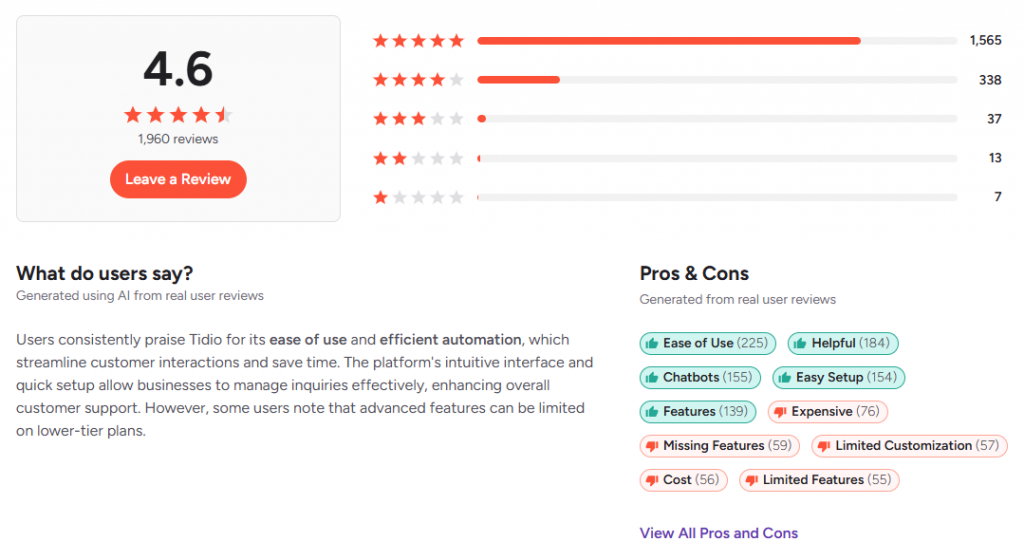
Tidio’s third-party scores are unusually consistent for a support platform, at least on the two review sites that matter most in a purchase decision.
G2 puts Tidio at 4.6 out of 5 across 1,959 reviews, as of August 13, 2026. Top praised categories: ease of use (225), support (184), AI chatbot quality (155), easy setup (154). Pricing dominates the complaints. “Expensive” appears in 76 reviews and “too expensive” in another 56, ahead of missing features (59) and limited customization (57).
Capterra shows a closely aligned 4.7 out of 5 from 590 reviews, updated August 3, 2026. Individual reviews echo the same pattern: praise for setup speed and Lyro’s handling of repetitive questions, complaints about the layered pricing and where the free plan’s limits sit.
Trustpilot tells a rougher story. Secondary aggregators place Tidio somewhere between 3.2 and 3.8 depending on the snapshot date, a spread wide enough to warrant reading a few recent reviews directly rather than trusting any single number, including this one.
How We Evaluated Tidio
This review draws on Tidio’s own live product and pricing pages, published G2 and Capterra review data, and cross-checked funding and company records. A hands-on trial account wasn’t part of this process.
- Pricing. Sourced directly from tidio.com/pricing and tidio.com/faq at write time, given how recently the Plus tier changed. Memory and secondary aggregators were not used for any figure.
- AI claims. Lyro’s model choice, resolution-rate figures, and conversation-counting rules checked against Tidio’s own ai-agent and help center pages.
- User sentiment. G2 and Capterra pulled directly, including grep-able pro and con category counts. Summarized impressions from other reviewers weren’t treated as a substitute.
- Company background. Founding, funding, and headcount cross-referenced across three independent trackers (Tracxn, PitchBook, TechFundingNews) given that individual sources disagreed on specifics.
- Security and compliance claims. Checked against Tidio’s own vendor-reported certifications, never assumed from general category norms.
We didn’t assign Tidio a single weighted score. That requires a live trial account run against real support volume, which desk research shouldn’t pretend to replace.
Tidio Alternatives
Tidio fits best for small teams and e-commerce stores that want live chat and a capable AI layer without an enterprise buying process. Outside that profile, a few alternatives come up consistently in the same comparisons.
- Intercom (Fin) for teams that need deeper multi-step reasoning and CRM context in the AI agent, and don’t mind per-resolution billing at $0.99 per outcome, a materially higher cost at real volume.
- YourGPT for teams that want AI automation across support, sales, and operations in one platform, priced from $39/mo on annual billing for the entry Essential tier, with a choice of model across OpenAI, Anthropic, Google, and xAI under one plan.
- Zendesk for larger teams that need mature ticketing, skills-based routing, and multi-brand support at a higher price point than Tidio targets.
- Crisp for teams that want flat, per-workspace pricing instead of Tidio’s three-meter structure, at the cost of a smaller native e-commerce feature set.
Tidio Alternatives by Priority
| If Your Priority Is | Choose | Why |
|---|---|---|
| AI automation across support, sales, and operations, not just chat | YourGPT | Usage-based pricing with model choice across four providers and agentic workflows across departments |
| The lowest-friction entry into AI live chat for a small store | Tidio | Genuine free tier, fast no-code setup, and deep Shopify integration |
| AI that reasons through complex, multi-step support questions | Intercom (Fin) | Deeper CRM and product context, at a materially higher per-resolution cost |
| Predictable, flat pricing instead of multiple usage meters | Crisp | Per-workspace pricing avoids Tidio’s three separate billing quotas |
| Enterprise-scale ticketing and multi-brand routing | Zendesk | Built for larger support organizations than Tidio’s SMB-focused target market |
A broader roundup of Tidio alternatives covers more platforms if integration depth or a different pricing model is the deciding factor, and the wider customer service AI chatbot comparison is worth a look for teams still narrowing the category itself.
Frequently asked questions
What is Tidio used for?
Tidio is a customer communication platform combining live chat, a shared inbox, and an AI agent called Lyro. Small businesses and e-commerce stores use it to answer customer questions, automate FAQ-style support, and manage conversations across channels like WhatsApp, Instagram, and email from one dashboard.
How much does Tidio cost?
Tidio runs Free, Starter, Growth, Plus, and Premium plans. Starter begins around $29/mo billed monthly, Growth from $59/mo, and Plus now starts at $300/mo plus usage-based billing. Lyro AI and Flows are separate add-ons with their own pricing, so the actual monthly cost depends on conversation volume across all three meters. Check Tidio’s live pricing page for the current figures before budgeting.
Is Tidio’s Lyro AI free to use?
The Free plan includes 50 Lyro AI conversations, but that allowance is a one-time grant rather than a monthly quota. Ongoing Lyro usage past those 50 conversations requires the paid AI Agent add-on, which starts at $39/mo monthly for 50 conversations.
How does Tidio compare to Intercom Fin?
Tidio targets small teams and e-commerce stores with a lower entry price and faster no-code setup. Intercom Fin targets larger support organizations that need deeper multi-step reasoning and CRM context, at a materially higher per-resolution cost.
What are the best alternatives to Tidio?
Common alternatives include Intercom Fin for complex support reasoning, Zendesk for enterprise ticketing, Crisp for flat per-workspace pricing, and YourGPT for teams that want AI automation across support, sales, and operations with model choice across OpenAI, Anthropic, Google, and xAI.
How does YourGPT compare to Tidio?
Both platforms offer AI-powered live chat, but the scope differs. Tidio focuses on customer support, with deep Shopify integration and fast no-code setup built for small e-commerce stores. YourGPT spans support, sales, and operations from one no-code builder, with model choice across OpenAI, Anthropic, Google, and xAI, plus AI Studio for building multi-step agentic workflows. A side-by-side comparison of both platforms breaks down the differences in more depth.
Is Tidio Worth It in 2026
For a small team or e-commerce store that wants live chat running the same day, Tidio still earns its reputation. The free tier is real, Shopify support runs deep, and Lyro running on Claude gives it a specific, checkable story most competitors can’t match.
The pricing story needs actual math beyond the sticker price. Three separate meters and a Plus tier that changed structure this year mean the page price is only a starting point. Model expected conversation volume before signing up, and re-check the live pricing page for the current figure.
Teams needing AI that reasons through multi-step problems or takes complex actions across systems are the ones most likely to hit Tidio’s ceiling first.

Related posts

Ada CX Review 2026: Pricing, Pros & Cons