Ada CX Review 2026: Pricing, Pros & Cons
TL;DR
Ada CX is a no-code enterprise AI platform for automating support across chat, voice, email, and messaging.
Pricing is quote-only, with no public plans or self-serve signup.
Admin reviews are generally positive, while end-customer feedback is more mixed.
Ada supports SOC 2 Type II, GDPR, HIPAA, PCI DSS, and AIUC-1 certification.
Ada CX shows up in almost every enterprise AI customer service shortlist. Almost every one of those lists skips the same detail. What does the platform actually cost? That question is worth answering before booking a single demo call.
Ada, styled Ada CX or ada.cx, is a Toronto company that spent the past two years rebuilding itself around large language models under what it now calls the Agentic Customer Experience (ACX) Operating Model. The pitch is agents that reason through multi-step service requests instead of following a fixed decision tree, deployed across chat, voice, email, and messaging from one platform.
This review breaks down what Ada CX does in practice, what its own site says about cost and what it leaves out, how real users rate the experience, and where the platform’s limits start to show once the sales call ends.
What Is Ada CX in 2026
Ada CX is an enterprise platform for building and managing AI agents that handle customer service across channels. Founded in 2016 by Mike Murchison and David Hariri, the company grew out of the founders’ own stint answering support tickets before they built software to automate the patterns they found there.
A few facts frame where Ada sits in the market today:
- Scale. By its own count, Ada has deployed more than 550 AI agents globally and powered over 6.4 billion interactions since founding, working with more than 350 businesses across ecommerce, financial services, travel, gaming, SaaS, and insurance.
- Notable customers. Names on Ada’s own pages include Monday.com, Pinterest, Square, Cebu Pacific, IPSY, YETI, and Malaysia Airlines.
- Recent growth. In March 2026, Ada reported more than 100 percent year-over-year revenue growth, 108 percent growth in agentic AI annual recurring revenue, and 146 percent net revenue retention, alongside a new partnership with Medallia and fresh AIUC-1 and PCI certifications.
- Market position. The platform sits at the enterprise end of the market. Ada’s demo page previously stated a floor of at least 300,000 annual customer service conversations for prospective buyers. That line is gone from the live page as of August 2026, though the sales-led process described below still filters toward larger teams in practice.
The 2026 Ada CX Pricing Model Question, Broken Down
Status. Unpublished. Ada does not show plan names, tiers, or dollar figures on its official website. Its pricing URL redirects visitors directly to a demo request.
What that means in practice. Ada uses a sales-led buying process. Its main calls to action are to speak with an expert or book a demo rather than select a public pricing plan.
What’s actually unknown. Ada does not publish a starting price or specific conversation rate. Its content indicates that billing is generally based on conversations rather than resolutions, but actual costs remain private.
What to do about it. Request a demo from Ada to get pricing based on your conversation volume, channels, integrations, and support requirements.
Key Features of Ada CX
Eight capabilities do most of the work here, spanning how the platform reasons through a request, where it can operate, and where its limits sit.
- Reasoning Engine. Launched in February 2026, a single intelligence layer across every channel, running two tracks at once so fast queries get instant answers while complex tasks process in the background.
- Playbooks. Multi-step workflows that execute real tasks, such as an address change or a refund, using live data instead of a fixed script, now running across voice as well as chat and messaging.
- Coaching. An operator corrects agent behavior in plain language after a conversation, and it applies going forward without a formal retrain, a feature G2 reviewers consistently rate as one of the more useful admin tools.
- Conversation Hub. Deploys agents across voice, messaging, email, and custom channels in 60-plus languages, with human handoff built in.
- Channel coverage. Eight or more surfaces, including web chat, voice, WhatsApp, SMS, Messenger, and Instagram DMs (self-serve since 2026), plus custom API integrations.
- Knowledge ingestion, with a real limit. Trains on connected knowledge bases, a website crawl, in-app articles, and the Knowledge API, but there is no first-party Confluence, Notion, SharePoint, or Google Docs connector, no document upload, and no way to train on past support tickets.
- Simulations. A pre-launch testing tool that runs hand-written test cases against a Playbook, rather than replaying a company’s actual historical ticket volume the way some newer competitors do.
Ada CX Pricing in 2026
Ada does not publish plan names, tiers, or prices anywhere on its official website. Visiting ada.cx/pricing redirects straight to a demo-booking page, and no dollar figure, starting price, or plan comparison appears on the homepage, the platform pages, or any of the industry-specific pages either.
What Ada’s site does say. Ada’s own blog explains its general billing philosophy: the default model bills per conversation rather than per resolution, on the reasoning that a per-resolution model can end up charging more as an AI agent gets better at its job. That post lays out the logic behind the two models but stops short of stating an actual rate for either one.
What Ada’s site does not say. A starting price, a specific per-conversation or per-resolution rate, a minimum contract size, or anything resembling a public plan structure. There is also no self-serve signup flow anywhere on the site. Evaluating Ada CX means booking a demo first.
The closest thing to a public number. Ada’s own listing on the Salesforce AppExchange states a default plan starting at $30,000 USD per company per year, described as a consumption-based model with economies of scale at higher volume, discounts available for nonprofits, and a 14-day free trial through that specific integration path. Salesforce hosts the listing, but the number comes directly from Ada’s own account.
What third-party trackers report beyond that. Reported figures vary by source but converge on a consistent range across several independent trackers:
| Pricing Signal | Reported Range | Source Type |
|---|---|---|
| Entry-level annual contract | ~$30,000/year | Ada’s own Salesforce AppExchange listing |
| Median annual contract, 96 tracked purchases | ~$70,001/year | Secondary (Vendr procurement data, cited by CorePiper) |
| Contract range across that same sample | $33,700 to $273,500/year | Secondary (Vendr, same source) |
| High-volume enterprise deployments | $100,000 to $300,000+/year | Secondary (Featurebase, Fin.ai, corroborated by a widely cited operator account on Reddit) |
| Per-resolution rate, exception billing | $1.00 to $3.50 per resolution | Secondary (multiple trackers) |
None of these third-party figures are confirmed by Ada’s own site, so they belong in a planning spreadsheet rather than a budget line, best treated as a rough sense of scale until Ada’s sales team confirms an actual number.
What to do about it. Treat the gap between what Ada publishes and what third parties report as a genuine signal worth asking about directly. Book the conversation through Ada’s demo page, and ask specifically whether the quote is conversation-based or resolution-based, and how a billable conversation gets defined, before assuming either model applies by default.
Pros of Ada CX
These themes recur most often across verified G2 reviews from the admins and support teams who actually run Ada day to day.
- Ease of use draws the most consistent praise. It is the single most-mentioned strength across Ada’s G2 reviews, appearing in 23 separate pros mentions, with reviewers repeatedly citing the drag-and-drop Playbook builder as approachable for non-technical support staff.
- Hands-on support during rollout. Dedicated onboarding and customer success teams show up across dozens of reviews as a differentiator, with one enterprise reviewer describing phase-one setup as complete in roughly three weeks with active guidance the whole way through.
- Playbooks handle real multi-step work. Reviewers across financial services, ecommerce, and travel companies describe using Playbooks for identity verification, order changes, and refund flows, a meaningful step past static answer trees toward actual task execution.
- Coaching creates a fast feedback loop. Multiple reviewers highlight correcting agent behavior in plain language and seeing the change reflected quickly, without waiting on a formal retrain cycle.
- Enterprise-grade security is a genuine differentiator at this end of the market. SOC 2 Type II, HIPAA, GDPR, PCI DSS, and AIUC-1 certification (detailed further below) give procurement and security teams a documented answer.
- Documented outcomes at scale. Published customer results include a 943 percent ROI within four months for IPSY, an 85 percent automated resolution rate for Endy during a major promotional period, and a 200 percent ROI for eSky Group running three travel brands across 50-plus markets on one team. These are vendor-published case studies that have not been independently audited, though they remain useful as directional evidence.
- Native Zendesk and Salesforce sync. Reviewers on both platforms describe help center content updates flowing into Ada automatically, cutting down the double maintenance that shows up with less integrated tools.
Cons of Ada CX
These are the friction points that show up most often, both on Ada’s own site and in what reviewers report once they are actually running the platform.
- Pricing is not published anywhere on Ada’s official website. There is no pricing page with real content, no plan names, and no self-serve way to see a number without booking a sales call first. That absence makes early budgeting difficult for a team just starting to evaluate the platform.
- Setup is a project, not a signup. There is no self-serve trial on Ada’s main site, only a demo request. Even reviewers who described the process positively frame it as weeks of guided configuration rather than an afternoon of setup.
- Knowledge sources stay narrower than some competitors. No first-party Confluence, Notion, SharePoint, or Google Docs connector, no document upload, and past support tickets sit outside the training pipeline entirely, so knowledge scattered across those systems needs manual consolidation first.
- Playbooks can trap a conversation. At least one enterprise G2 reviewer flagged that once a customer enters a Playbook flow, exiting cleanly is not always straightforward, calling it out as a top concern.
- Reporting and metrics customization lags the rest of the platform. This surfaces in 8 separate pros-and-cons summaries on G2, with multiple reviewers wanting to export raw data or build custom report views that are not currently available.
- Integration depth varies by helpdesk. Reviewers on Kustomer and Zoho Desk describe feature gaps that reviewers on Zendesk and Salesforce do not encounter, since Ada’s deepest integrations concentrate on those two platforms specifically.
- The end-customer experience does not match the admin experience. Trustpilot reviews, detailed further below, describe a meaningfully rougher experience than the G2 admin-side reviews, with lost context between conversation turns as a recurring theme.
Security and Risk
Ada’s agents touch customer conversation data, connect to core business systems such as CRMs and helpdesks through APIs tools, and on voice deployments handle live phone conversations. That scope makes security a genuine evaluation item here, deserving real scrutiny.
- Certifications. Ada holds SOC 2 Type II, HIPAA, GDPR, and PCI DSS compliance, and in February 2026 became the first AI customer service platform to earn AIUC-1 certification, the first standard built specifically for AI agent safety, security, and reliability.
- What AIUC-1 actually tests. The certification is administered by Schellman and requires more than 5,000 adversarial simulations across security, safety, reliability, data privacy, and accountability, plus quarterly technical retesting and annual renewal to stay current. Ada also served as a founding technical contributor to the standard itself.
- Data handling. Ada runs Zero Data Retention agreements with its LLM providers, so customer conversation data does not train third-party models. Companies retain ownership of their own conversation data, knowledge base content, and interaction logs, with data residency options available at the enterprise tier.
- Ongoing testing. Ada describes independent annual penetration testing at both the infrastructure and model layers, along with jailbreak testing and red-teaming aimed specifically at the AI model itself.
- The operational risk worth naming separately. Several G2 reviewers describe Playbooks a customer can get stuck inside once a flow has started, and Trustpilot reviewers describe conversations that lose context between turns. Neither counts as a security vulnerability in the traditional sense, but both are reliability gaps that shape whether an automated conversation actually resolves or quietly stalls out on the person at the other end.
Ada CX Reviews and Ratings
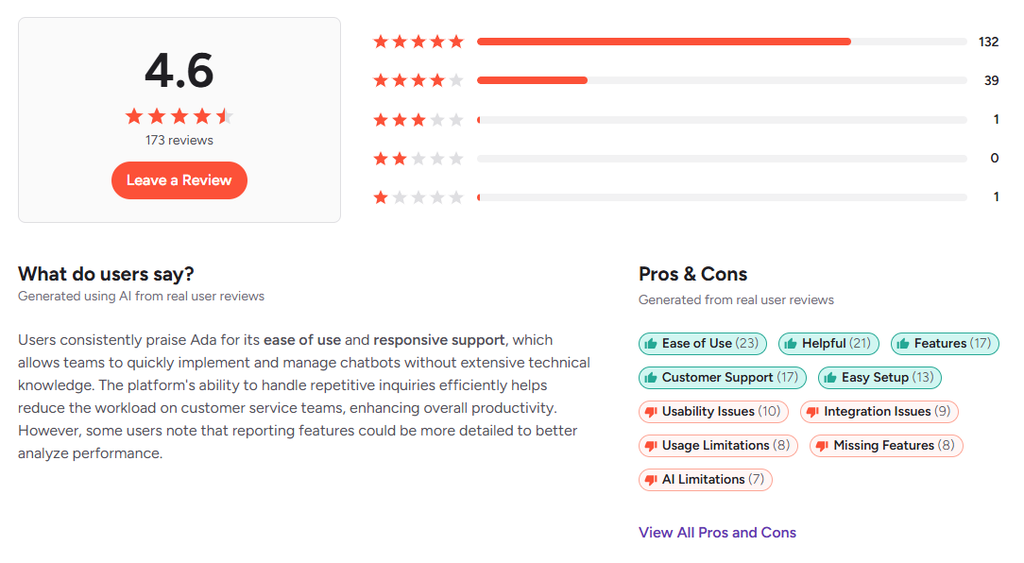
The rating gap between review platforms comes down to audience. On G2, Ada holds 4.6 out of 5 across 173 reviews as of August 2026, largely from the support ops managers and admins who configure and manage the platform day to day. Trustpilot tells a different story, sitting around 1.8 out of 5 from roughly 20 reviews as of mid-2026, mostly end customers who talked to an Ada-powered bot on someone else’s website, with lost context between turns and difficulty reaching a human as recurring complaints.
A support team handling high volumes of routine, well-scoped questions tends to land closer to the G2 experience. A team fielding complex, emotionally loaded conversations should weigh the Trustpilot pattern more heavily.
How We Evaluated Ada CX
This review draws on Ada’s own live pages, G2’s aggregated review data, third-party procurement trackers, and Ada’s public press releases. Ada does not offer self-serve access, so no hands-on trial account factored into this evaluation.
- Pricing was checked against Ada’s official pricing page (which redirects to a demo form), Ada’s homepage, Ada’s own blog post on billing philosophy, Ada’s Salesforce AppExchange listing, and multiple third-party procurement trackers including Vendr-sourced data. Figures without a direct Ada source are labeled secondary throughout, and everywhere Ada’s own site states nothing, that absence is reported as the fact itself.
- Feature and product claims were verified against Ada’s own platform, trust, and press release pages, cross-checked against G2’s product description (itself sourced from Ada) and third-party feature breakdowns for how capabilities behave in practice.
- User sentiment combines G2’s aggregated pros-and-cons data and individual reviews with Trustpilot ratings, read together specifically because the two platforms attract different reviewer populations.
- Security and compliance claims were checked against Ada’s own trust page and cross-referenced against AIUC-1’s certification requirements as published by the standard’s own operator.
- Customer outcome figures (ROI and resolution-rate percentages) are vendor-published case studies pulled from Ada’s marketing pages and G2 profile. None are independently audited, and they appear here as directional evidence only, since results at any other company depend on its own data, configuration, and volume.
No single weighted score gets assigned here. That would require a live account running real support traffic against the platform. Published documentation and aggregated review data cannot substitute for that kind of live testing.
Ada CX Alternatives
Ada fits best for large enterprises with high, steady conversation volume, budget for a sales-led rollout measured in weeks, and a support operation already concentrated on Salesforce or Zendesk. Outside that profile, a few alternatives worth comparing come up often.
- YourGPT for teams that want a self-serve start and published pricing. Essential, Professional, and Advanced plans run $39 to $349 per month billed annually across three self-serve tiers plus a custom Enterprise option, each including a visual AI Studio for multi-step workflows, native WhatsApp and Instagram deployment, and a 7-day free trial with no credit card required, none of which require a sales call to access.
- Voiceflow for teams that want granular, visual control over conversation logic and a model-agnostic runtime spanning several LLM providers, accepting the tradeoff of manually mapping flows over training an agent directly on business content.
- Decagon and Sierra for teams comparing large-enterprise, LLM-first platforms in the same conversation-volume range as Ada, worth a direct look at Decagon’s own alternatives given how closely they compete on the same enterprise shortlists.
Ada CX Alternatives by Priority
| If The Priority Is | Choose | Why |
|---|---|---|
| A self-serve start with published pricing and no sales call | YourGPT | Public pricing, a 7-day trial, multi-step AI Studio workflows, and native omnichannel deployment |
| Granular, hand-built control over conversation logic | Voiceflow | Visual canvas for deterministic flows plus autonomous reasoning across multiple LLM providers |
| Large-enterprise, LLM-first automation at Ada’s scale | Decagon or Sierra | Comparable enterprise automation scope and procurement profile for direct evaluation |
| An existing Zendesk or Salesforce investment with minimal new tooling | Ada CX | Deep native integrations with Zendesk and Salesforce make it a strong fit for those ecosystems |
Frequently Asked Questions
What Is Ada CX? ▼
Ada CX is a no-code enterprise agentic customer experience platform for automating support across chat, voice, email, and messaging. Its Reasoning Engine and Playbooks support multi-step customer service workflows.
How Much Does Ada CX Cost? ▼
Ada does not publish plans or pricing on its official website. Its Salesforce AppExchange listing shows a default plan starting at $30,000 per company per year, but an exact quote requires contacting Ada’s sales team.
Does Ada CX Offer a Free Trial? ▼
Ada does not offer a general self-serve trial on its main website. A 14-day free trial appears on its Salesforce AppExchange listing specifically for that integration path.
What Is the Ada CX Reasoning Engine? ▼
Launched in February 2026, Ada’s Reasoning Engine is its intelligence layer across channels. It can answer simple requests immediately while processing longer, multi-step tasks in the background.
Is Ada CX Secure and Compliant? ▼
Ada holds SOC 2 Type II, HIPAA, GDPR, and PCI DSS certifications. It also earned AIUC-1 agentic AI safety certification and states that it uses Zero Data Retention agreements with its LLM providers.
What Are Ada CX’s Biggest Limitations? ▼
Key limitations include unpublished pricing, a sales-led setup process, limited self-serve evaluation, and less flexible reporting. Knowledge integrations are also narrower than some competitors.
Is Ada CX a Good Fit for Small or Mid-Sized Teams? ▼
Ada is generally better suited to larger enterprises with high conversation volumes and resources for a guided rollout. Teams wanting published pricing and a self-serve start may prefer alternatives such as YourGPT.
What Are the Best Alternatives to Ada CX? ▼
Voiceflow is strong for granular conversation-flow control, while Decagon and Sierra compete at the enterprise level. YourGPT suits teams wanting multi-step AI workflows and omnichannel deployment with a self-serve buying process.
Is Ada CX Worth It in 2026
Ada CX earns its place among the best-known names in enterprise AI customer service. It genuinely handles complex, multi-step service work beyond simple FAQ answering, and the security stack (SOC 2 Type II, HIPAA, GDPR, PCI DSS, AIUC-1) gives regulated industries a documented answer.
The friction shows up early. Ada’s own site publishes no starting price, no billing model, and no self-serve way to try the product, so getting a number means booking a sales call first, setup runs weeks, and the gap between G2’s admin-side praise and Trustpilot’s end-customer complaints deserves real weight before signing anything.
Ada earns the sales conversation for a team already on Salesforce or Zendesk with steady volume and bandwidth for a multi-week rollout. Therefore, Everyone else should compare it against a self-serve alternative like YourGPT first.

Related posts