8 Best Drift Alternatives in 2026 (What Teams Actually Migrate To)
TL;DR
- Drift’s situation goes well past “post-acquisition.” Clari and Salesloft announced a formal sunset after a major OAuth breach pushed Drift offline for weeks.
- Two of the other usual “alternatives” are getting bought too. Salesforce closed its acquisition of Qualified and signed a deal to acquire Intercom, now Fin.
- The real split is budget and use case: ABM teams go to Intercom or Qualified, support-heavy teams go to YourGPT or HubSpot, budget-conscious teams go to Zoho SalesIQ or Landbot, and teams wanting a fast fix go to Knock AI or LiveChat.
- Drift conversation flows, routing logic, and CRM field mappings do not export, so every migration path below starts with a manual rebuild instead of a data import.
Drift customers spent most of 2025 fielding a very specific kind of bad news. First a breach that put customer data in the hands of an unknown actor. Then, seven months later, the platform got a formal sunset date. Both are confirmed by the company’s own communications and by security researchers who tracked the incident in real time.
So the question most teams are asking in mid-2026 has moved past whether to look at alternatives to Drift. It is about where Drift’s stranded customers go, and which of the obvious answers are themselves stable, since two platforms on every “Drift alternative” list are mid-acquisition by Salesforce right now. Recommending them without saying so is not a complete answer.
This guide covers the eight platforms teams are landing on right now, what each one costs, and where the fit breaks down, plus what Drift itself costs today, since that number moved after the Salesloft acquisition and still surprises people expecting their old contract terms.
Limitations of Drift
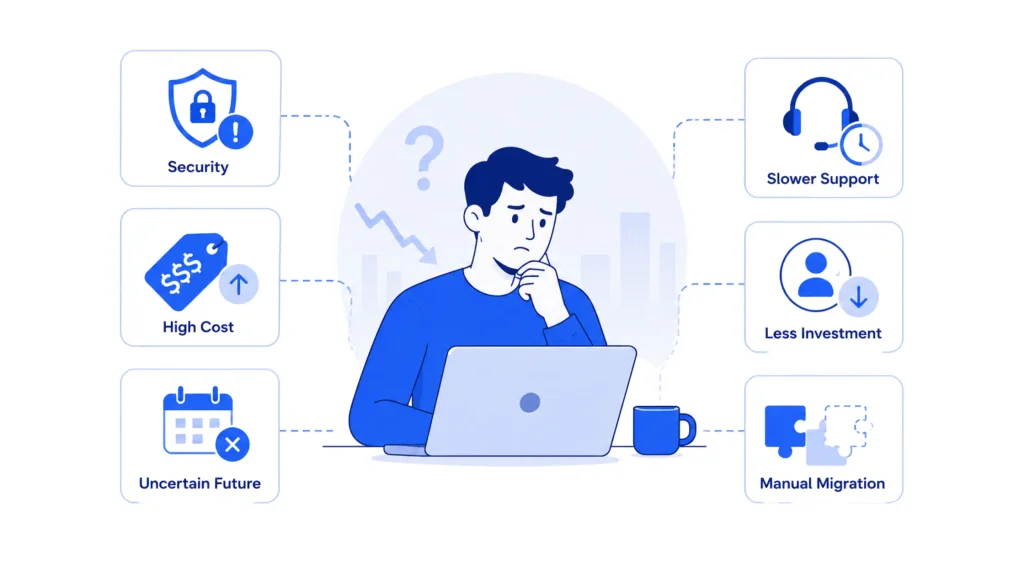
Drift’s limitations now go beyond individual features. Teams evaluating the platform also have to consider product continuity, security, pricing, and the level of ongoing investment behind it.
- Uncertain product future. After the Salesloft and Clari merger, Drift entered a wind-down phase. With no clear end-of-life date, teams may find long-term planning and migration timing difficult.
- Security concerns around integrations. The August 2025 breach, involving stolen OAuth tokens connected to Drift’s Salesforce integration, exposed data from hundreds of organizations. This raised broader concerns about third-party access and integration security.
- High cost for smaller teams. Drift pricing had reportedly reached a floor of around $30,000 per year, which can make it difficult to justify for SMBs and teams that only need core conversational sales or support features.
- Slower support experience. Some G2 reviewers reported slower support after the acquisition, which can be a problem for teams relying on Drift for customer-facing workflows.
- Reduced feature investment. New feature development has slowed or stopped as Drift is wound down, meaning teams should not expect the same level of product innovation or roadmap expansion.
- Migration requires manual rebuilding. Drift conversation flows, routing logic, and CRM field mappings do not transfer cleanly to other platforms. Teams moving away usually need to rebuild workflows manually rather than rely on a direct import.
Together, these limitations make Drift less suitable for teams looking for a platform they can confidently build around for the next several years.
Quick Glance
| Platform | At a Glance |
|---|---|
| Intercom (Fin) | Support-focused AI agent platform, with its acquisition by Salesforce currently pending. |
| YourGPT | No-code AI agent platform for support, sales, operations, and omnichannel customer experiences. |
| Qualified | Drift’s closest ABM-focused alternative, acquired by Salesforce in April 2026. |
| Knock AI | Conversational sales platform designed to move website visitors from chat to booked meetings faster. |
| HubSpot (Breeze) | AI-powered customer engagement built directly into HubSpot’s CRM and broader customer platform. |
| Zoho SalesIQ | Cost-effective live chat and engagement platform, especially suited to teams already using the Zoho ecosystem. |
| Landbot | Visual no-code chatbot builder that combines structured conversation flows with AI-powered automation. |
| LiveChat | Established live chat platform with AI-assisted replies and customer support automation. |
Best Drift Alternatives
Here are the best Drift alternatives for 2026, ranked on business stability, real-world cost, strength at Drift’s core use case, and setup speed. Pricing reflects the most recent figures found at the time of writing. Confirm current numbers directly with each vendor before budgeting.
1. Intercom (Fin)
Intercom rebranded around its AI agent, Fin, in May 2026, and a month later Salesforce signed a definitive agreement to acquire the company for roughly $3.6 billion. The deal is signed but not closed as of this writing, expected to complete around Salesforce’s fourth fiscal quarter of 2027, so Fin is still operating independently for now. It resolves support conversations end to end across live chat, email, phone, WhatsApp, SMS, and Slack, and it also runs a dedicated sales agent that can qualify and route inbound leads, which is the closer match to what Drift customers actually used.
Intercom has been one of the most recognized names in this category since 2011, long before “AI agent” was common vocabulary, which gives Fin a longer track record in support automation than most other entrants on this list.
Features:
- Fin AI Agent resolving conversations across chat, email, phone, WhatsApp, SMS, and Slack
- Separate Fin for Sales product handling proactive engagement, product discovery, and conversational qualification
- Native integrations with Salesforce, HubSpot, Marketo, Attio, Calendly, and Chili Piper
- Works on top of an existing helpdesk, Zendesk included, or Intercom’s own inbox
- Copilot add-on giving human agents an in-inbox AI assistant for drafting and summarizing
Limitations:
- Mid-acquisition by Salesforce, signed but not yet closed, so pricing and packaging could shift once the deal formally completes
- Fin’s per-outcome pricing stacks on top of seat costs, making total spend hard to predict at volume
- Fin for Sales, the closer match to Drift’s use case, is licensed separately from the core support agent
Pricing:
- Essential $19, Advanced $85, and Expert $132 per seat per month, billed annually
- Fin AI Agent billed separately at $0.99 per resolved outcome across every tier
- Standalone version for teams on another helpdesk runs the same $0.99 per outcome with no seats required
- Add-ons include Copilot at $29 per agent per month and a Pro add-on starting at $99 a month
Best for: Teams that need proven, high-volume support automation now and are comfortable evaluating a vendor mid-acquisition, since pricing and packaging typically shift only after a deal formally closes.
2. YourGPT
YourGPT is a no-code AI agent platform for customer support, sales, and operations. Instead of bolting a basic chat widget onto an existing stack, teams connect their business data, policies, and rules directly, so the AI agents can answer questions, resolve requests, qualify leads, guide prospects, and carry out multi-step actions across connected systems. YourGPT reports its Autonomous AI resolving over 90% of queries in production deployments, based on its own usage data.
The platform also learns over time, analyzing unresolved conversations to spot knowledge gaps and feed them back into agent training. Teams can start with a basic no-code setup and expand into more advanced capabilities as needs grow.
Features:
- Omnichannel deployment across web, WhatsApp, Instagram, Messenger, Slack, Telegram, Discord, and voice
- Support for 100+ languages with flexible model switching
- AI Studio for advanced, multi-step workflow automation
- Multi-agent coordination and human handoff for complex cases
- Deep integrations for real business actions through connected APIs
Limitations:
- Advanced setups require more configuration time
- New teams may face a learning curve with unfamiliar automation tools
- Business actions are limited by available integrations or APIs
- Teams needing only a basic FAQ chatbot may not need the full platform
Best for: Teams that want support, sales, and operations handled by one self-learning, no-code AI agent platform.
3. Qualified
Qualified is Drift’s closest direct peer, a Salesforce-native conversational marketing and pipeline generation platform built around Piper, its AI SDR. Salesforce signed a definitive agreement to acquire Qualified in December 2025, and the deal closed on April 1, 2026, so Qualified is now literally owned by Salesforce. That makes it a strange recommendation for a team leaving Drift specifically to get away from platform instability, but for teams already deep in the Salesforce world, native routing and pipeline attribution remain genuinely strong. Piper is designed to run full conversations rather than simple decision trees, adjusting its approach based on signals like a visitor’s account, campaign source, and prior engagement.
The platform was built for account-based marketing from the start, which shows in how deeply it ties buying intent back to specific target accounts rather than treating every visitor the same way.
Features:
- Piper, an AI SDR handling real-time website conversations, meeting scheduling, and personalized email
- Deep, native Salesforce integration for routing and account-based buying intent
- Account-based marketing tooling built for enterprise pipeline attribution
- Enterprise Reporting API and Salesforce Sandbox support on higher tiers
- Real-time buyer intent scoring that adapts engagement to returning visitors and target accounts
Limitations:
- Now owned by Salesforce as of April 2026, carrying the same platform-stability risk Drift customers are trying to leave
- No pricing published on the official site at any tier, so budgeting requires a sales conversation before any commitment
- Built natively for Salesforce, a weaker fit for teams running a different CRM
Pricing:
- Three tiers are named, Premier, Enterprise, and Ultimate, each unlocking more of the platform
- No dollar figures appear on any tier, every plan routes to “Schedule a demo”
- Integration into Salesforce Agentforce is likely to reshape packaging over the next several quarters
Best for: Salesforce-native enterprise teams with budget for inbound pipeline automation who are comfortable with the same acquisition dynamics they are trying to leave behind.
4. Knock AI
Knock AI replaces the chatbot-to-calendar model with a messaging-first AI SDR that qualifies buyers and books meetings inside the conversation itself, across the website, Slack, LinkedIn, and WhatsApp. Where Drift routed a visitor into a bot flow and pushed toward a future calendar slot, Knock AI is built to close the loop in the same session. Several teams cite this as directly solving Drift’s biggest weakness, high-intent conversations that went cold waiting for a scheduled call.
Conversations run through a private Slack channel by default, letting a buyer chat without creating an account while the selling team replies from its own workspace. It is a newer entrant than most names on this list, built specifically around replacing forms and static chat widgets with a conversational front door.
Features:
- Real-time qualification and objection handling inside the conversation
- Native meeting booking without leaving the chat thread
- Multichannel reach across website, Slack, LinkedIn, and WhatsApp
- Automatic routing to the right human rep or bot inside Slack
- Buyer enrichment and intent scoring feeding directly into routing decisions
Limitations:
- Inbound-only, so it does not generate outbound pipeline or find buyers who have not yet visited the site
- Entry pricing sits well above the cheapest tools on this list, and full qualification flows require the second tier
- A newer platform with a thinner public review base than more established alternatives
Pricing:
- Pipeline Foundation: $2,000 a month
- Pipeline Acceleration: $3,500 a month
- Enterprise Pipeline: custom
Best for: Teams whose main complaint about Drift was the gap between a chatbot conversation and an actual booked meeting, and who want that closed in real time rather than through a follow-up email.
5. HubSpot (Breeze)
HubSpot’s chat stack has three layers that get conflated in most comparisons: a free rule-based Chatflows builder, a live chat widget, and Breeze Customer Agent, the paid AI layer. For teams already on HubSpot CRM, conversations, contacts, and pipeline stages live in one system without a separate integration. HubSpot is also the most established name on this list by a wide margin, with a CRM footprint that predates the current wave of AI-first chat tools by more than a decade.
Breeze Customer Agent runs on a credit-based billing system shared across HubSpot’s other AI agents, so cost scales with usage rather than a flat per-seat AI fee. The tradeoff for that scale is a heavier, more bundled product than the purpose-built tools elsewhere on this list.
Features:
- Free rule-based Chatflows builder for lead qualification and routing
- Breeze Customer Agent for AI-resolved support conversations
- Native contact-timeline logging tied to every conversation
- Deep integration across HubSpot’s marketing, sales, and service hubs
- Breeze Copilot inside the CRM for drafting and summarizing alongside the AI agent
Limitations:
- Breeze Customer Agent is locked behind Professional or Enterprise plans, unavailable on Free or Starter
- Professional requires a one-time $1,500 onboarding fee and Enterprise a one-time $3,500 onboarding fee, on top of seat and credit costs
- Best value assumes a team is already committed to HubSpot as its CRM
Pricing:
- Free $0, Starter $7 per seat monthly (from $20), Professional $90 per seat monthly (from $100), Enterprise $150 per seat monthly, all discounted rates billed annually
- Breeze Customer Agent requires Professional or Enterprise, runs on credits at $0.01 each, 50 credits ($0.50) per resolved conversation
- Professional adds a one-time $1,500 onboarding fee, Enterprise a one-time $3,500 fee
Best for: Teams already committed to HubSpot CRM that want AI chat folded into the same system rather than run as a separate tool.
6. Zoho SalesIQ
Zoho SalesIQ is a live chat and visitor tracking platform built inside the wider Zoho product line, pairing chatbot automation with a codeless Zobot builder and native Zoho CRM sync. It is the budget option on this list by a wide margin, and it is a natural fit specifically for teams already running Zoho CRM or Zoho Desk, since the visitor-to-lead handoff happens without a separate integration step.
Zia, Zoho’s AI layer, adds an answer bot and chat summaries on top of the rule-based Zobot flows, and higher tiers let teams swap in Anthropic Claude, Google Gemini, DeepSeek, or a self-hosted LLM instead of relying on Zia alone. The platform was built for support and live chat first, so teams expecting Drift’s sales-pipeline routing out of the box will need to configure that behavior themselves.
Features:
- Codeless Zobot builder for automated chat and lead qualification
- Zia Agents that pull from records, webhooks, and third-party apps rather than just answering questions
- AI vendor choice across Zia, Anthropic Claude, Google Gemini, DeepSeek, or a self-hosted LLM
- Native sync with Zoho CRM and Zoho Desk
- WhatsApp, Telegram, Instagram, and Facebook Messenger channel support
Limitations:
- Free is capped at 100 chat sessions a month and includes no chatbot at all
- Multi-vendor AI and Zia Agents require at least the Basic tier, with the built-in (non-BYOK) Answer Bot reserved for Enterprise
- Not built for the sales-pipeline routing Drift customers relied on, closer to support and live chat than conversational marketing
Pricing:
- Free: ₹0, 100 sessions a month, 10K visitors, no chatbot
- Basic: ₹350 a month annual, 1,000 sessions, 1 chatbot, 50K visitors
- Professional: ₹750 a month annual, unlimited sessions, 5 chatbots, 100K visitors
- Enterprise: ₹1,200 a month annual, unlimited sessions, 10 chatbots, 200K visitors
- Confirmed live, per operator per month, billed annually
Best for: Small and mid-sized teams, especially ones already running other Zoho products, that want basic AI chat and visitor tracking without enterprise pricing.
7. Landbot
Landbot is a no-code, visual chatbot builder where conversations are designed as flowcharts on a drag-and-drop canvas, layering AI steps onto what started as a purely rule-based tool. It covers web, WhatsApp, and Facebook Messenger, with no native voice or phone channel. The visual-flow approach gives marketing teams fine control over exactly what a bot says at each step, a different philosophy from Drift’s more open-ended, AI-first conversations.
Pricing scales through four tiers, from a free Sandbox up to a custom Business plan, with WhatsApp and AI-chat allowances metered separately at each level. It reads as a builder for teams that want a defined script with AI used to fill gaps, rather than a fully autonomous agent.
Features:
- Visual flowchart builder for structured conversation design
- Native AI Agent mode running on OpenAI or Gemini models
- Knowledge base support for AI flows to query for answers
- WhatsApp Business API and Facebook Messenger coverage
- Zapier, Webflow, WordPress, Stripe, and Shopify integrations
Limitations:
- No native voice or phone channel
- WhatsApp is billed as an add-on toggle on top of the base plan price, not included by default
- Starter plan’s AI-chat allowance is limited before overage charges apply
Pricing:
- Free $0, Starter $36 a month, Professional $88 a month, Business custom, all annual-billed rates in USD, confirmed live on the pricing page
- Starter includes 500 chats and 100 AI chats a month across 2 seats, Professional includes 2,500 chats and 300 AI chats across 3 seats, Business scales to custom volume with 5-plus seats
- Overage charges apply once chat or AI-chat allowances are exceeded, and WhatsApp adds to the base price via a toggle at checkout
Best for: Marketing teams that want granular, visual control over conversation logic and only need light AI layered on top, at a lower cost than most of this list.
8. LiveChat
LiveChat is a live chat and customer messaging platform built by Text, formerly LiveChat Software, the same company behind ChatBot.com and HelpDesk.com, positioned as an established, no-frills live chat tool rather than an AI-first platform. The AI layer, Copilot, assists human agents with reply suggestions, chat summaries, and sentiment analysis, but a fully autonomous AI chatbot requires pairing it with ChatBot.com, a separate product at additional cost.
LiveChat publishes official comparison pages against Drift, Intercom, Zendesk, Crisp, and Tidio directly on its own site. Trusted by more than 35,000 companies, it reads as the most conservative pick on this list for teams that want proven live chat infrastructure first and AI as an add-on rather than the core product.
Features:
- Copilot AI Assistant offering reply suggestions, chat summaries, and sentiment analysis for human agents
- Traffic tracking showing visitor counts and behavior up to each plan’s limit
- Smart and manual chat routing with queue management
- SMS and Apple Messages for Business on higher tiers
- Native Shopify, WooCommerce, and BigCommerce integrations with a built-in sales tracker
Limitations:
- No native autonomous AI chatbot, ChatBot.com is a separate product starting at $52 a month
- Charges per user account created, whether or not that agent is actively logged in
- Starter plan is capped at a single user and 100 tracked visitors, tight for anything beyond a solo operator
Pricing:
- Starter: $19 a month per person billed annually, 1 user, 100 tracked visitors
- Team: $49 a month per person billed annually, unlimited users, 400 tracked visitors
- Business: $79 a month per person billed annually, 1,000 tracked visitors, advanced reporting and staffing prediction
- Enterprise: custom, adds SSO, HIPAA compliance, white label, and dedicated onboarding
- ChatBot.com, the separate AI chatbot add-on, starts at $52 a month
Best for: Teams that want established, reliable live chat infrastructure with light AI assistance for human agents, and are fine treating a fully autonomous chatbot as a separate purchase.
Side by Side Comparison
| Platform | Best For | Main Strength | Drift Replacement Fit | Key Limitation | Starting Price |
|---|---|---|---|---|---|
| Intercom (Fin) | High-volume support automation | AI support across chat, email, phone, WhatsApp, SMS, and Slack | Strong for support-first Drift teams; Fin for Sales adds qualification and routing | Salesforce acquisition is pending, and Fin for Sales is licensed separately | $19/seat/month + $0.99 per resolved outcome |
| YourGPT | Support, sales, and operations automation | No-code AI agents with multi-step workflows, omnichannel deployment, and business actions | Strong fit for teams that want lead qualification plus support and operational automation | Advanced workflows require more configuration and depend on available integrations or APIs | Not listed in this article section |
| Qualified | Salesforce-native ABM and pipeline teams | Deep Salesforce integration, AI SDR workflows, and account-based intent | Closest direct replacement for Drift’s conversational marketing and ABM use case | Now owned by Salesforce and less suitable for teams using another CRM | Custom pricing |
| Knock AI | Real-time sales qualification and meeting booking | Moves high-intent visitors from conversation to booked meeting in the same session | Good fit for teams replacing Drift’s inbound qualification and scheduling flow | Inbound-only and has a smaller public review base than established competitors | $2,000/month |
| HubSpot (Breeze) | Teams already using HubSpot CRM | AI chat, customer data, marketing, sales, and service in one CRM ecosystem | Strong replacement when Drift was mainly used alongside CRM-based lead and support workflows | Breeze Customer Agent requires Professional or Enterprise plans | Free chat tools; Breeze requires Professional from $90/seat/month |
| Zoho SalesIQ | Budget-conscious SMBs and Zoho users | Affordable live chat, visitor tracking, AI, and native Zoho CRM integration | Good lower-cost replacement for basic chat, qualification, and support workflows | Less focused on advanced sales-pipeline routing and conversational marketing | ₹350/operator/month for Basic |
| Landbot | Marketing teams that prefer structured visual flows | Drag-and-drop conversation builder with AI layered into controlled workflows | Good fit when teams want to manually recreate Drift playbooks with precise flow control | No native voice channel, and WhatsApp plus AI usage can add extra costs | $36/month for Starter |
| LiveChat | Teams that want reliable live chat with light AI assistance | Established live chat infrastructure with routing, tracking, and AI agent assistance | Best as a straightforward live-chat replacement rather than a full AI-first Drift substitute | Autonomous AI chatbot requires the separate ChatBot.com product | $19/person/month |
Security and Compliance Considerations
Every alternative on this list inherits the same access model that got Drift breached in the first place.
- The access in question is a script or integration sitting on a website, often connected to a CRM through OAuth tokens that persist far longer than a login session
- That is exactly what the August 2025 breach exploited. Attackers did not break Salesforce’s security. They impersonated a trusted, already-authorized connection and walked through the front door with credentials Drift itself had been granted
- Ask each vendor directly how OAuth tokens are scoped, whether access follows least-privilege principles by default, and how quickly they can revoke and rotate tokens if a downstream integration is compromised
- Ask whether support case data, the specific data type UNC6395 targeted since it often contains credentials and internal details, is treated with any special handling
- None of the platforms above have published a breach at this scale, a reasonable starting point rather than a guarantee, worth treating as an active question in vendor evaluation instead of an assumption baked into the decision
Frequently asked questions
Is Drift shutting down?
Drift is being wound down rather than shut off immediately. Clari and Salesloft confirmed the sunset on March 6, 2026. There is no announced cutoff date, though Drift has already stopped taking new customers and is not shipping new features.
Why did teams start leaving Drift before the official sunset announcement?
The bigger trigger for most teams was the August 2025 OAuth breach through Drift’s Salesforce integration, not the earlier Salesloft acquisition itself. The sunset announcement seven months later confirmed what many had already concluded on their own.
How much do Drift alternatives typically cost?
Pricing spans a wide range depending on category. Budget tools like Zoho SalesIQ and Landbot start under $50 a month, no-code platforms run from roughly $40 to $500 a month depending on tier, and enterprise platforms like Qualified are sales-led with no published rate card.
Can Drift conversation history and playbooks be exported to a new platform?
The conversational logic does not transfer. Playbooks, routing rules, and CRM field mappings have to be rebuilt manually in whichever platform gets picked. What can typically be pulled out beforehand is raw data, conversation transcripts, and contact records tied to Drift interactions, which are worth exporting before making a platform decision.
Which Drift alternative works best for small or budget-conscious teams?
Zoho SalesIQ and Landbot are the most budget-friendly options on this list. YourGPT sits a step above that group, adding support and operations automation alongside lead qualification, which the cheaper single-purpose tools do not cover.
Is YourGPT a good replacement for Drift specifically?
For teams whose main use of Drift was lead qualification tied to sales pipeline, YourGPT covers that use case through its no-code AI Studio, alongside support automation the original Drift setup did not include. It is not built for account-based marketing at Qualified’s depth, so heavily ABM-focused teams may still want an enterprise-specific tool.
Should teams wait for Drift’s official end-of-life date before migrating?
No official deadline has been set, and waiting for one has already worked against teams that tried it. Reported accounts of the March 2026 announcement describe a 60 to 90 day contract runway, and the safer approach is treating that window as the real deadline rather than waiting for a firm shutdown date.
Conclusion
The right Drift replacement depends on which job you were using it for, not which tool looks most similar on paper. Enterprise ABM teams fit Qualified. Support-first teams fit Intercom, HubSpot, or YourGPT. Teams that just want the visitor-engagement layer without an enterprise contract fit Zoho SalesIQ, Landbot, LiveChat, or Knock AI.
Pick based on the job Drift was actually doing for you, not the name on the invoice. Before you sign anywhere, pull your existing playbooks, routing rules, and CRM field mappings out of Drift now, while the product is still live and searchable. No platform migrates that logic automatically, and rebuilding it after the contract lapses is far harder than rebuilding it on your own timeline.
For a broader look at the category, see 10 Best AI and Live Chat Tools for Growing Online Businesses and 7 Best Customer Engagement Platforms.

Related posts

Ada CX Review 2026: Pricing, Pros & Cons