9 Customer Success Tools Compared for 2026
TL;DR
Customer success tools fall into two groups: dedicated CS platforms such as Gainsight, ChurnZero, Totango, Planhat, Vitally, and Custify, and support or AI-agent tools such as Freshdesk, YourGPT, and Intercom.
None of the six dedicated CS platforms publish list pricing, and third-party estimates can vary widely for the same tool.
AI agent adoption in customer service has grown sharply, with Salesforce’s move to acquire Intercom’s AI agent business pointing to where the market is heading.
AI agents work best alongside a CS platform by handling support volume that customer success teams should not need to manage manually.
Most customer success teams are still running the same health-score-and-spreadsheet workflow they had in 2022, except now the spreadsheet has a churn-prediction model bolted on. That gap between what CS platforms promise and what a small team can operate day to day is where a lot of 2026 buying decisions are getting made, especially for teams building out a broader retention strategy.
Nine tools show up on nearly every shortlist for a reason. Six are purpose-built customer success platforms, and none of them publish pricing that survives contact with a sales call. Freshdesk, YourGPT, and Intercom publish clear self-serve pricing, since ticketing and AI agent tools tend to sell that way even when a dedicated CSP doesn’t.
This guide breaks down what each tool actually does, what it costs as far as that’s knowable, and where AI agents fit into a CS stack that increasingly can’t be built on health scores alone.
Customer Success Tool Evaluation Criteria
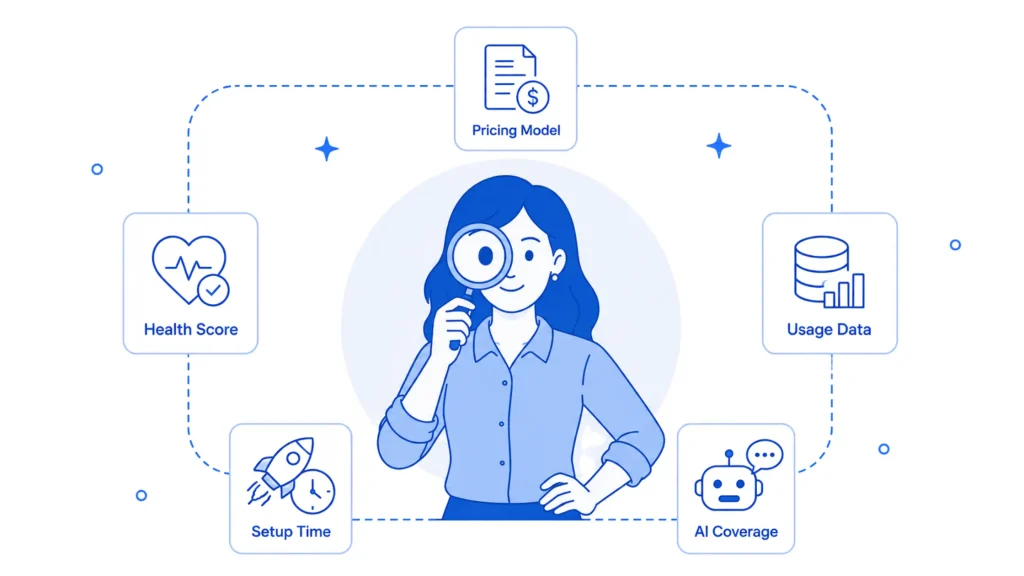
Before comparing platforms, it helps to know which questions separate them:
- Pricing model. Per-seat, per-account, or a flat platform fee. Account-based pricing (Planhat, Vitally, ChurnZero) can get expensive fast if churned accounts still count toward the total.
- Health scoring depth. Some tools ship usable default health scores. Others require weeks of configuration before the score means anything.
- Native product usage data. Platforms that pull usage signals directly (Vitally, ChurnZero) catch risk earlier than ones that rely on manual CSM input.
- Implementation timeline. Enterprise CSPs like Gainsight commonly take months to configure. Lighter tools like Vitally or Custify can be live in weeks.
- Where it stops. A CS platform tracks health and triggers playbooks. It generally doesn’t resolve a support ticket or answer a customer directly, which is the gap AI agents are now filling.
Quick Glance
| Platform | Best For |
|---|---|
| Gainsight | Enterprise customer success, health scoring, product analytics, and customer education |
| ChurnZero | Usage-driven health scoring and early churn detection |
| YourGPT | AI-powered support, sales conversations, and multichannel automation |
| Vitally | Product-led SaaS teams using a modern data stack |
| Totango | Enterprise customer success with composable CS products |
| Planhat | Account-based customer success and configurable dashboards |
| Custify | B2B SaaS teams needing faster customer success implementation |
| Freshdesk | Ticketing, help desk workflows, and AI-assisted support |
| Intercom (Fin) | AI-first customer support across chat, email, and voice |
Best Customer Success Platforms to Know
Nine tools worth knowing for customer success teams in 2026, covering health scoring, renewal workflows, and AI-driven support.
1. Gainsight
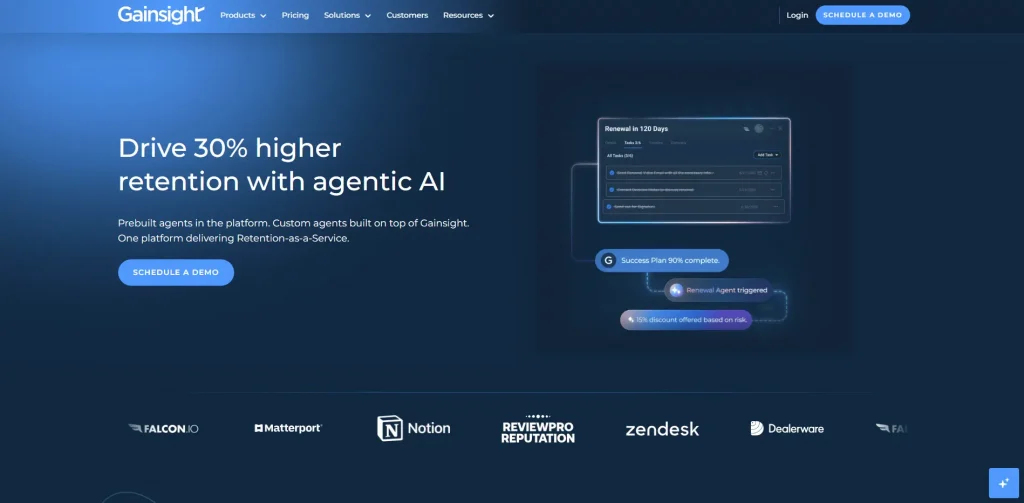
Gainsight is the platform most enterprise CS orgs benchmark against. Its CustomerOS suite bundles Gainsight CS (health scoring and playbooks), Gainsight PX (product analytics), Skilljar (customer education), and Staircase AI agents into one system built for companies managing thousands of accounts. Gainsight puts its own customer base at more than 2,000 companies, spanning onboarding through renewal inside a single connected workflow.
The platform also scores each account’s growth readiness and pushes qualified expansion leads directly into a company’s CRM, per Gainsight’s own product pages. Gainsight also states it was named a Leader in Gartner’s Magic Quadrant for Customer Success Management Platforms.
Features
- Configurable health scores pulling from CRM, product usage, and support data
- Automated playbooks triggered by health score changes
- Journey orchestration across onboarding, adoption, and renewal
- Deep Salesforce integration and enterprise-grade reporting
- Community management hub for customer self-service and engagement
Pros
- Broadest feature depth on this list, spanning health scoring, product analytics, customer education, and AI agents in one suite
- Deep Salesforce integration for teams already standardized on that CRM
- The default enterprise benchmark, so best-practice guides and experienced hires are easier to find than for smaller platforms
- Renewal-risk scoring updates continuously as new signals arrive, surfacing at-risk accounts earlier than periodic manual reviews
Cons
- No public pricing anywhere on the site, and third-party cost estimates for similar deals disagree by an order of magnitude.
- Implementation commonly takes months given the depth of configuration involved.
Pricing
- Custom, quote-based. Gainsight’s own pricing page publishes no dollar figures.
Best for. Enterprise CS teams with dedicated ops resources and the budget for a multi-month implementation.
2. ChurnZero
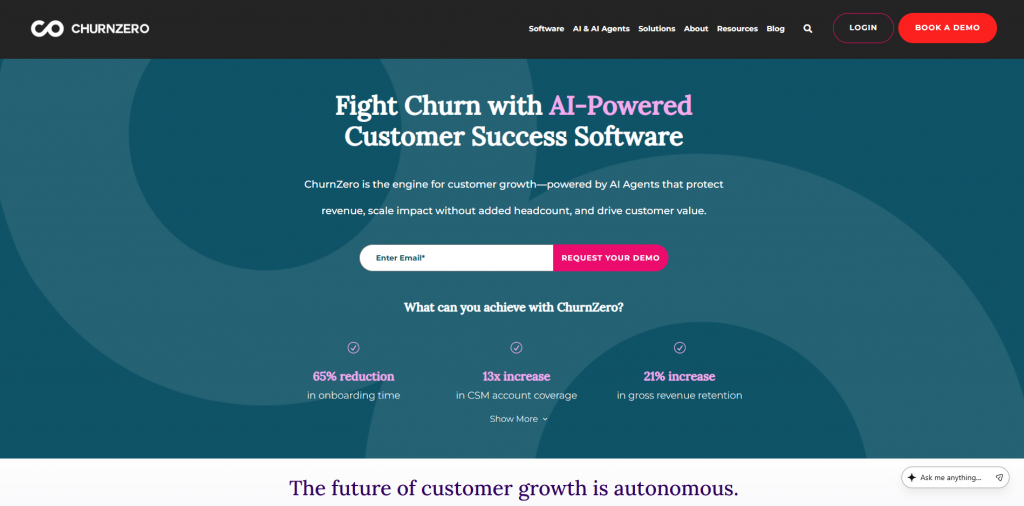
ChurnZero connects directly to a company’s product to read usage patterns in near real time. That’s its main differentiator from platforms that rely more heavily on manual CSM updates. Founded in 2015, the company is remote-first with offices in Washington, D.C. and Amsterdam. ChurnZero also markets itself as the first customer success platform to embed native, CS-specific generative AI directly into its workflows.
Success Insights, a machine learning feature, scans account data for churn patterns that health scores alone might miss. The platform connects to more than 70 business tools, per its own site.
Features
- Real-time usage tracking tied to health scores
- In-app messaging and automated customer journeys
- Segmentation and win/loss analysis
- Integrations with Salesforce, HubSpot, Intercom, and NetSuite
- AI agents that handle administrative work like account research and executive-ready account snapshots, part of the broader AI customer support trends shaping 2026
- WalkThroughs for in-app product tours and feature announcements
Pros
- Usage tracking catches risk earlier than platforms built around manual CSM input
- Broad integration list covering the CRMs and support tools most mid-market teams already run
- Positioned as the more accessible alternative to Gainsight without giving up usage-driven health scores
- AI agents handle repetitive admin work like account research, freeing CSMs for strategic account work
Cons
- No public pricing page. ChurnZero quotes every deal individually, and third-party annual-contract estimates range from roughly $10.7K to $180K, too wide to plan a budget around.
- Cost scales on two dimensions at once: customer accounts tracked and CSM seat licenses.
Pricing
- Custom, quote-based. ChurnZero’s official website publishes no pricing figures or tier names, and cost is based on the number of customer accounts tracked plus CSM seat licenses.
Best for. Mid-market SaaS teams that want usage-driven health scores without Gainsight’s implementation overhead.
3. YourGPT
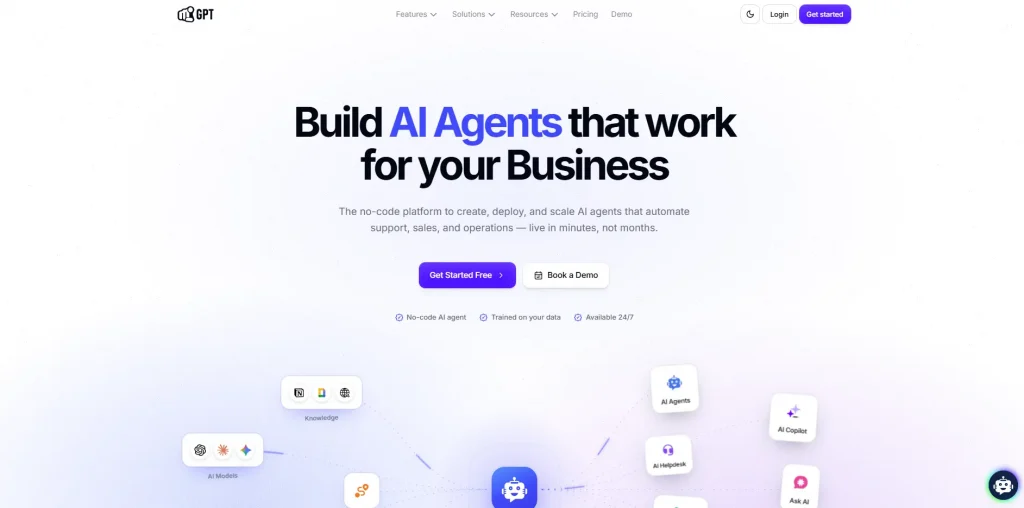
YourGPT is a no-code AI agent platform for automating customer support, sales, and operations across web, WhatsApp, Slack, and other channels from one system. It carries no health-scoring or renewal-forecasting layer of its own. Agents reason through multi-step requests, pull answers from a company’s own data, and take actions such as updating an order or escalating a conversation with full context. YourGPT’s 2.0 release added an AI Copilot that builds an agent from a plain-English description.
The platform also displays SOC 2 Type II and GDPR compliance badges on its site. Model providers are configured with privacy-first settings, including zero-day data retention, according to the platform’s own security documentation.
Features
- No-code agent builder plus AI Studio for multi-step workflows with API calls, custom code, and conditional logic
- RAG-grounded responses trained on company data, with self-learning from real conversations over time
- Human-in-the-loop handoff that preserves full conversation context
- Omnichannel deployment across web, WhatsApp, Slack, Discord, and native mobile SDKs
- Multi-modal support for text, voice, and image conversations
- Built-in analytics dashboard tracking sentiment, resolution rate, and CSAT
Pros
- One platform runs support and sales agents across every channel instead of stitching together separate point tools
- Model choice across OpenAI, Anthropic, Google, and xAI avoids lock-in to a single provider
- Published flat-tier pricing instead of a sales-gated quote, so costs are known before a demo
- Multi-modal support means agents handle text, voice, and image conversations without separate tools
- Built-in analytics dashboard tracks sentiment and resolution rate without a separate reporting tool
Cons
- No health-scoring or renewal-forecasting layer, so it doesn’t replace a dedicated CSP for account health tracking
- Answer quality still depends on how well the underlying knowledge base is organized, a known limitation across AI agent tools generally
Pricing
- Essential. $39/month billed annually ($59/month billed monthly)
- Professional. $79/month billed annually ($129/month billed monthly)
- Advanced. $349/month billed annually ($499/month billed monthly)
- Enterprise. Custom
- 7-day free trial included.
Best for. Teams that want AI agents absorbing support and sales ticket volume alongside a CS platform, not replacing one.
4. Vitally
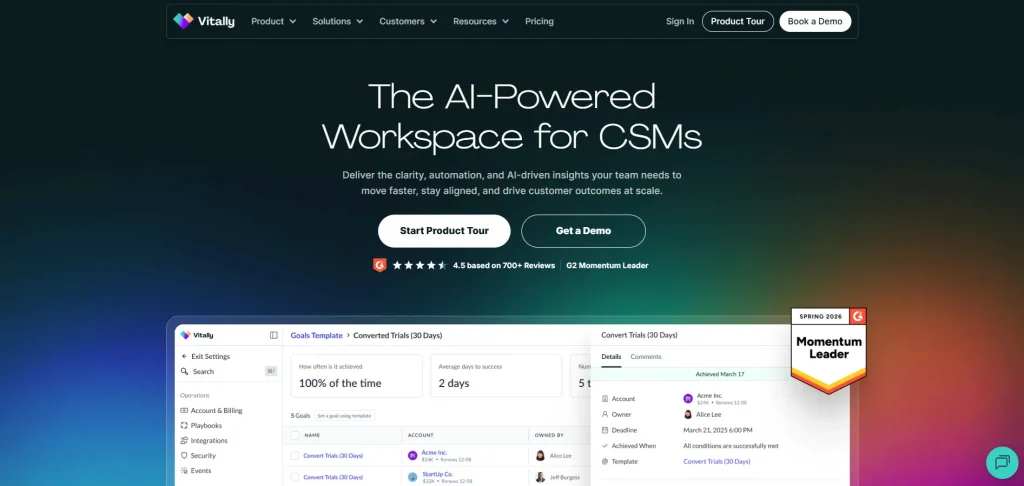
Vitally leans harder into modern data infrastructure than most competitors, with native support for warehouse tools like Snowflake and BigQuery alongside the usual CRM connections. Vitally counts SaaS companies like Segment, Zapier, and Productboard among its customers, per its own marketing materials.
The company also holds a 4.5 rating across more than 700 reviews on G2, shown as a badge on its own site. Vitally runs a free resource hub called Vitally Labs, offering churn and ROI calculators. It also publishes direct comparison pages against Planhat, Totango, Gainsight, and ChurnZero, several of the same platforms covered here.
Features
- Health scores and dashboards built around live product usage
- Hubs workspaces for organizing accounts by segment
- Automated playbooks and an AI copilot for CSM workflows
- Warehouse integrations for teams already on a modern data stack
- NPS and custom survey tools built into the platform
- Project management tools for tracking onboarding and account tasks
Pros
- Native Snowflake and BigQuery integrations give product-led teams a faster path from raw usage data to health scores
- Built-in AI copilot supports CSM workflows directly inside the platform
- Lighter implementation than enterprise-scale CSPs like Gainsight
- NPS and survey tools built in, removing the need for a separate feedback product
Cons
- No public pricing. Every tier is quote-only through a request-pricing form.
- Full health-scoring value depends on warehouse integration, a heavier lift for teams without that infrastructure already in place.
Pricing
- Custom, quote-based across three named tiers (Tech-Touch, Hybrid-Touch, High-Touch). Vitally’s own pricing page names these tiers but publishes no dollar figures for any of them.
Best for. Product-led or hybrid SaaS teams already invested in a modern data warehouse.
5. Totango
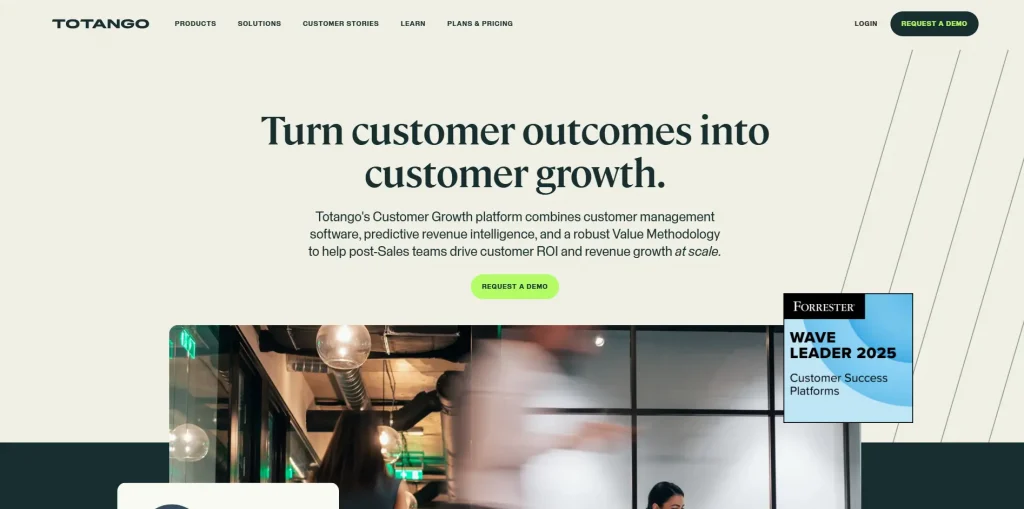
Totango restructured in 2024, merging with Catalyst and folding its AI churn-prediction engine into a separate product called Unison. What used to be one tool is now three: the core Totango CSP, Unison AI, and Catalyst. Totango lists customers including SAP, GitHub, Schneider Electric, and Aircall on its own marketing materials.
The company positions its combined offering as a Customer Revenue Optimization suite, aimed at large and fast-growing businesses rather than early-stage teams.
Features
- SuccessBLOCs, prebuilt workflow templates for common CS motions
- Unison AI for standalone churn prediction, usable with or without the core CSP
- Practitioner, contributor, and viewer seat tiers for flexible access control
- Slack-centric collaboration for CS teams
- Composable product architecture, so teams can adopt Unison AI or Catalyst independently of the core CSP
- Catalyst product line focused on growth and expansion motions
Pros
- SuccessBLOCs give teams a library of prebuilt workflows instead of building CS processes from scratch
- Unison AI can be bought and run on its own, even without the core CSP
- Seat tiers by access level (practitioner, contributor, viewer) help control cost as teams scale
- Named enterprise customers like SAP and GitHub signal the platform handles large, complex deployments
Cons
- Buyers now evaluate up to three related products, adding complexity to the buying process compared with a single unified tool.
- No public pricing on any of the three products.
Pricing
- Custom, quote-based. Enterprise and Premier tiers are listed with defined seat and account limits, but every tier routes to a sales call.
Best for. Enterprise teams that want a composable, mix-and-match platform over one monolithic system, and are comfortable evaluating three related products.
6. Planhat
Planhat prices per customer account rather than per internal seat, so every user on the team gets a login without inflating the bill. Planhat’s customers include Nasdaq, Dropbox, Trustpilot, and Nutanix, according to its own site. The company has also been named a Leader in Gartner’s Magic Quadrant for Customer Success Management Platforms.
Planhat also holds Cisco’s CX Partner of the Year 2025 award and appears in IDC’s MarketScape for Worldwide Customer Success Applications.
Features
- Unlimited users included on all plans
- Configurable dashboards and lifecycle tracking
- Add-on modules for advanced service, email marketing, and portals
- Health scoring with customizable weighting
- Open API and native integrations connecting to CRM, support, and product analytics tools
- AI-led automation spanning CRM, CSP, and professional services in one system
Pros
- Unlimited users on every plan avoids per-seat cost creep as the platform rolls out across departments
- Add-on modules let teams add capability without switching platforms
- Configurable health-score weighting adapts to different business models
- Open API supports custom integrations beyond the native connector list
Cons
- No public pricing. Every tier is quote-only.
- Some Enterprise contracts reportedly count already-churned accounts toward the total, which can inflate costs unexpectedly.
Pricing
- Custom, quote-based. Planhat’s own pricing page doesn’t name specific tiers, organizing instead around product lines (CRM, CSP, PSA) with add-on modules, and every option routes to an inquiry form rather than a dollar figure.
Best for. Teams that want to roll the platform out broadly across sales, support, and CS without per-seat cost scaling.
7. Custify
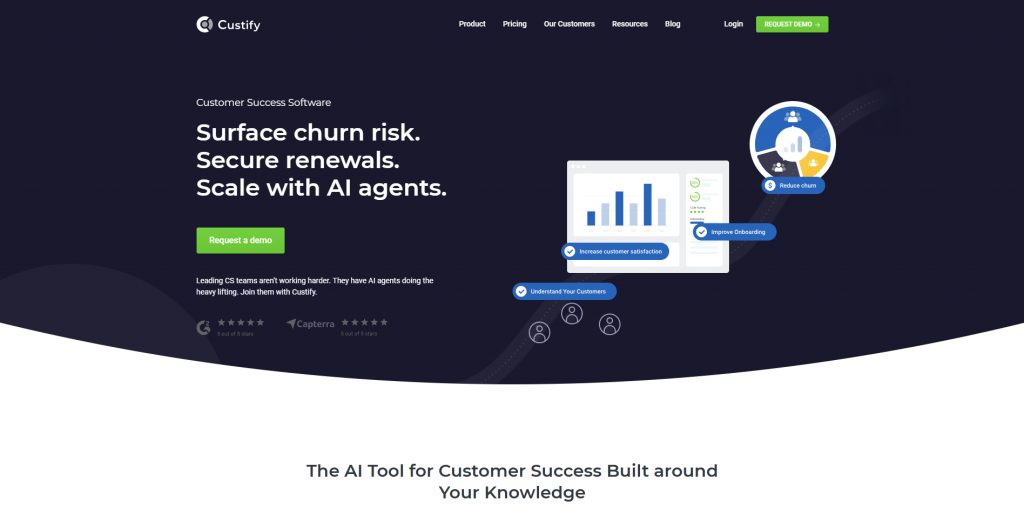
Custify is built specifically for B2B SaaS companies and stays narrower in scope than Gainsight or Totango, which shows up in both its feature set and its typical customer size. Custify maintains active GDPR compliance and holds ISO 27001 certification, per its own security page.
Customer testimonials on its site describe teams handling several times more accounts after switching from spreadsheets to the platform. The company has also picked up several G2 badges, including Best Support and Momentum Leader.
Features
- Configurable Customer 360 view combining product, billing, and support data
- Automation playbooks for renewal and onboarding workflows
- Customizable health scores
- NPS and CSAT survey tools built in
- Concierge Onboarding, a structured guided implementation process
- Calculated Metrics for combining data points into custom insights
Pros
- Purpose-built for B2B SaaS, so setup maps closely to CS workflows without heavy customization
- Built-in NPS and CSAT tools remove the need for a separate survey product
- Narrower scope keeps implementation faster than an enterprise-scale CSP
- Concierge Onboarding gives every new customer a dedicated, structured implementation path
Cons
- No official pricing page, so the commonly cited ~$899/month figure is a third-party estimate, not a confirmed number.
- No advertised free trial.
Pricing
- Custom, quote-based. Custify’s pricing page shows no dollar figures and routes every option to a demo request.
- The company does confirm no setup fees are charged, with onboarding handled through a guided implementation process.
Best for. Small to mid-market B2B SaaS teams that want core CS functionality without an enterprise implementation.
8. Freshdesk
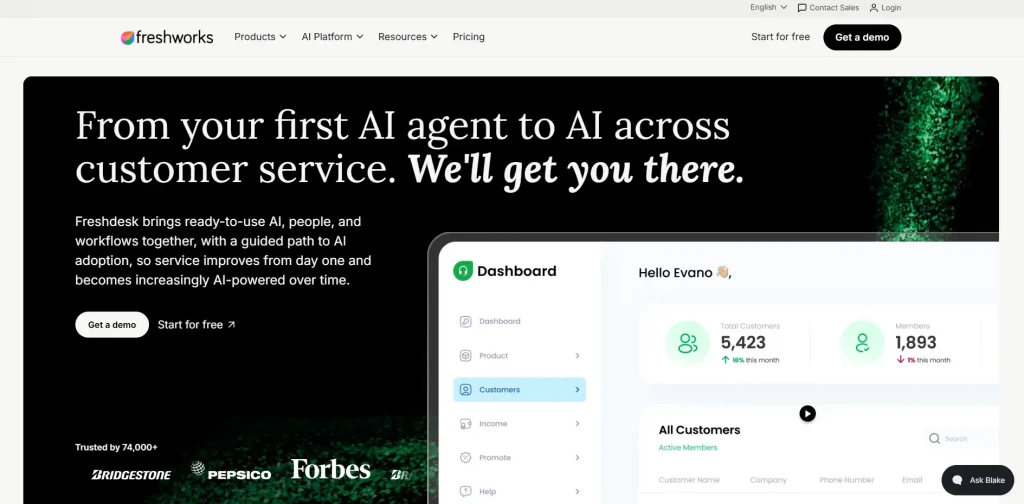
Freshdesk is a help desk first and a customer success tool second, but enough CS teams use it for support ticketing alongside a dedicated CSP that it belongs on this list. Freshdesk says it’s trusted by more than 74,000 businesses worldwide, including Pearson, PepsiCo, and Klarna. Freshworks, its parent company, also sells Freshdesk alongside Freshservice for IT teams and Freshsales for CRM.
The 14-day free trial opens with full Enterprise-tier access before a plan is chosen, and the company charges no cancellation fees regardless of when a subscription ends.
Features
- Tiered ticketing with automation and SLA management
- Freddy AI Copilot for agent-assist drafting and summarization
- Freddy AI Agent for customer-facing automated resolution, billed separately
- Freshdesk Omni as a separate omnichannel product bundling chat, WhatsApp, and social
- Multilingual help desk support across languages
- Custom dashboards and reporting on higher tiers
Pros
- Free plan and low entry price make it accessible before a team is ready for a dedicated CSP
- AI add-ons are optional rather than bundled, so teams can start without them
- Large integration ecosystem through Freshworks
- Custom dashboards give visibility into performance without a separate BI tool
Cons
- Freddy Copilot and Freddy AI Agent are billed as separate add-ons, so real cost climbs past the advertised per-agent price once AI is turned on.
- Full omnichannel support requires the separate Freshdesk Omni product, not the base Freshdesk plan.
Pricing
- Free plan available.
- Growth. $19/agent/month billed annually
- Pro. $55/agent/month billed annually
- Enterprise. $89/agent/month billed annually
- Freddy AI Copilot adds roughly $29/agent/month. AI Agent sessions run roughly $49 per 100 sessions past the included allowance.
Best for. Support-heavy teams that need ticketing and a knowledge base more than health scoring, and want a lower entry price than a dedicated CSP. For more options in this category, see the full AI help desk roundup, or a direct comparison against YourGPT.
9. Intercom (now Fin)
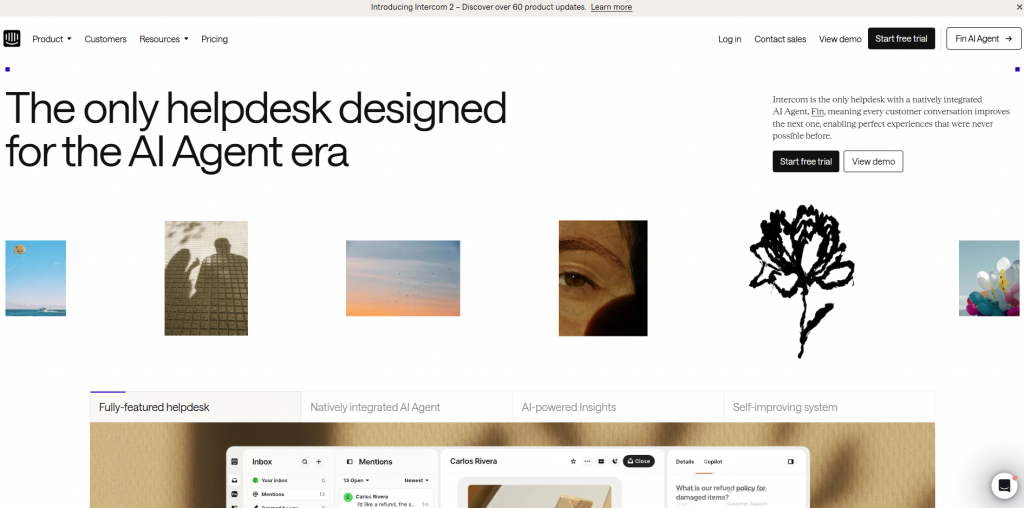
Intercom rebranded around its AI agent, Fin, in mid-2026, and the rename turned out to be a preview of a much bigger move. In June 2026, Salesforce signed a definitive agreement to acquire Fin for approximately $3.6 billion, folding its AI agent technology into Agentforce. The deal is signed but not yet closed. Intercom highlights customer results such as a 96% drop in resolution time at Synthesia and a 50% resolution rate at Robin, according to case studies on its own site.
The company also backs Fin with what it calls a “million dollar guarantee” and offers startups up to 93% off through an early-stage program..
Features
- Fin AI Agent for end-to-end resolution across chat, email, WhatsApp, and voice
- Proactive messaging and in-app product tours for onboarding
- Copilot for human agent assistance
- Custom workflows for onboarding and adoption triggers
- Pro add-on for AI-powered conversation analytics across CX Score, Topics, and Recommendations
- SSO, HIPAA support, and multibrand Messenger on the Expert plan
Pros
- Fin AI Agent resolves end-to-end across chat, email, WhatsApp, and voice from one system
- Proactive messaging ties support directly to onboarding and product engagement
- Backed by Salesforce’s resources and roadmap once the pending acquisition closes
- Multibrand Messenger and Help Center support on Expert makes it usable for companies running several product brands
Cons
- Fin AI Agent bills per resolution on top of seat costs, making total spend hard to predict for support-heavy teams.
- The pending Salesforce acquisition adds uncertainty about pricing and roadmap after the deal closes.
Pricing
- Essential. $19/seat/month billed annually under a current new-customer promotion (save 35%). List price is $29/seat/month billed annually ($39/month billed monthly).
- Advanced. $85/seat/month billed annually ($99/month billed monthly)
- Expert. $132/seat/month billed annually ($139/month billed monthly)
- Fin AI Agent billed separately at $0.99 per resolved outcome.
Best for. SaaS and digital product companies that want support tightly connected to onboarding and product engagement, and are comfortable with usage-based AI pricing on top of seats.
Side-by-Side Comparison
| Tool | Category | Pricing Model | Core Focus | Customer Success Capabilities | Key Strengths |
|---|---|---|---|---|---|
| Gainsight | Enterprise CS platform | Custom, quote-based | Enterprise account health and lifecycle management | Health scoring, automated playbooks, product analytics, customer education | Broadest feature depth on this list, deep Salesforce integration |
| ChurnZero | Mid-market CS platform | Custom, per account + seats | Real-time usage-driven churn prevention | Real-time usage tracking, health scores, in-app messaging, segmentation | Earlier risk detection than manual-input tools, broad CRM and support integrations |
| YourGPT | AI agent platform | Flat monthly tiers | Automating support and sales conversations | AI agent workflows, RAG-grounded responses, human-in-the-loop handoff, omnichannel deployment | One platform across every channel, model choice, published flat-tier pricing |
| Vitally | CS platform | Custom, per account | Product-led health scoring on a modern data stack | Usage-based health scores, Hubs workspaces, AI copilot, warehouse integrations | Native Snowflake and BigQuery integration, lighter implementation than enterprise CSPs |
| Totango | Enterprise CS platform (3 products) | Custom, per seat/account | Composable, modular customer success operations | SuccessBLOCs workflow templates, standalone churn prediction via Unison AI, seat-tiered access | Prebuilt workflow library, Unison AI works independently of the core CSP |
| Planhat | CS platform | Custom, per account | Account-based rollout across sales, support, and CS | Configurable dashboards, lifecycle tracking, customizable health-score weighting | Unlimited users on every plan, modular add-ons |
| Custify | CS platform | Custom, quote-based | B2B SaaS customer success out of the box | Customer 360 view, renewal and onboarding playbooks, built-in NPS and CSAT | Purpose-built for B2B SaaS, faster implementation than an enterprise CSP |
| Freshdesk | Help desk | Tiered, per agent/month | Ticketing and support operations | Tiered ticketing, SLA management, Freddy AI Copilot and AI Agent add-ons | Free plan, large Freshworks integration ecosystem |
| Intercom (Fin) | AI-first support platform | Per seat, plus per resolution | AI-resolved support tied to onboarding | Fin AI Agent resolution, proactive messaging, product tours, agent copilot | End-to-end resolution across channels, Salesforce-backed roadmap once the acquisition closes |
Choosing the Right Customer Success Tool
With nine options and mostly quote-based pricing, the fastest way to narrow this list is to start from five details about the buyer, not the tools.
- Company Size: Startup teams are usually better served by Custify or YourGPT, both of which keep setup light and costs visible before a sales call, since a full CSP is often more platform than a small team needs at this stage. Mid-market companies fit ChurnZero, Vitally, and Planhat well, with usage-driven health scores and account-based pricing that scales with the book of business instead of jumping straight to enterprise contract sizes. Enterprise organizations tend to land on Gainsight or Totango, which carry the deepest feature sets and the longest implementations, built for CS orgs with dedicated ops resources to run them.
- Customer Volume: A book of a few hundred accounts fits Custify or Vitally well, without paying for enterprise-scale infrastructure a smaller team won’t use. Once volume climbs into the thousands, ChurnZero, Planhat, and Totango’s SuccessBLOCs are built to organize and segment accounts at that scale. Beyond that, a health-scoring platform alone doesn’t answer individual customer questions at high volume. That’s where an AI agent layer like YourGPT or Intercom’s Fin matters as much as the CSP itself, handling ticket volume a CSM team can’t touch by hand.
- AI Requirements: Not every “AI requirement” on a shortlist is asking for the same thing. AI insights, meaning churn prediction and health scoring, point toward ChurnZero’s real-time usage tracking, Vitally’s AI copilot, and Totango’s standalone Unison AI. AI support, meaning answering customers directly, is what YourGPT and Intercom’s Fin are built for, and Freshdesk’s Freddy AI Agent covers it as an add-on. AI onboarding, meaning guiding new customers through setup, is led by Intercom’s proactive messaging and product tours, with YourGPT’s workflow automation covering the more operational side of the same job.
- Integration Needs: CRM-heavy teams should look at Gainsight, ChurnZero, and Totango, which lean heavily on Salesforce, or Custify and Planhat for a broader CRM set. Teams that need a helpdesk should note that Freshdesk is a helpdesk first, while Intercom and YourGPT both fold support into the same system as the AI agent, so there’s no separate ticketing tool to run alongside it. For product analytics, Vitally’s native Snowflake and BigQuery integrations stand out from the rest of the list. On communication tools, Totango and ChurnZero build around Slack, while YourGPT and Intercom cover WhatsApp, email, and chat from one deployment.
- Budget: Enterprise and startup-friendly options split cleanly along the same line as company size. Gainsight, ChurnZero, Vitally, Totango, and Planhat all require a sales call for any real number, and the eventual quote usually runs into five or six figures annually. Freshdesk has a genuine free tier, and YourGPT publishes flat pricing starting at $39/month, both without a demo required just to see the cost.
AI’s Growing Impact on Customer Success
- None of the six dedicated CS platforms above talk to a customer directly. They score health and trigger a human playbook, leaving the actual conversation to a person.
- That gap is where agentic AI in customer support has moved fastest. Salesforce’s State of Service: AI Agents Edition report found AI agent adoption in customer service organizations jumped from 39% in 2025 to 66% in 2026.
- Salesforce’s roughly $3.6 billion deal to acquire Fin (formerly Intercom) is the clearest signal yet that AI agents are their own category, not a feature checkbox on an existing support tool.
- YourGPT, covered above, sits in that AI-agent category. It’s built to absorb the ticket volume a CSM team shouldn’t have to touch by hand, freeing them for strategic account work.
- Answer quality still depends on how well the knowledge base is organized. Studio’s conditional logic, knowledge-conflict detection, and human-in-the-loop handoff exist to manage that limitation.
- Intercom sits in the same AI-agent category and is worth comparing directly.
- A CS platform and an AI agent solve different problems, and the strongest stacks in 2026 run both.
Frequently Asked Questions
What is a customer success tool?
A customer success tool is software that helps a business track account health, predict churn, and manage renewal and expansion workflows across a book of customers. The category also includes support and AI agent platforms that customer success teams lean on for ticket volume, even though those tools don’t score health on their own.
What’s the difference between a customer success platform and a help desk?
A customer success platform like Gainsight or ChurnZero scores account health and triggers playbooks for a CSM to act on. A help desk like Freshdesk manages incoming tickets. Some tools, including Intercom and YourGPT, combine support and AI agents into one system.
Why don’t platforms like Gainsight and ChurnZero publish pricing?
Six of the nine tools in this guide, all dedicated CS platforms, price by quote. Cost depends on factors like customer account volume, seat count, and which modules a business buys, so vendors route every deal through a sales conversation with no fixed rate card published.
How much should a business expect to pay for a customer success platform?
Real numbers are hard to pin down since none of the six dedicated CS platforms publish pricing. Third-party cost trackers commonly place annual contracts in the five to six figure range, though estimates for the same tool can disagree by an order of magnitude, so any specific figure should be confirmed directly with the vendor before budgeting against it.
Can AI agents replace a customer success platform?
No. A CS platform scores health and forecasts renewals. An AI agent resolves a support conversation directly. They solve different problems, and the strongest customer success stacks in 2026 run both.
Which customer success tool is best for a startup?
Custify and YourGPT both keep setup light and pricing visible before a sales call, which suits a small team better than an enterprise-scale CSP built for thousands of accounts.
Which customer success tool is best for an enterprise?
Gainsight and Totango carry the deepest feature sets on this list, built for CS organizations with dedicated ops resources and the budget for a multi-month implementation.
How does YourGPT fit into a customer success stack?
YourGPT is an AI agent platform built to automate support and sales tickets, complementing the health-scoring work a CS platform already does. It absorbs the ticket volume a CSM team shouldn’t have to handle by hand, freeing that team for renewal and expansion work, and it’s designed to run alongside a CS platform rather than stand in for one.
Conclusion
Six of the nine tools here withhold pricing until a sales call happens, and the ones that do publish pricing still charge per seat or per resolution in ways that scale fast once volume climbs. None of that is a reason to skip the category. It’s a reason to walk into each demo already knowing what the actual problem is: health scoring and renewal workflows point toward a dedicated CSP, while high ticket volume increasingly points toward AI-driven support automation running alongside one. For a closer look at what to check before signing on with either kind of tool, see what to evaluate before buying an AI agent.

Related posts