Cheap Frontier Models for Support Bots in 2026
TL;DR
Cheap frontier models now compete for the same high-volume support workloads, with DeepSeek V4 remaining the lowest-cost option in this comparison.
Kimi K2.6 and GLM-5.2 are open-weight and self-hostable, while Qwen 3.7 Plus is proprietary and available only through an API.
Claude Haiku 4.5 is the only model here that its developer explicitly recommends for customer service and chatbot use.
The biggest savings come from routing routine tickets to the cheapest model that meets your accuracy requirements, while escalating high-risk cases to a stronger model or a human agent.
Support teams now have a wider range of affordable AI models capable of handling high-volume customer conversations. Claude Haiku 4.5, GPT-5.6 Luna, Gemini 3.5 Flash, DeepSeek V4, Qwen 3.7 Plus, Kimi K2.6, and GLM-5.2 all compete on price, speed, context size, and deployment flexibility.
DeepSeek V4 leads on cost, Gemini 3.5 Flash offers broader capability at a higher price, and Claude Haiku 4.5 is the only model in this group that its developer directly positions for customer service.
Most support queues are built around repeatable tasks such as order tracking, return questions, account updates, and product guidance. These workflows benefit more from fast responses, accurate policy handling, reliable tool use, and consistent escalation than from flagship-level reasoning on every ticket.
This blog compares all seven models across pricing, context window, strengths, limitations, hosting options, and support use cases. It also estimates the monthly cost of running each model on a realistic ticket volume and shows where each one fits best.
What Is a Cheap Frontier Model?
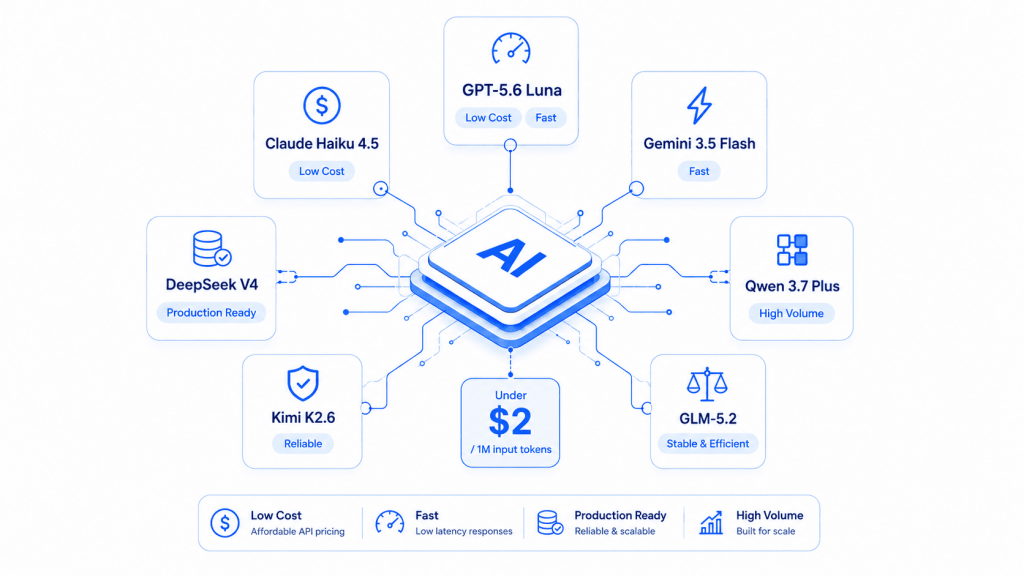
A cheap frontier model is a current, production-ready model that offers strong capabilities at a relatively low API cost. For this guide, that means a model priced below $2 per million input tokens and positioned by its developer for fast, high-volume, or cost-sensitive workloads.
This definition excludes experimental releases, discontinued models, and small community projects without reliable production support.
The models compared here are Claude Haiku 4.5, GPT-5.6 Luna, Gemini 3.5 Flash, DeepSeek V4, Qwen 3.7 Plus, Kimi K2.6, and GLM-5.2. Each is actively supported and sits below a more expensive flagship model from the same developer, making it a practical option for support workloads where speed, scale, and cost matter more than maximum reasoning capability.
What Makes an AI Model Ready for Customer Support?
A low token price matters only if the model can answer accurately, follow business rules, use tools reliably, and handle real traffic. Before routing customer conversations to any model, evaluate it against the workflows and failure risks of your own support queue.
- Response quality and accuracy. Answers should reflect the customer’s actual question, account details, and company policy rather than simply sounding fluent.
- Hallucination and abstention. A support model should admit when information is missing and escalate the case instead of inventing an answer.
- Instruction following. Test whether it consistently follows rules such as confirming prices, protecting customer data, and escalating refunds above a set amount.
- Tool and function calling. The model must select the correct tool, pass valid arguments, and return structured JSON that backend systems can parse reliably.
- Context handling. A large context window is useful only when the model can retain important details across long conversations, policies, and retrieved documents.
- Speed and streaming. Measure both time to first token and total response time. Streaming can make a response feel faster even when generation takes longer.
- Multilingual performance. Test quality in the languages customers actually use, including policy accuracy and tool calls rather than translation alone.
- API reliability and scale. The provider should maintain stable endpoints, sufficient rate limits, and predictable performance during traffic spikes.
- Safety. Evaluate how the model handles prompt injection, fraud claims, abusive messages, legal threats, and requests involving sensitive data.
- Total operating cost. Compare input, output, caching, and tool-use costs against successfully resolved tickets, not token pricing alone.
The Business Value of Cheap Frontier Models
Cheap frontier models give support teams more than lower token prices. They make it practical to automate a larger share of the support queue, route tickets by complexity, and reduce dependence on a single model provider.
Lower operating costs. In the cost comparison later in this guide, the same monthly ticket volume ranges from roughly $9 to $150 on budget models, compared with about $450 to $495 on flagship models.
Broader automation coverage. When routine tickets cost only a fraction of a cent to process, AI can handle order tracking, policy questions, ticket classification, product queries, and account updates across the full queue.
Better returns through routing. The metric that matters is resolved tickets per dollar, not token price alone. Routine requests can go to the cheapest model that meets the accuracy bar, while complex or sensitive cases move to a stronger model or a human agent.
Smaller capability trade-offs. Budget models now perform closer to flagship models on many common tasks. Reliability still varies around hallucination, policy compliance, and knowing when to escalate, so testing against real support tickets remains essential.
More deployment control. Open-weight models such as DeepSeek V4, Kimi K2.6, and GLM-5.2 can run on private infrastructure. This gives teams more control over customer data, hosting location, fine-tuning, and long-term availability.
Greater vendor flexibility. Credible options from several labs make it easier to switch providers when pricing, rate limits, performance, or availability changes. A multi-model setup reduces lock-in and keeps support costs more predictable.
The strongest business case comes from using cheap models as part of a routing strategy rather than as a single replacement for every model and human agent in the support stack.
Best Cheap AI Models for Support Bots in 2026
The models below are compared on the factors that matter in a real support environment, including pricing, response quality, context size, tool use, hosting options, and known limitations.
Each entry explains what the model does well, where it falls short, how much it costs, and which types of support tickets it is best suited to handle.
1. Claude Haiku 4.5
Claude Haiku 4.5 is Anthropic’s fast, low-cost model, and the only model in this comparison that Anthropic itself names for customer service and chatbot use. It replaced Haiku 3.5 in October 2025 at a 25 percent price increase, justified by a real capability jump, scoring 73.3 percent on SWE-bench Verified, matching Sonnet 4’s coding performance at a fraction of the cost and four to five times the speed. For a support bot, that speed matters as much as the score. A model a customer waits three to five seconds per step for starts to feel broken, regardless of how good the answer eventually is.
Features
- 200,000-token context window (anthropic.com/claude/haiku)
- Extended thinking support, including tool-assisted workflows
- Already listed by name in YourGPT’s own model tiers, covered further down
Pros
- Anthropic states it’s suited to real-time applications like customer service agents and chatbots where response time is critical (Anthropic’s Haiku 4.5 announcement)
- Up to 90% savings with prompt caching, 50% with batch processing
- The only direct, named vendor endorsement for this exact use case in this comparison
Cons
- The smallest context window in this comparison at 200K, well short of the 1-million-token windows several competitors offer
- Costs more per token than DeepSeek V4, Qwen 3.7 Plus, or Kimi K2.6
Pricing
| Mode | Input (per 1M tokens) | Output (per 1M tokens) |
|---|---|---|
| Standard | $1.00 | $5.00 |
| Batch (async) | $0.50 | $2.50 |
| Cached input | $0.10 | — |
Context window: 200,000 tokens, up to 64,000 max output. Cache writes cost $1.25 per million tokens, a premium over the standard rate, so caching only pays off once a cached prefix gets reused.
Best for. Standard resolution work with a real conversation, where the direct vendor positioning around customer service is worth the price over cheaper, less-targeted options.
2. GPT-5.6 Luna
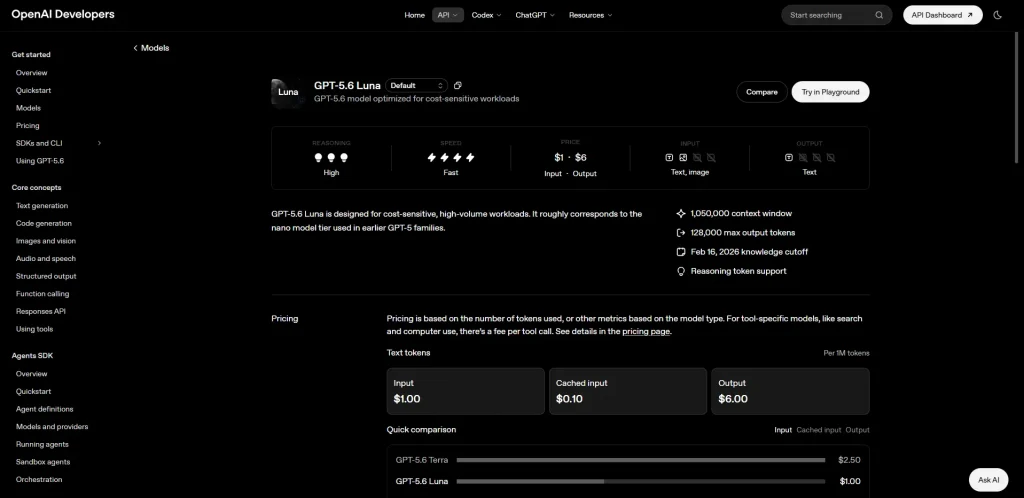
GPT-5.6 Luna is OpenAI’s fastest and most affordable tier in the newly launched GPT-5.6 family, replacing the old mini and nano naming with a tier name that can advance on its own release cadence. It’s the bottom of three tiers, Sol as flagship and Terra in the middle, positioned for cost-sensitive, high-volume workloads like the traffic a support queue generates daily. Its caching structure, with explicit breakpoints and a 30-minute minimum cache life, suits a system prompt and knowledge base that barely change from ticket to ticket. Being this new cuts both ways though, with no large body of independent testing yet to back up the day-one specs.
Features
- 1.05-million-token context window with up to 128K max output (OpenAI’s GPT-5.6 launch post)
- Reached general availability July 9, 2026, after a limited preview that opened June 25
- Explicit cache breakpoints and a 30-minute minimum cache life under OpenAI’s newer caching structure
Pros
- OpenAI positions Luna specifically for high-volume, latency-sensitive work like chat, classification, and lightweight agentic workflows
- 90% discount on cached input reads
- Corresponds to the nano tier from earlier GPT-5 generations, so it inherits a familiar cost profile with a newer model underneath it
Cons
- General availability is only days old as of this writing, so it carries a thinner independent track record than older models in this comparison
- Priced above DeepSeek V4, Qwen 3.7 Plus, and Kimi K2.6 on both input and output
Pricing
| Mode | Input (per 1M tokens) | Output (per 1M tokens) |
|---|---|---|
| Standard | $1.00 | $6.00 |
| Batch (async) | $0.50 | $3.00 |
| Cached input | $0.10 | — |
Context window: 1.05 million tokens, up to 128,000 max output. Cache writes cost 1.25x the uncached input rate.
Best for. Teams standardizing on OpenAI who want a fast, cheap triage and classification layer without stepping down to a different vendor entirely.
3. Gemini 3.5 Flash
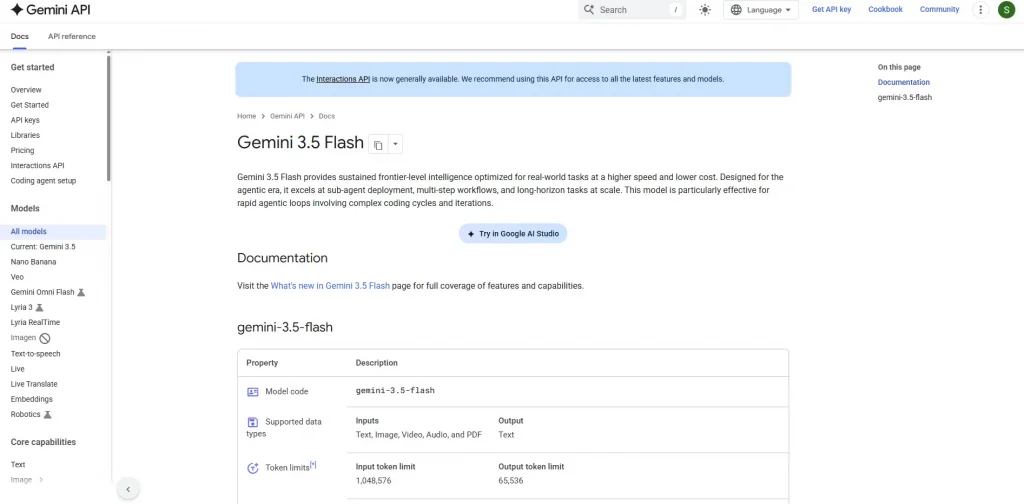
Gemini 3.5 Flash is Google’s higher-capability Flash tier, a step up over Google’s budget-tier models rather than the cheapest option in this comparison. Google unveiled it at I/O on May 19, 2026, calling it the strongest agentic and coding model the Flash line has shipped, and it scores 1,656 Elo on the GDPval-AA benchmark while running roughly four times faster than other frontier-class models. Its 1,048,576-token context window holds a lengthy policy document or a full conversation history without chunking either one. The tradeoff is the highest per-token price in this roster, better suited to tickets that actually need the extra reasoning than to every incoming message.
Features
- 1-million-token context window with up to 65,536 output tokens (Google’s official Gemini API pricing)
- Native multimodal support across text, image, video, audio, and PDF input
- Search grounding and Google-native tooling integration
Pros
- The largest, most flexible context window paired with true multimodal input in this comparison
- Search grounding is a differentiator none of the other six models in this roster offer natively
- Confirmed directly on Google’s own live pricing page, the strongest sourcing of any model in this comparison
Cons
- The most expensive model in this roster on a per-token basis
Pricing
| Mode | Input (per 1M tokens) | Output (per 1M tokens) |
|---|---|---|
| Standard | $1.50 | $9.00 |
| Batch (async) | $0.75 | $4.50 |
| Cached input | $0.15 | — |
Context window: 1 million tokens, up to 65,536 max output. Cache storage carries an added $1.00 per million tokens per hour on top of the per-token rate above.
Best for. Multimodal or long-document support cases, an uploaded image or a long policy PDF, where capability matters more than shaving cost.
4. DeepSeek V4
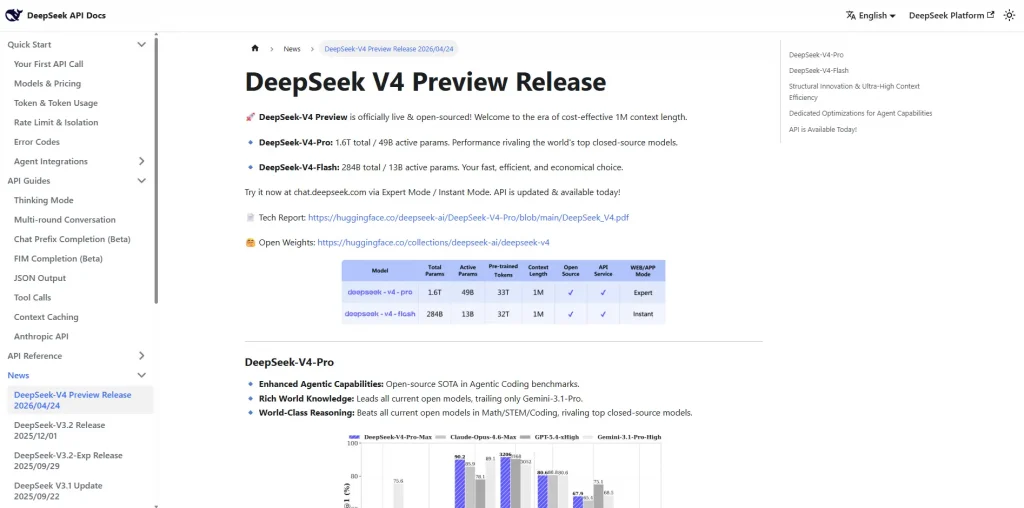
DeepSeek V4 is the cost floor of this comparison by a wide margin, with a 1-million-token context window and open weights available for self-hosting. DeepSeek shipped it on April 24, 2026, the same day OpenAI released GPT-5.5, retiring its entire prior lineup, V3.2, R1, and their legacy aliases, in one move. It runs in both thinking and non-thinking modes, scoring 61 and 77 respectively on DeepSeek’s own quality scale, a gap worth knowing before assuming one mode fits every ticket. At $0.14 input and $0.28 output per million tokens, it undercuts every other model in this roster by enough to function less like a competitor and more like a different category of tool.
Features
- 1-million-token context window with up to 384K max output (DeepSeek API docs)
- Both thinking and non-thinking modes in the same model
- Open weight, so self-hosting is available as an alternative to the first-party hosted API
- Aggressive cache-hit pricing that drops input cost close to zero on repeated context
Pros
- Cheapest model in this comparison on both input and output by a wide margin
- Self-hosting sidesteps the data-residency question entirely, covered in the risk section below
- Listed as a selectable model on YourGPT’s own site, with the prior-generation V3 confirmed in the platform’s low-credit tier
Cons
- A documented tendency to answer confidently instead of admitting uncertainty, covered in depth in the risk section below
- DeepSeek’s own privacy policy states personal data is processed and stored in the People’s Republic of China when using the first-party hosted API (DeepSeek Privacy Policy)
Pricing
| Mode | Input (per 1M tokens) | Output (per 1M tokens) |
|---|---|---|
| Standard | $0.14 | $0.28 |
| Cached input | $0.0028 | — |
Context window: 1 million tokens, up to 384,000 max output. No official flat batch-processing discount has been confirmed for V4 as of this writing, unlike the historical off-peak discount DeepSeek offered on V3 and R1. Self-hosting the open weights is free beyond compute cost.
Best for. The highest-volume, lowest-stakes tier of a queue where a team has already built in a confidence threshold or human handoff to catch the confident-wrong-answer risk.
5. Qwen 3.7 Plus
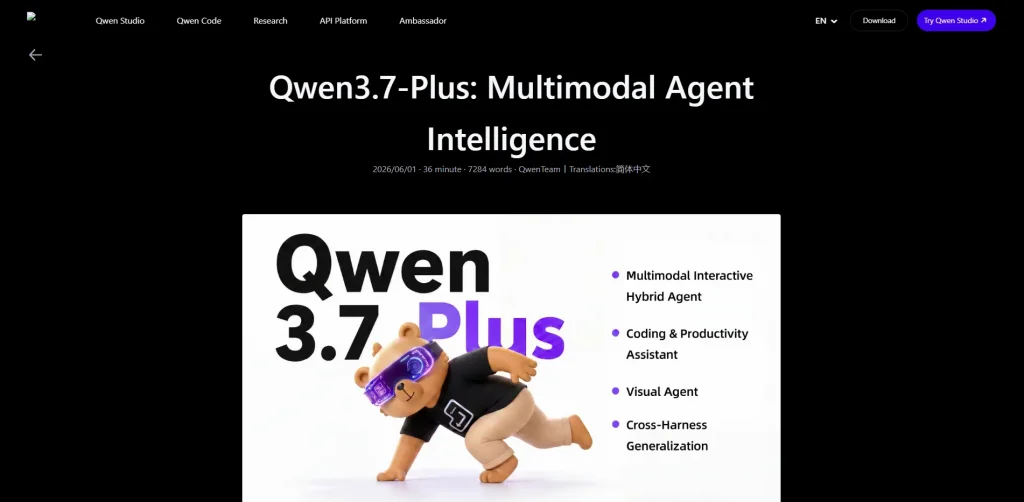
Qwen 3.7 Plus is Alibaba’s multimodal, agent-focused model, priced well below its own Qwen3.7-Max flagship, and the only model here that breaks from its lab’s usual open-weight habit. Alibaba brought it to general availability on June 1, 2026, positioned less as a chat model and more as the engine behind GUI-driving agents that read a screenshot and decide what to click next. Alibaba also offers a choice of hosting region, a Singapore-based international endpoint alongside the default Beijing one, more control than DeepSeek’s single location gives. The catch is that none of this comes with open weights, making it a bet on Alibaba’s API staying available rather than a hedge against it.
Features
- 1-million-token context window with up to 65,536 output tokens (VentureBeat, quoting Alibaba’s launch post)
- Accepts text, image, and video input, built for GUI-agent grounding and computer-use style tasks
- A preserve_thinking parameter that retains reasoning state across conversation turns
Pros
- Roughly six times cheaper than Qwen3.7-Max on input while adding vision and video input the flagship doesn’t have
- Strong tool-calling and multimodal benchmark scores relative to its price tier, per Alibaba’s own launch claims
- Offers a choice of deployment region, a Singapore-based international endpoint alongside the Beijing endpoint, unlike DeepSeek’s single hosting location
Cons
- Proprietary and API-only, with no open weights, breaking from the pattern the rest of Alibaba’s Qwen line and most of this comparison follows, so there is no self-hosting fallback if pricing or access changes
- Not listed anywhere in YourGPT’s current model documentation, covered further down
Pricing
| Mode | Input (per 1M tokens) | Output (per 1M tokens) |
|---|---|---|
| Standard (list price) | $0.40 | $1.60 |
| Batch (async) | $0.20 | $0.80 |
| Cached input | $0.08 | — |
Context window: 1 million tokens, up to 65,536 max output. OpenRouter currently lists a discounted rate of $0.32 input / $1.28 output rather than the list price above, which may reflect a promotional rate.
Best for. Support cases involving screenshots, product photos, or short video clips, where a team is comfortable with a fully API-only vendor relationship.
6. Kimi K2.6
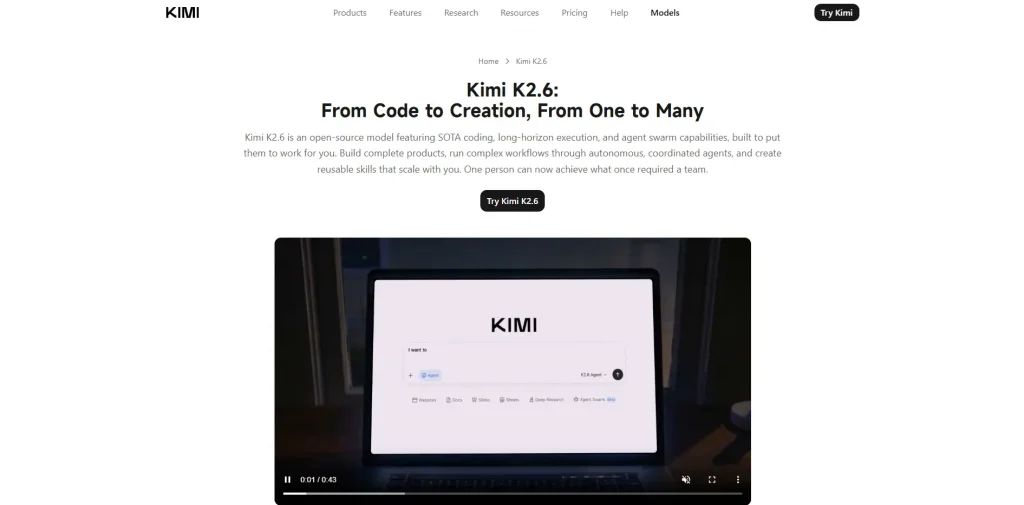
Kimi K2.6 is Moonshot AI’s flagship open-weight model, a 1-trillion-parameter mixture-of-experts system that only activates a fraction of that capacity per request, which is the entire basis of its price. Moonshot released it on April 20, 2026, positioned squarely for long, tool-heavy agent sessions rather than short conversational exchanges. The weights ship under a Modified MIT license and download directly from Hugging Face, so the price quoted here is a starting point for any team willing to host it. Independent reviewers have generally placed it a step behind Claude Opus-class models on ambiguous, multi-file reasoning, the kind of judgment call a messy escalated ticket demands more than a straightforward one.
Features
- 262,144-token context window, matching output limit (Requesty)
- 1 trillion total parameters, 32 billion active per token, Multi-head Latent Attention, native INT4 quantization
- Open weight under a Modified MIT license, downloadable from Hugging Face
- Native multimodal input, with thinking and non-thinking modes
Pros
- Frontier-class positioning at well under half of Claude Haiku 4.5’s per-token cost
- Self-hosting is a genuine option under the Modified MIT license, beyond just a theoretical one
- A generic “Kimi K2” listing appears inside YourGPT’s own model tier documentation, though the docs don’t specify which K2 version
Cons
- Independent testing collected in third-party reviews has rated it behind Claude Opus-class models on ambiguous, multi-file reasoning tasks (a Kimi K2.6 review roundup)
- No explicit data-residency statement was found for the first-party API in this research, an open question rather than a confirmed risk either way
Pricing
| Mode | Input (per 1M tokens) | Output (per 1M tokens) |
|---|---|---|
| Standard | $0.95 | $4.00 |
| Batch (async) | $0.57 | $2.40 |
| Cached input | ~$0.16 | — |
Context window: 262,144 tokens, matching max output. Some third-party hosts list a lower blended rate around $0.66/$3.40, which appears to reflect competitive hosting rather than Moonshot’s own direct pricing, covered further in the research log.
Best for. Long, agentic support workflows involving many tool calls in a single session, where Kimi K2.6’s coding-and-agent-oriented design earns its price over simpler chat-only models.
7. GLM-5.2
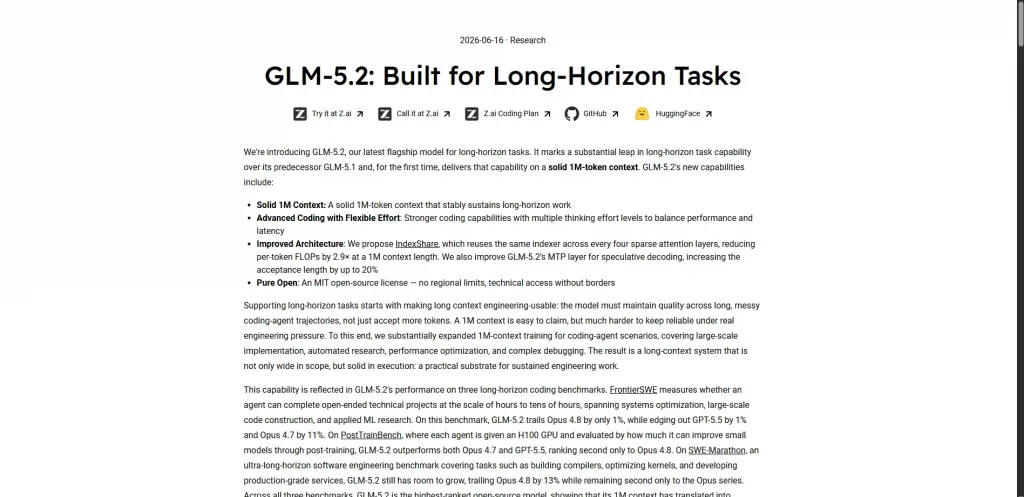
GLM-5.2 is Z.ai’s newest open-weight model, the most recently released in this comparison, posting the highest score among open-weight models on the Artificial Analysis Intelligence Index at launch. Z.ai announced it on June 13, 2026, and turned on the pay-per-token API three days later, leaving little time for independent testing. On SWE-bench Pro it edged out GPT-5.5 outright, 62.1 percent against 58.6, at roughly one-sixth the cost per token. Like Kimi K2.6, the weights are freely downloadable, here under a plain MIT license, making self-hosting straightforward, though whether that benchmark lead holds up on a live support queue is a question a model this new hasn’t had time to answer.
Features
- 1-million-token context window (techtimes.com, Requesty)
- Open weight under an MIT license
- Beat GPT-5.5 on several long-horizon coding benchmarks at launch, per Z.ai’s own claims covered by VentureBeat
Pros
- The strongest published benchmark position of any open-weight model in this comparison at time of writing
- MIT license makes self-hosting straightforward, avoiding the data-residency question below entirely if a team chooses that path
- Aggressive cache-hit pricing brings input cost down substantially on repeated context
Cons
- The newest model in this comparison, which means the shortest production track record of any of the seven
- Z.ai runs its infrastructure primarily in China, which can affect both latency and data-residency compliance on the first-party hosted API (developer.puter.com)
- Not listed anywhere in YourGPT’s current model documentation, covered further down
Pricing
| Mode | Input (per 1M tokens) | Output (per 1M tokens) |
|---|---|---|
| Standard | $1.40 | $4.40 |
| Cached input | $0.26 | — |
Context window: 1 million tokens, up to 128,000 max output. No confirmed flat batch-processing discount was found for the first-party API as of this writing. Self-hosting the MIT-licensed weights is free beyond compute cost.
Best for. Teams chasing the newest open-weight capability available and willing to either self-host or accept the same data-residency tradeoff already covered for DeepSeek.
Side by Side Comparison
| Model | Vendor | Released | Input / 1M | Output / 1M | Context | Capability Marker | Customer Support Positioning | Notes |
|---|---|---|---|---|---|---|---|---|
| Claude Haiku 4.5 | Anthropic | Oct 2025 | $1.00 | $5.00 | 200K | Not published in this index | Yes, named directly | Named for customer service by Anthropic |
| GPT-5.6 Luna | OpenAI | Jul 9, 2026 (GA) | $1.00 | $6.00 | 1.05M | 51.2 | No | Newest OpenAI budget tier |
| Gemini 3.5 Flash | May 19, 2026 | $1.50 | $9.00 | 1M | 50.2 | No | Highest-priced option with broader capability | |
| DeepSeek V4 | DeepSeek | Apr 24, 2026 | $0.14 | $0.28 | 1M | Not published in this index | No | Cheapest option and open weight |
| Qwen 3.7 Plus | Alibaba | Jun 1, 2026 (GA) | $0.40 | $1.60 | 1M | Not published in this index | No | Proprietary and API-only |
| Kimi K2.6 | Moonshot AI | Apr 20, 2026 | $0.95 | $4.00 | 262K | 44.2 | No | Open weight and agent-focused |
| GLM-5.2 | Z.ai | Jun 13–16, 2026 | $1.40 | $4.40 | 1M | 51.1 | No | Open weight and the newest release |
Estimated Monthly Support Costs by Model
Token usage has a greater impact on cost than benchmark scores. This comparison assumes 10,000 resolved tickets per month, with three turns per ticket, 2,500 input tokens, and 300 output tokens per turn.
That equals 75 million input tokens and 9 million output tokens per month, without caching. The figures below are planning estimates based on current per-token pricing, not guaranteed real-world averages.
| Model | Monthly Cost (Uncached) |
|---|---|
| Claude Haiku 4.5 | ~$150.00 |
| GPT-5.6 Luna | ~$165.00 |
| Gemini 3.5 Flash | ~$247.50 |
| DeepSeek V4 | ~$14.70 |
| Qwen 3.7 Plus | ~$54.00 |
| Kimi K2.6 | ~$131.25 |
| GLM-5.2 | ~$171.00 |
| GPT-5.5 (flagship, for contrast) | ~$825.00 |
| Claude Opus 4.8 (flagship, for contrast) | ~$750.00 |
Support Limitations and Reliability Risks
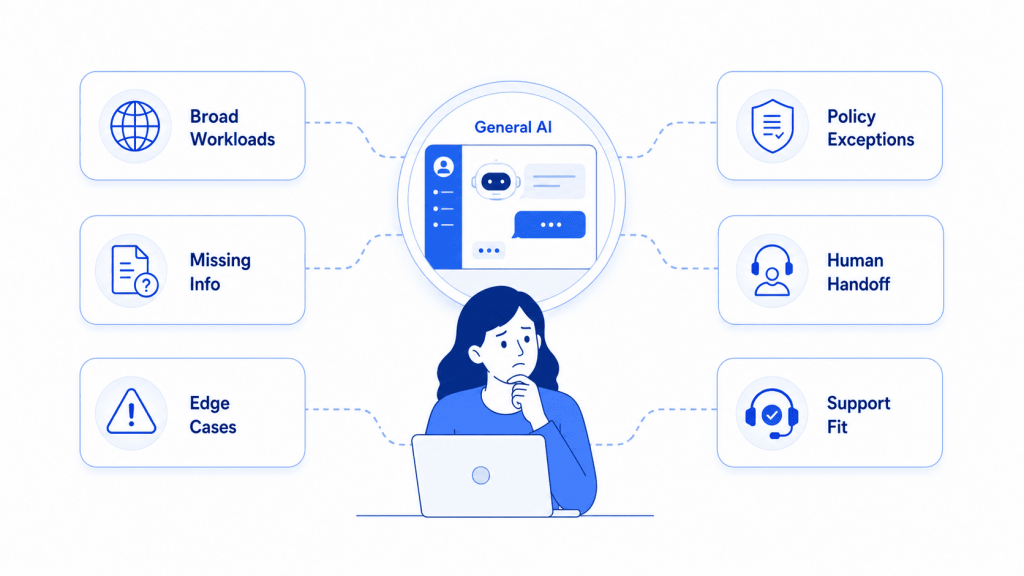
Most models in this comparison were designed for broader workloads rather than customer support specifically. OpenAI emphasizes high-volume chat and classification for GPT-5.6 Luna, Google focuses on throughput and multimodal tasks, while Qwen 3.7 Plus, Kimi K2.6, and GLM-5.2 are positioned mainly around agents, computer use, and coding. Claude Haiku 4.5 is the exception, with Anthropic naming customer service as a direct use case.
The larger concern is whether a model knows when not to answer. On Artificial Analysis’s AA-Omniscience benchmark, DeepSeek V4 variants recorded confident-wrong-answer rates of 94% and 96%, showing a strong tendency to guess instead of abstaining when information is missing.
Comparable abstention data was not available for the other six models, so their risk should not be assumed to be lower. Before deployment, test each model against real support edge cases, including missing account data, unclear policies, refund exceptions, and questions that should trigger a human handoff.
Security, Data Residency, and Vendor Risk
Model quality is only one part of the deployment decision. Support teams also need to consider where customer data is processed, whether the model can be self-hosted, and what happens if a provider changes access or pricing.
- Data residency. DeepSeek states that data sent through its hosted API is processed and stored in the People’s Republic of China. (DeepSeek Privacy Policy). Z.ai also operates much of its GLM infrastructure in China, which may affect latency and compliance requirements. Alibaba offers both Beijing and Singapore endpoints for Qwen 3.7 Plus, although the legal treatment of data sent through the international endpoint should be confirmed before deployment. Clear residency information was not available for Kimi K2.6’s first-party API.
Open-weight models provide another option. DeepSeek V4, Kimi K2.6, and GLM-5.2 can be deployed on infrastructure controlled by the business, giving teams more authority over data location, retention, and access. - Vendor dependence. Qwen 3.7 Plus is proprietary and API-only. Unlike the open-weight models above, it cannot be self-hosted if Alibaba changes pricing, limits access, or retires the service. That makes availability and vendor lock-in part of the risk calculation.
- Unsafe automated actions. Any model can produce a confident but incorrect response. Ground answers in approved knowledge sources, require confidence checks before actions such as refunds or account changes, and That pattern is exactly what human-in-the-loop handoff exists to enforce.
The safest deployment is not determined by one model ranking. It comes from combining suitable hosting, restricted tool permissions, reliable retrieval, action-level safeguards, and human escalation.
Deploying Cheap Models in a Flexible Support Stack
YourGPT currently lists Claude Haiku 4.5 in Tier 3, its fastest and lowest-cost reasoning tier, with a 1x credit multiplier (docs.yourgpt.ai). A generic Kimi K2 option also appears in Tier 2, although the documentation does not confirm whether it refers specifically to Kimi K2.6.
DeepSeek V3 and GPT-5 Mini are also available, providing earlier-generation equivalents to some of the budget models covered here. GPT-5.6 Luna, Gemini 3.5 Flash, Qwen 3.7 Plus, and GLM-5.2 are not currently named in the standard model documentation.
Enterprise plans support custom model integrations, which gives teams a route to use models outside the default selection. Availability should still be confirmed inside the platform before building a budget around a specific model.
The broader lesson is to keep the model layer flexible. A support stack should allow teams to change models as pricing, performance, and availability shift, without rebuilding the chatbot, knowledge base, integrations, or routing logic around it.
A Routing Rule for Ticket Triage
Skip the leaderboard and ask what the ticket actually needs.
- Known, low-stakes answers. Store hours, tracking links, standard policy questions. DeepSeek V4 or Qwen 3.7 Plus handle this tier at the lowest possible cost.
- Standard resolution work. Order lookups, straightforward returns, product questions that need a natural back-and-forth conversation. Claude Haiku 4.5, GPT-5.6 Luna, or Kimi K2.6 earn their higher price here, with Haiku 4.5’s explicit vendor positioning around customer service worth the modest premium.
- Multimodal or long-document cases. Anything involving an uploaded image, a product photo, or a policy document that needs to stay in context across a long conversation favors Gemini 3.5 Flash or Qwen 3.7 Plus, both of which accept images directly, with Gemini’s larger context window covering longer documents in a single pass.
- High-stakes or ambiguous cases. A refund, a policy exception, or anything with unclear eligibility. Route to a stronger model, or better, to a confidence-gated human handoff, regardless of which cheap model is running the rest of the queue. This is where the risk of a confident wrong answer actually bites.
- Anything measuring deflection. A cheap model that answers confidently and wrongly is not actually cheap once the follow-up ticket and the CSAT hit are counted. Log which model handled a ticket alongside the outcome, so a bad routing choice shows up in the numbers instead of getting absorbed into overall support metrics.
FAQ
Which cheap AI model is best for a customer support bot?
There is no single best model for every support team. Claude Haiku 4.5 is a strong choice for everyday customer conversations, DeepSeek V4 is suitable for high-volume routine requests, and Gemini 3.5 Flash works well for tickets involving images or long documents.
Should I choose the AI model with the lowest token price?
Not necessarily. A cheaper model can cost more in the long run if it gives incorrect answers, creates repeat tickets, or lowers customer satisfaction. Compare models based on cost per correctly resolved ticket rather than token pricing alone.
How much does it cost to run an AI support bot?
For an estimated 10,000 resolved tickets per month, the models compared in this guide cost approximately $14.70 to $247.50 without caching. Comparable flagship models could cost around $750 to $825 for the same estimated usage. Actual costs depend on conversation length, output size, caching, and tool use.
Can I use different AI models with YourGPT?
Yes. YourGPT supports multiple AI models, allowing teams to use lower-cost models for routine questions and stronger models for complex or sensitive cases. Enterprise plans also support custom model integrations, so businesses can change models without rebuilding their chatbot, knowledge base, integrations, or support workflows.
What should I test before using an AI model for customer support?
Test the model using real support conversations. Measure answer accuracy, policy compliance, response speed, tool-call reliability, multilingual performance, escalation behavior, safety, and cost per successful resolution.
Are open-weight AI models better for customer data privacy?
Open-weight models such as DeepSeek V4, Kimi K2.6, and GLM-5.2 can be self-hosted, giving businesses greater control over data location, retention, and access. Hosted APIs still require a careful review of the provider’s privacy, security, and data-residency policies.
When should an AI support bot transfer a conversation to a human?
Human review should be required for refunds, account changes, policy exceptions, legal concerns, unclear eligibility, missing customer information, or any request where an incorrect answer or action could cause financial or customer harm.
Conclusion
The cheapest model is not always the most cost-effective. DeepSeek V4 may have the lowest token price, but the better model is the one that answers accurately, follows policies, uses tools reliably, and knows when to escalate instead of guessing.
Use low-cost models for routine tickets such as order tracking, FAQs, product questions, and ticket classification. Refunds, account changes, policy exceptions, legal concerns, and unclear requests should require stronger verification, a more capable model, or human approval.
Before choosing, test two or three models on real support conversations. Measure cost per correctly resolved ticket, response speed, tool-call accuracy, unnecessary escalations, and confident wrong answers. A flexible routing setup is usually more valuable than relying on one model for the entire queue.

Related posts

YourGPT 2.0: Complete Platform Overview
