Multi-Agent Systems: The Architecture Behind Truly Autonomous AI
TL;DR
Multi-agent systems replace one general-purpose AI with a team of specialized agents that coordinate, reason in parallel, and solve complex tasks more effectively. They offer clear advantages in speed, modularity, resilience, and scalability, which is why they are increasingly shaping modern AI architectures. The tradeoff is higher system complexity, making orchestration, monitoring, governance, and cost control essential for production use.
A team of specialists will always outperform a single generalist on a complex problem. That principle is exactly why multi-agent systems have become the architecture behind the most capable AI in production today.
Instead of one AI agent handling everything sequentially, you get a team: specialized agents working in parallel, each focused on what it does best, each contributing to an outcome no single agent could reach alone. The result is faster execution, cleaner outputs, and systems that stay reliable even when one piece needs attention.
Amazon coordinates warehouse robotics with it. Moonshot AI built Kimi K2.5 with Agent Swarm, a system that spins up to 100 sub-agents simultaneously to tackle complex tasks. xAI went as far as rebuilding their AI model itself around this idea. Grok 4.20 Beta, released in February 2026. It is four specialized agents that think in parallel, debate each other’s outputs, and only deliver an answer once they reach consensus.
This article covers how it all works, what is inside a multi-agent system, and how to build your first one.
What Is a Multi-Agent System?
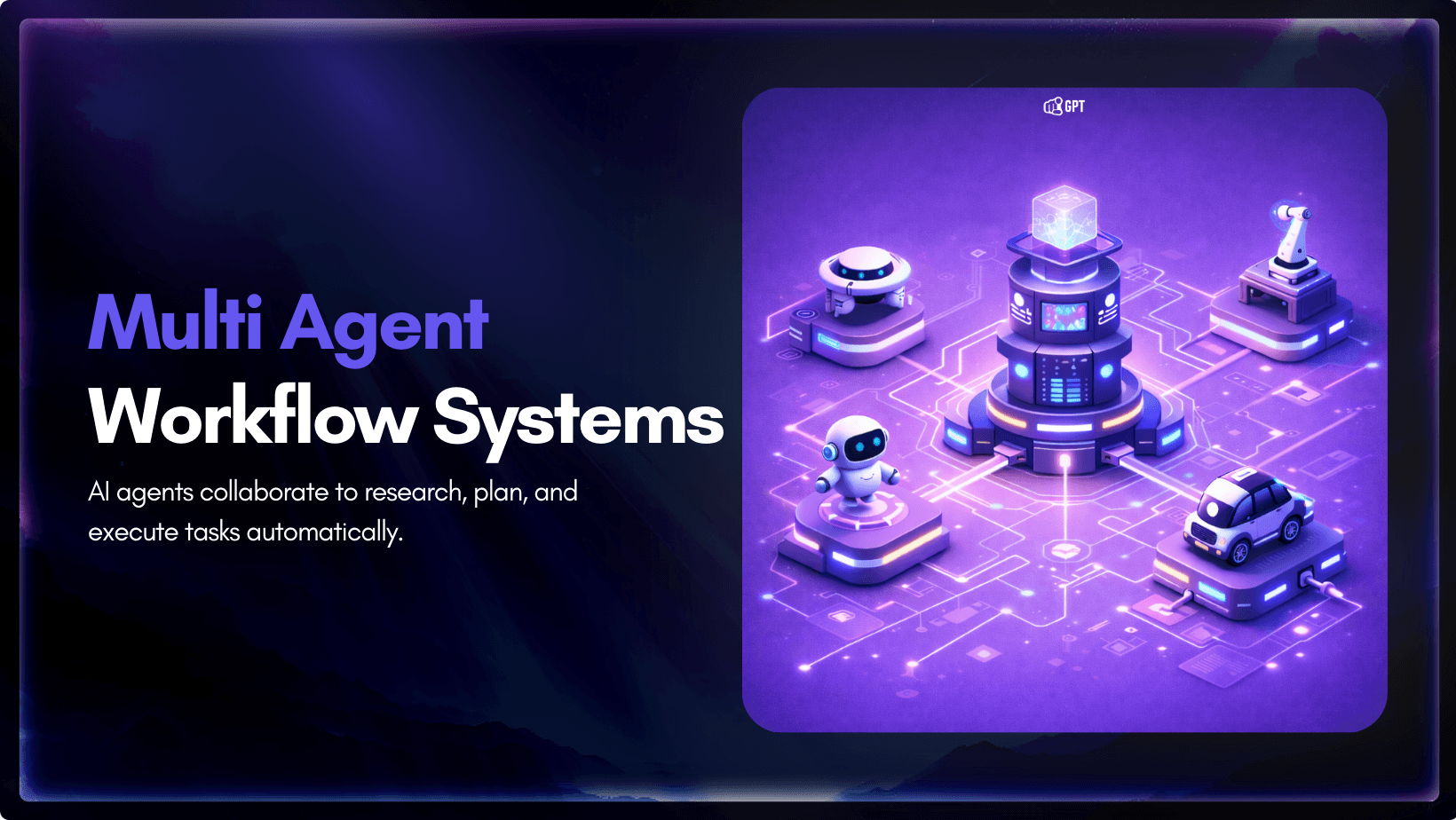
A multi-agent system (MAS) is a group of autonomous agents that interact within a shared environment to achieve individual or shared goals. Each agent has its own goals, memory, and decision logic, which allows the system to distribute decision authority rather than rely on a single controller. This structure helps solve complex problems that demand parallel work or specialized roles.
Think of it like a well-run kitchen. The head chef does not cook every dish, plate every order, and manage every station alone. There is a prep cook, a grill cook, a pastry chef, and an expeditor. Each one owns their role, runs in parallel, and the result comes out faster and better than any single person could produce.
Multi-agent systems aims to work the same way like we (humans) do. Agents may cooperate, compete, or operate in mixed settings, communicating through message passing, shared memory, or by given prompt instructions. Together they tackle problems that would overwhelm a single model working alone.
What makes this different from just calling one model multiple times is coordination. Agents do not simply take turns. They share context, challenge each other’s outputs, divide subtasks dynamically, and adapt when something changes. Here is how a typical agentic AI architecture looks:
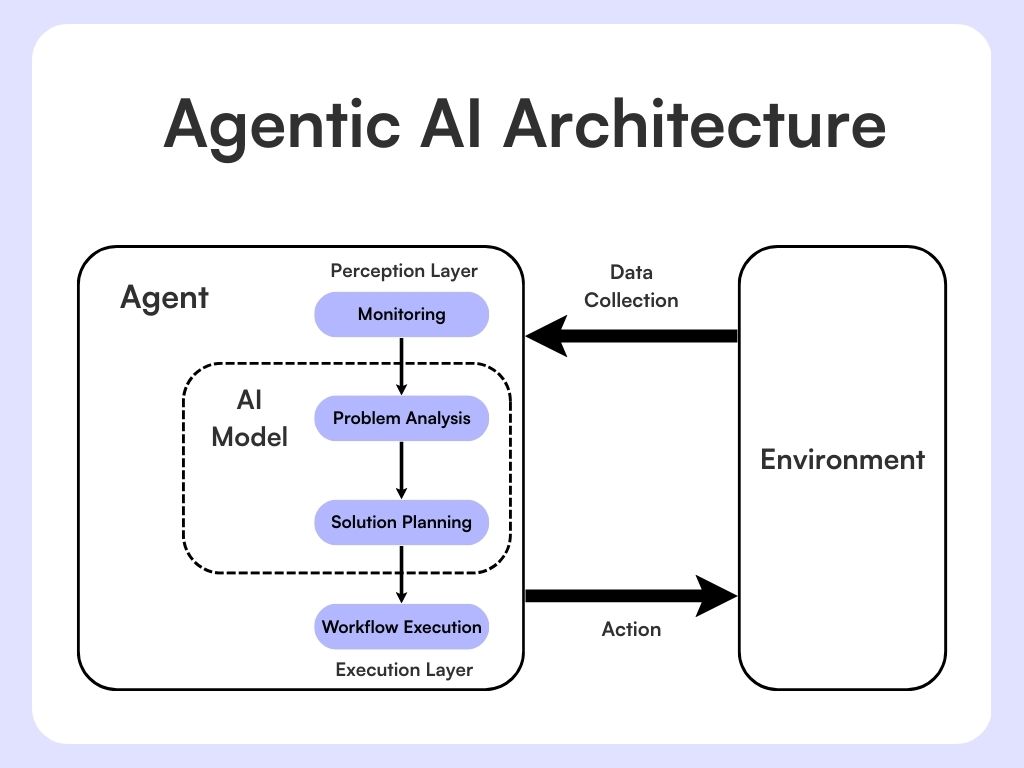
Modern MAS often use large or small language model-driven agents that coordinate through structured text exchanges, dividing tasks and aligning actions.
Single Agent vs Multi-Agent Systems
The easiest way to understand multi-agent systems is to see what changes when you move away from a single agent.
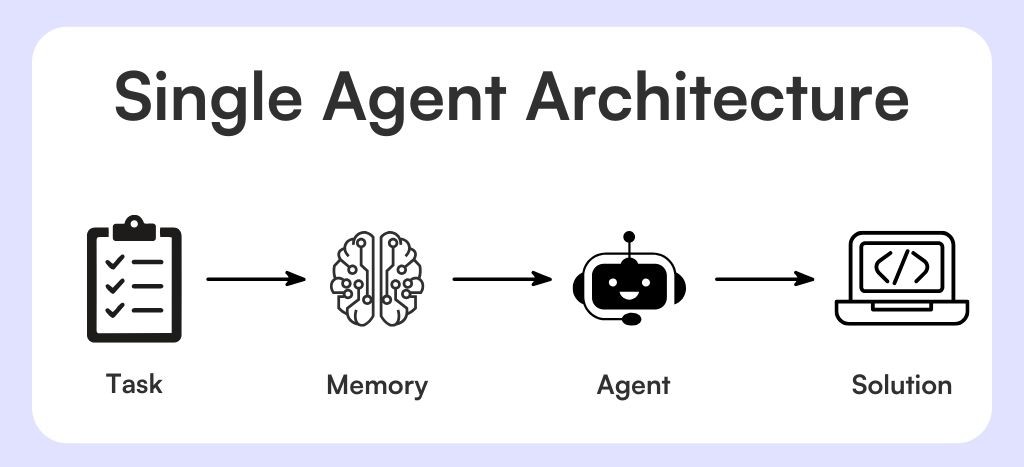
A single agent is a centralized decision maker. It receives a task, reasons through it, and acts. That works well for contained, well-defined problems. But give it something that requires parallel thinking, specialized knowledge, or resilience under failure, and the limitations become clear fast. There is one brain, one bottleneck, and one point of failure.
A multi-agent system distributes that responsibility. Different agents own different parts of the problem. They run simultaneously, specialize in their lane, and keep the system moving even when one component needs attention. The coordination overhead is real, but for complex tasks the tradeoff is worth it.
Here is how the two approaches compare directly:
Here’s what single-agent architecture looks like:
The right choice depends on your usecase. If the task is simple and self contained, a single agent is usually the better option. It is easier to build, cheaper to run, and avoids unnecessary complexity.
But when the task requires parallel work, different specialized roles, or systems that continue working even if one part fails, a multi agent setup can be more effective.
Still, multi agent systems come with tradeoffs. Agents must communicate, coordinate, and adapt to each other, which can make the system harder to manage.
So how do multi agent systems actually work? Let’s look at that next.
How Do Multi-Agent Systems Work?
Every agent in a multi-agent system runs the same core loop: perceive the environment, decide on an action, communicate with other agents if needed, act, observe what changed, and repeat. This happens across all agents simultaneously, which is where the real speed and throughput gains come from.
Coordination is where systems differ from each other. Three main patterns exist:
- Centralized training with decentralized execution — agents learn together during training but operate independently at runtime
- Fully decentralized — no shared controller at all; each agent acts on local information only
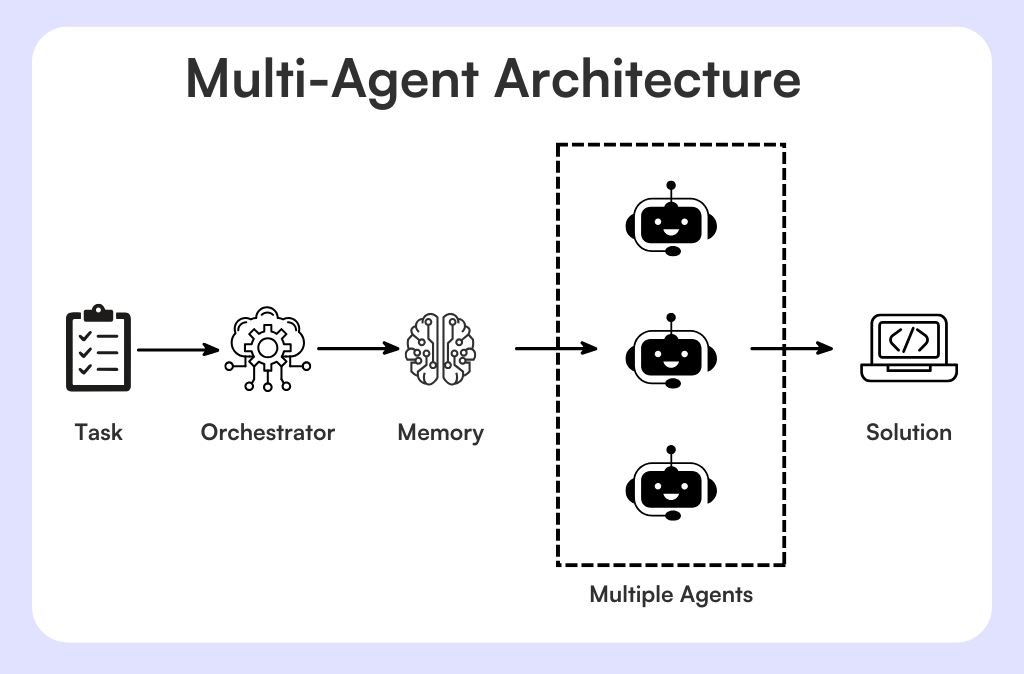
- Hybrid — an orchestrator assigns tasks to specialized agents while each one handles its own execution
Research from 2025 found that hybrid models combining reinforcement learning with LLM reasoning consistently outperform either approach alone on dynamic, multi-step tasks.
How agents decide also varies. Some follow hand-engineered rules. Others learn behavior through multi-agent reinforcement learning, adapting over time based on feedback from the environment.
In LLM-based systems, agents typically coordinate through natural language, with an orchestrator routing tasks and collecting outputs. Traditional systems use direct message passing or shared memory, sometimes called a blackboard, where agents read and write to a common workspace.
One of the more genuinely interesting areas of current research is emergent communication, where agents develop their own efficient coordination protocols through training rather than being given a fixed format. It remains an open problem and an active area heading into 2026.
Core Components of Multi-Agent Systems
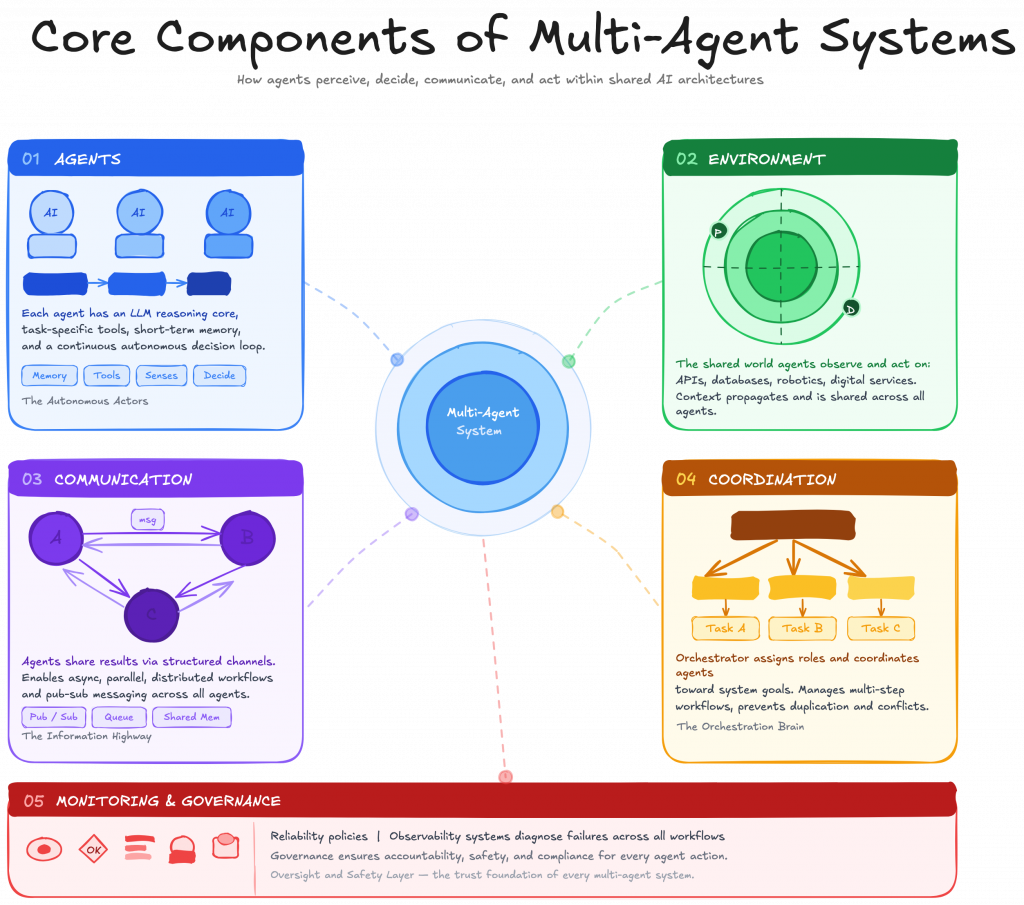
Multi-agent systems are built from interacting components that allow agents to perceive information, make decisions, communicate, and act within a shared system. These components define how agents collaborate and operate in real world AI architectures.
1. Agents
At the center of every MAS are the agents themselves. A multi-agent system is defined as multiple autonomous agents interacting within a shared environment, a foundational definition described in the Wikipedia overview of multi-agent systems.
In modern AI architectures, an agent usually contains a reasoning engine, often powered by an LLM, along with task specific tools, communication interfaces to interact with other agents, and short term working memory that stores the current task context.
2. Environment
The environment is the shared space where agents observe system state, perform actions, and update the world around them as tasks progress. It represents the external context in which agents operate.
Depending on the system, this environment may be a physical world such as robotics or autonomous systems, or a digital infrastructure made up of APIs, databases, and external services that agents interact with during execution.
3. Communication Layer
For agents to collaborate effectively, they must exchange information through structured communication channels. This layer defines how messages are passed between agents, how shared information is stored, and how agents interpret updates from others.
Typical implementations rely on message passing systems or shared data spaces that allow agents to publish results, retrieve updates, and maintain coordination across distributed tasks.
4. Coordination and Orchestration
Coordination defines how multiple agents align their actions to achieve system level goals. In complex MAS architectures, orchestration logic manages task assignment, defines specialized agent roles, and ensures that agents interact through structured protocols.
These orchestration mechanisms are highlighted as core architectural elements in research on orchestrated agent systems, such as the arXiv paper on multi-agent orchestration frameworks.
5. Monitoring and Governance
Production multi-agent systems require monitoring and governance mechanisms to maintain reliability and transparency. Observability systems trace agent decisions, execution paths, and inter-agent communication so teams can diagnose failures and improve system behavior.
For example, Anthropic describes how tracing and system level observability are used to analyze agent workflows in their engineering write-up on a multi-agent research system. Governance practices such as event logging, audits, privacy constraints, and least privilege policies further help ensure accountability across complex agent systems.
Architectures of Modern Systems
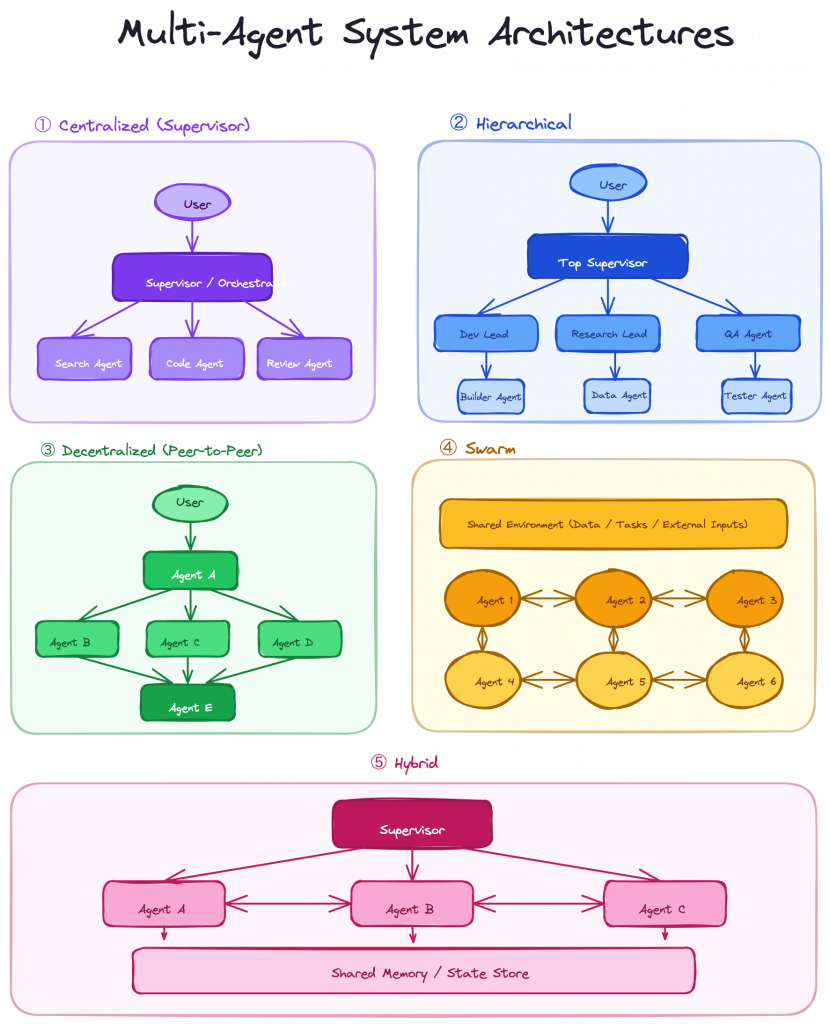
Multi-agent systems can be organized using different architectural structures depending on how control, coordination, and communication are distributed among agents. The architecture determines how agents share information, coordinate decisions, and collaborate toward system level goals. MAS research commonly distinguishes architectures based on whether control is centralized, distributed, hierarchical, or emergent. A formal overview of these structural approaches appears in research on multi-agent coordination and control systems such as this MAS architecture study.
Below are the major architectures used in real-world multi-agent systems.
1. Centralized Architecture
In a centralized architecture, a single orchestrator agent coordinates the entire system. This agent receives the original task, decomposes it into subtasks, assigns those tasks to specialized worker agents, collects the outputs, and synthesizes the final result.
Because the orchestrator has visibility into the full workflow, it can manage dependencies between tasks, resolve conflicts between agents, and enforce consistent reasoning steps. This makes centralized systems easier to debug and control compared to fully distributed systems.
However, this design introduces a potential performance bottleneck. All decisions flow through the orchestrator, which increases token usage and latency for large systems. If the supervisor fails, the entire workflow may halt unless redundancy or fallback mechanisms are implemented.
Centralized architectures are common in production LLM systems and appear in many frameworks where reliability and traceability are important.
2. Hierarchical Architecture
Hierarchical architectures extend centralized coordination by organizing agents into multiple layers of responsibility. A top-level supervisor manages high-level goals, while mid-level agents coordinate groups of worker agents responsible for specific subtasks.
This structure resembles an organizational hierarchy. The top layer focuses on strategic planning, intermediate agents handle coordination within teams, and worker agents execute concrete tasks.
Hierarchical designs reduce the coordination burden on a single controller because decision-making is distributed across layers. They also allow systems to scale to complex, multi-stage workflows where tasks must be broken down progressively.
Such architectures are particularly useful for long-horizon tasks like software development pipelines, research workflows, or large automation systems.
3. Decentralized (Peer-to-Peer) Architecture
In decentralized architectures, no permanent central controller exists. Agents communicate directly with one another and coordinate their actions through messaging, negotiation, shared context, or collaborative reasoning.
Each agent may have specialized capabilities, but all agents operate as peers. Coordination emerges through interaction rather than top-down control. Agents may debate solutions, vote on decisions, or dynamically delegate tasks to each other.
This architecture provides strong resilience and flexibility. Because there is no single controlling node, the system can continue operating even if individual agents fail.
The downside is that coordination becomes harder to manage. Without a central orchestrator, systems may experience conflicting decisions, communication loops, or difficulty reaching consensus.
Decentralized architectures are often used in collaborative reasoning setups, agent debates, and simulation environments where multiple agents explore different perspectives.
4. Swarm Architecture (Agent Swarms)
Swarm architectures are inspired by swarm intelligence, where many simple agents interact locally and collectively produce complex global behavior. In these systems, agents usually do not coordinate through direct messaging. Instead, they interact indirectly through a shared environment such as memory, traces, or a blackboard.
This indirect coordination mechanism is called stigmergy, where agents influence each other by modifying the environment rather than communicating explicitly. For example, in an 🐜 ant colony, each ant simply follows pheromone trails, but together they automatically discover the shortest path to food, showing how simple agents can produce intelligent collective behavior.
Because agents follow simple rules and rely on local information, swarm systems can scale to very large numbers of agents. They are also highly resilient since the system does not depend on any individual component.
However, swarm behavior can be difficult to predict or debug because global outcomes emerge from many local interactions rather than from explicit planning.
In modern LLM systems, swarm architectures are often used for tasks like parallel exploration, large-scale research, or idea generation.
5. Hybrid Architectures
Hybrid architectures combine elements from multiple architectural patterns to balance coordination, flexibility, and scalability.
For example, a system might use a hierarchical planning structure where a top-level orchestrator defines goals, while lower-level agents collaborate using decentralized communication protocols. In other cases, distributed agents may operate independently but periodically report results to a central aggregator.
Hybrid architectures are extremely common in modern AI systems because purely centralized or purely decentralized designs rarely satisfy all system requirements. By combining multiple architectural patterns, hybrid systems can achieve both global coordination and local autonomy.
Many contemporary LLM-based multi-agent frameworks follow this model, using centralized orchestration for task planning while allowing agents to communicate and collaborate directly during execution.
Use Cases of Multi-Agent Systems
Multi-agent systems are most valuable when a problem requires multiple specialized components working together. Instead of forcing one system to handle everything, MAS divide responsibilities across agents that collaborate, run tasks in parallel, and coordinate decisions.
Below are some of the most practical and widely used applications of multi-agent systems.
1. AI Research and Knowledge Work
Research workflows often involve several steps such as searching for sources, analyzing documents, verifying information, and synthesizing insights. A single model trying to perform all of these steps usually becomes inefficient or unreliable.
Multi-agent systems address this by assigning each stage of the workflow to a specialized agent.
A typical research pipeline might include:
- a search agent that gathers relevant documents
- an analysis agent that extracts insights
- a fact-checking agent that validates claims
- a writer agent that compiles the final report
This mirrors how human research teams operate and allows systems to process large volumes of information more effectively.
2. Automated Software Development
Multi-agent architectures are increasingly used to automate parts of the software development lifecycle.
Instead of one AI attempting to design, write, test, and review code, different agents handle different responsibilities.
A common setup includes:
- a planning agent that breaks down product requirements
- a coding agent that implements functionality
- a testing agent that generates and runs tests
- a review agent that evaluates code quality
By distributing tasks across agents, development workflows can iterate faster while maintaining higher reliability.
3. Robotics and Autonomous Systems
Multi-agent systems are widely used in robotics where multiple autonomous machines must cooperate to complete tasks.
Examples include:
- warehouse robots coordinating package movement
- fleets of drones performing search and rescue missions
- autonomous vehicles sharing traffic data
Each robot operates as an independent agent that senses its environment and communicates with others to coordinate behavior. This distributed structure makes robotic systems scalable and resilient.
4. Financial Markets and Trading
Financial markets naturally resemble multi-agent systems because they involve many independent participants interacting simultaneously.
In these systems, agents may represent:
- traders with different strategies
- institutional investors
- market makers
By simulating these interactions, MAS can model market dynamics, test trading strategies, and analyze risk across complex financial environments.
5. Supply Chain and Logistics Optimization
Supply chains involve multiple independent entities such as suppliers, manufacturers, warehouses, and transportation networks. Multi-agent systems allow each of these components to act as a decision-making agent while coordinating with the rest of the system.
Applications include:
- inventory management
- delivery route optimization
- demand forecasting
- warehouse coordination
This distributed decision-making model helps supply chains adapt to disruptions and changing demand conditions.
AI systems are becoming more advanced, and multi-agent architectures are gaining importance as a way to build solutions that can handle complex, collaborative, and large-scale tasks.
Advantages of Multi-Agent Systems
Multi-agent systems offer structural advantages that make them well suited for complex, dynamic environments:
- Scalability: Work distributes across multiple agents instead of relying on a single monolithic system. New agents can be added to handle higher load or expanded scope.
- Modularity: Each agent operates as a self-contained unit. Teams can upgrade, replace, or retrain one agent without redesigning the entire system.
- Robustness: Failure of a single agent does not collapse the whole system. Other agents can continue operating or compensate.
- Specialization: Agents can focus on narrow tasks where they perform best, improving efficiency and accuracy.
- Real-time Parallelism: Multiple agents act simultaneously, which increases throughput and reduces response time.
Despite these strengths, multi-agent systems also introduce meaningful challenges.
Challenges of Multi-Agent Systems
While multi-agent systems offer scalability and specialization, they also introduce new engineering challenges. Once multiple autonomous agents begin interacting, the difficulty shifts from solving the task itself to managing coordination, communication, and system stability. Without careful design, agent systems can become difficult to control, expensive to operate, or unpredictable in behavior.
Some of the most common challenges include:
- Coordination Complexity: Determining which agent should perform which task and managing dependencies between agents becomes difficult as the number of agents increases.
- Communication Overhead: Agents must exchange messages or shared state to coordinate their actions. As the number of agents increases, communication volume can grow rapidly, introducing latency, increasing compute cost, and reducing overall system efficiency.
- Non-Stationary System Dynamics: Because agents continuously adapt to each other’s behavior, the environment keeps changing, making system optimization and stable coordination harder.
- Emergent Behavior: Interactions between autonomous agents can produce unintended global outcomes such as feedback loops, conflicting actions, or suboptimal solutions.
- Debugging and Observability: Failures often emerge from chains of interactions across multiple agents, making it difficult to trace which agent decision caused the problem.
- Resource and Cost Management: Large multi-agent workflows may require many agent calls and model invocations, increasing compute usage, latency, and operational cost.
- Security and Trust: Agents depend on outputs from other agents, and incorrect or malicious results from one agent can propagate through the system and affect downstream decisions.
- Governance and Control: Ensuring agents follow policies, respect constraints, and remain aligned with system objectives becomes harder as autonomy and system scale increase.
Where Multi-Agent AI Is Actually Heading
- Multi-agent models become native architectures — Frontier models increasingly run multiple internal reasoning agents that explore different hypotheses and converge on a final answer, as early systems like Grok’s multi-agent mode demonstrate.
- Reasoning becomes parallel rather than sequential — Instead of one reasoning path, future systems run multiple reasoning branches across agents and combine the most consistent outcome.
- Verification agents become mandatory for reliability — Autonomous systems rely on critic agents that challenge reasoning and catch errors before outputs are returned or actions are executed.
- Governance frameworks regulate autonomous agents — Agent systems will operate under strict policy layers that define boundaries for actions, ensuring agents stay aligned with system goals and operational constraints.
- Cost and latency decrease through specialization — Multi-agent systems route tasks to smaller specialized agents instead of always invoking the largest model.
Conclusion
Multi-agent systems are becoming important because they address structural limitations of single-agent systems. They provide structure by distributing responsibilities such as planning, specialization, parallel execution, and verification across coordinated agents working toward a shared outcome.
That makes multi-agent design especially relevant for production use cases. In real environments, the challenge is rarely just generating an answer. It is managing complexity, handling dependencies, catching mistakes, and keeping the system useful when conditions change. Multi-agent systems are valuable because they can distribute these responsibilities instead of forcing them through a single point of reasoning.
Still, more agents do not automatically create a better system. The benefit comes from good architecture. Clear roles, controlled communication, review layers, and strong observability are what make collaboration useful rather than chaotic. In practice, the success of a multi-agent system depends as much on orchestration and governance as it does on the intelligence of the individual agents.
That is why multi-agent systems matter. They represent a shift from thinking about AI as a single interface to thinking about it as a coordinated system of roles, decisions, and controls. As organizations push AI into more serious workflows, that shift will become less optional and more foundational.
What comes next is simple: one agent will not be enough for more complex work. Different agents will handle different parts. The challenge is making that setup actually useful, not just more complicated.
Our team wrote this article in collaboration with Pratik. We ensured the blog meets our publishing standards by handling the editing, technical groundedness, and final quality checks.

Related posts